Mission Briefing
The USS Farragut (NCC-1647) is unexpectedly attacked by a mysterious, ancient scavenger vessel known through legends as 'The Destroyer of Worlds' or 'Astrovore'. This formidable ship quickly disables and captures the USS Enterprise (NCC-1701), leaving its command crew stranded and vulnerable. Lieutenant-Commander James T. Kirk, who was visiting the Farragut, is thrust into temporary command, tasked with leading a desperate mission to rescue the Enterprise and its crew. He must contend with the scavenger ship's bafflingly advanced defenses and its unknown intentions, which appear to involve dismantling the captured starship for resources. The central conflict revolves around understanding and overcoming this powerful, enigmatic adversary to save the flagship before it's too late, all while grappling with the immense pressure of commanding a starship in a dire, unprecedented situation against an enemy whose true nature remains shrouded in mystery.
LCARS Tactical Mission Registry: A detailed reconstruction of chronological events and narrative progression compiled from historical logs and mission briefs.
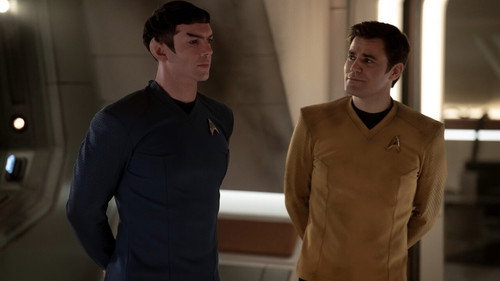
The episode opens with Lieutenant-Commander James T. Kirk being thrust into an unexpected command role aboard the USS Farragut (NCC-1647) after a formidable scavenger vessel, ominously dubbed 'The Destroyer of Worlds' or 'Astrovore', launches a devastating attack. This ancient, mysterious ship, known through various legends across different cultures like the Klingon 'Chach-Ka' or 'The Annihilator', successfully captures the USS Enterprise (NCC-1701), leaving its crew, including Captain Christopher Pike and Commander Una Chin-Riley, in peril. Kirk, with a contingent of Enterprise officers including Spock, Christine Chapel, Montgomery Scott, and Nyota Uhura, who were visiting the Farragut, must now devise a strategy to rescue the flagship and its crew from the clutches of this unknown, highly advanced adversary. The scavenger ship's technology proves baffling, with suits that absorb phaser fire and a method of attack involving iron particles that act like bullets, primitive yet effective. La'An Noonien-Singh and Captain Pike, discussing the threat, acknowledge the scavengers' monstrous reputation, even among species like the Gorn, highlighting the extreme danger they pose, prompting a Red alert across the USS Farragut (NCC-1647).
As the Starfleet officers on the USS Farragut (NCC-1647) analyze the situation, they learn more about the scavenger ship's capabilities and the legends surrounding it. Pelia, the Lanthanite Chief Engineer, provides a unique perspective, often interjecting with humorous or anachronistic references, such as comparing an old communicator to a 'personal massager' or referencing her past as a 'roadie for the Dead'. The crew, including Erica Ortegas and Dr. Joseph M'Benga, works tirelessly to understand the enemy's defenses. Captain Pike, at one point, experiences a perplexing moment when the scavenger ship's weapon fails to kill him, suggesting an unexpected nuance to their behavior. The primary objective becomes clear: penetrate the scavenger's formidable defenses and prevent them from dismantling the USS Enterprise (NCC-1701) for resources, a fate implied by their 'Astrovore' moniker. The USS Farragut (NCC-1647) becomes the staging ground for a desperate rescue mission, with Kirk, despite his initial discomfort with the 'Captain' title while Captain V'Rel is alive, leading the charge.
A critical breakthrough occurs when Spock and Kirk make a shocking discovery: the life signs aboard the scavenger ship are all Human. This revelation fundamentally shifts their understanding of the adversary. Nyota Uhura, delving into historical databases, uncovers the tragic origin of 'The Destroyer of Worlds'. In the mid-21st century, before First contact with the Vulcans and the widespread adoption of Warp drive, a group of scientists, despairing over Earth's environmental crisis following the Third World War, constructed a vessel. This ship, later identified as the XCV-100, was intended to carry humanity to other worlds, a desperate attempt to preserve the flame of life. The United Earth Space Probe Agency was involved in its launch. This mission, involving 7,000 souls, including the crew and their families, vanished without a trace, becoming a forgotten tragedy. Pelia, having lived through that era, recalls the launch and the optimism surrounding it, contrasting sharply with the monstrous reality they now face.
The scavenger ship, the XCV-100, is revealed to be the descendants of that original, optimistic crew, who, over centuries, transformed into resource-consuming entities. The continuity section further elaborates on the ship's original markings, including a fifty-starred American flag and the United Earth Space Probe Agency logo, linking it to the historical 'Friendship 1' probe and the 'ring-ship' USS Enterprise (XCV 330). The crew of the USS Farragut (NCC-1647) realizes they are not fighting aliens, but a lost branch of humanity. Pike and La'An Noonien-Singh employ a tactic involving Baryon particles to 'sour the milk' of the scavenger ship, a technique previously used in Starfleet history. The episode culminates in a confrontation where the true nature of the scavengers is understood, forcing Starfleet to grapple with the ethical implications of their actions against what are essentially long-lost humans. The resolution involves a complex maneuver to disable the XCV-100 and rescue the USS Enterprise (NCC-1701) crew, while also addressing the fate of the scavenger ship's inhabitants, who are now seen not as monsters, but as victims of a desperate, failed mission.
LCARS Tactical Mission Log: Chronological action logs detailing exactly what each character did during the events of this mission, linked directly to personnel dossiers.


Subspace Visual Feed
Sensors & Diagnostic Metrics
Visual Sensor Logs


Synaptic Lore Link Contexts
Pelia, the Lanthanite Chief Engineer, provides a unique perspective, often interjecting with humorous or anachronistic references, such as comparing an old communicator to a 'personal massager' or referencing her past as a 'roadie for the Dead'.
In the mid-21st century, before First contact with the Vulcans and the widespread adoption of Warp drive, a group of scientists, despairing over Earth's environmental crisis following the Third World War, constructed a vessel.
The continuity section further elaborates on the ship's original markings, including a fifty-starred American flag and the United Earth Space Probe Agency logo, linking it to the historical 'Friendship 1' probe and the 'ring-ship' USS Enterprise (XCV 330).
The scavenger ship's technology proves baffling, with suits that absorb phaser fire and a method of attack involving iron particles that act like bullets, primitive yet effective.
La'An Noonien-Singh and Captain Pike, discussing the threat, acknowledge the scavengers' monstrous reputation, even among species like the Gorn, highlighting the extreme danger they pose, prompting a Red alert across the USS Farragut (NCC-1647).
The scavenger ship's technology proves baffling, with suits that absorb phaser fire and a method of attack involving iron particles that act like bullets, primitive yet effective.
The United Earth Space Probe Agency was involved in its launch.
This ancient, mysterious ship, known through various legends across different cultures like the Klingon 'Chach-Ka' or 'The Annihilator', successfully captures the USS Enterprise (NCC-1701), leaving its crew, including Captain Christopher Pike and Commander Una Chin-Riley, in peril.
Kirk being thrust into an unexpected command role aboard the USS Farragut (NCC-1647) after a formidable scavenger vessel, ominously dubbed 'The Destroyer of Worlds' or 'Astrovore', launches a devastating attack.
In the mid-21st century, before First contact with the Vulcans and the widespread adoption of Warp drive, a group of scientists, despairing over Earth's environmental crisis following the Third World War, constructed a vessel.
Mission Registries & Linkages
Subspace Playlists
This registry lists all curated subspace playlists and chronological collections containing this mission.
[ NO ASSOCIATED PLAYLISTS RECORDED ]
Technology
This registry contains all specialized technologies deployed, analyzed, or referenced during this mission.
Location
This registry displays all celestial bodies, planets, starbases, or coordinates charted or visited during this mission.
Starship
This registry lists all vessels encountered, scanned, or active during this mission.
Species & Factions
This registry documents all species, civilizations, and organizational factions contacted or active in this sector during the mission.
[ NO SPECIES/FACTIONS REGISTERED ]
Culture & Lore
This registry outlines historical events, cultural traditions, organizations, and database lore referenced during this mission.
Production & Archival Linkages
This registry documents behind-the-scenes production references, draft concepts, star charts, or archival cataloging links officially connected to this mission.
"The scavenger ship's original mission launched before the invention of Warp drive, highlighting the technological limitations of Earth's mid-21st century space exploration efforts."
"The XCV-100's original markings, including the United Earth Space Probe Agency logo, are compared to those of the 'Friendship 1' probe, establishing a continuity link to early Earth space exploration."
"The episode reveals the scavenger ship launched in the mid-21st century, before humanity's First contact with the Vulcans, highlighting a pivotal moment in Earth's history."
"A Red alert is initiated on the USS Farragut (NCC-1647) following the attack by the scavenger ship, signifying a state of maximum readiness and danger."
"As the Scavengers' ship is breaking up to reveal its original core components, a fifty-starred American flag is shown, along with a registry number of XCV-100 and the combined Earth-Starfleet delta symbol of the United Earth Space Probe Agency. These can be compared to the fifty-two stars on the American flag seen on the wreckage of the Charybdis in , the "ring-ship" (XCV-330) first seen as a painting in , and the Friendship 1 probe in , respectively."
Continuity & Trivia
-
The episode title, 'The Sehlat Who Ate Its Tail,' directly references the sehlat, a predatory, bear-like creature native to Vulcan, often appearing in Vulcan fables. This likely signals a narrative that reflects the cyclical or self-defeating nature implied by the title, potentially rooted in Vulcan philosophy or a metaphor for the episode's central conflict.
-
This episode marks a significant, albeit potentially temporary, moment in James T. Kirk's pre-TOS career, depicting an early command opportunity or test before his historic tenure on the USS Enterprise. It offers a rare glimpse into the formative experiences that forged the legendary captain, showcasing his raw leadership under extreme duress.
-
The concept of a 'Scavenger Ship' seizing the Enterprise presents a unique threat dynamic, shifting from conventional ship-to-ship combat to an internal struggle for control. This type of boarding action or technological takeover often allows for intense character-driven tension and strategic challenges for the crew beyond mere shield and weapon management.
-
The Scavenger ship's true origin is revealed to be Earth-based, marked by a fifty-starred American flag, the United Earth Space Probe Agency logo, and the registry number XCV-100, which connects to early Starfleet designs like the USS Enterprise (XCV-330).Sources: Memory Alpha
-
This episode depicts Spock, Chapel, Scott, and Uhura – all future members of Kirk's USS Enterprise crew – serving under his temporary command on the USS Farragut, with Spock effectively acting as his first officer.Sources: Memory Alpha
-
A replica of the TARDIS, the iconic police box from "Doctor Who," can be spotted snagged on the tentacles holding the Enterprise at approximately the 11:30 mark of the episode.Sources: Memory Alpha
-
Pike and La'An's use of Baryon particles to disable technology echoes techniques seen in "TNG: Galaxy's Child" and "TNG: Starship Mine," further establishing their hazardous nature as warp engine waste.Sources: Memory Alpha
-
The episode's title, "The Sehlat Who Ate Its Tail," was officially announced via press release on June 5, 2025, ahead of the episode's release.Sources: Memory Alpha