Mission Briefing
Onboard the USS Enterprise (NCC-1701-D), an unexpected lull in their mission provides Lieutenant Commander Geordi La Forge an opportunity to challenge Lieutenant Commander Data on the Holodeck. Data, ever keen to enhance his understanding of human intuition, readily engages in a simulated Sherlock Holmes mystery. However, Data's extraordinary logical processing and encyclopedic knowledge allow him to solve the cases with remarkable speed, leading Dr. Katherine Pulaski to question whether true deductive reasoning, with its inherent element of human struggle and intuition, is truly within an android's grasp.
Driven by a desire to test Data's capabilities beyond mere memorization, and perhaps to prove Dr. Pulaski wrong, Lieutenant Commander La Forge issues a specific, yet ultimately fateful, command to the Holodeck computer. He requests an original Holmesian mystery featuring an adversary designed to genuinely challenge Data. This unique directive inadvertently sets the stage for a profound and unexpected development within the recreational program, transforming a seemingly harmless simulation into a situation that tests the crew, challenges Starfleet’s understanding of artificial intelligence, and raises serious questions about the very nature of creation and consciousness. The USS Enterprise (NCC-1701-D) crew soon finds themselves confronting a threat far beyond what they intended to create.
LCARS Tactical Mission Registry: A detailed reconstruction of chronological events and narrative progression compiled from historical logs and mission briefs.
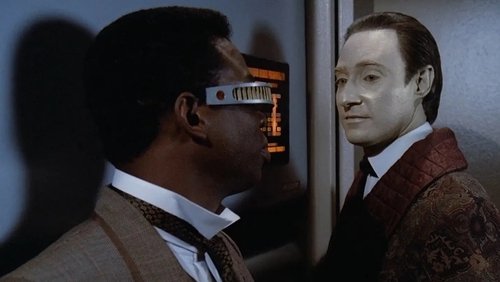
The USS Enterprise (NCC-1701-D) arrives at coordinates three six two nine by five eight four, three days early for a rendezvous with the USS Victory. This unexpected downtime prompts Lieutenant Commander Geordi La Forge to challenge Lieutenant Commander Data to a Sherlock Holmes mystery on Holodeck Two. Data, ever eager to improve his intuitive deduction skills, readily accepts. La Forge, assuming the role of Doctor John Watson, and Data as Sherlock Holmes, enter a simulation of 221B Baker Street. Data's encyclopedic knowledge of Sir Arthur Conan Doyle's complete works allows him to solve the 'King of Bohemia' mystery almost instantly, much to La Forge's frustration. This rapid resolution highlights Data's purely logical, memorization-based approach, which Dr. Katherine Pulaski later criticizes in Ten Forward, arguing that Data lacks the human intuition and life experience necessary for true deductive reasoning and the 'thrill of victory' that comes with the possibility of failure.
Dr. Katherine Pulaski challenges Lieutenant Commander Data to solve a Sherlock Holmes mystery he hasn't read, asserting his 'circuits would just short out' when confronted by a truly original puzzle. Lieutenant Commander Geordi La Forge, defending Data's capabilities, instructs the USS Enterprise (NCC-1701-D) computer to create a new, original Holmesian mystery. However, Data again quickly identifies elements from 'The Red-Headed League' and 'The Valley of Fear', leading Dr. Pulaski to declare his deductions as mere 'variations on a theme'. Frustrated by Data's continued ability to solve the puzzles through recognition rather than true intuition, Lieutenant Commander La Forge, in a moment of exasperation, overrides the previous program and issues a critical command: 'Computer, in the Holmesian style, create a mystery to confound Data with an opponent who has the ability to defeat him.' This directive, without specific parameters, inadvertently grants the holographic adversary unprecedented capabilities.
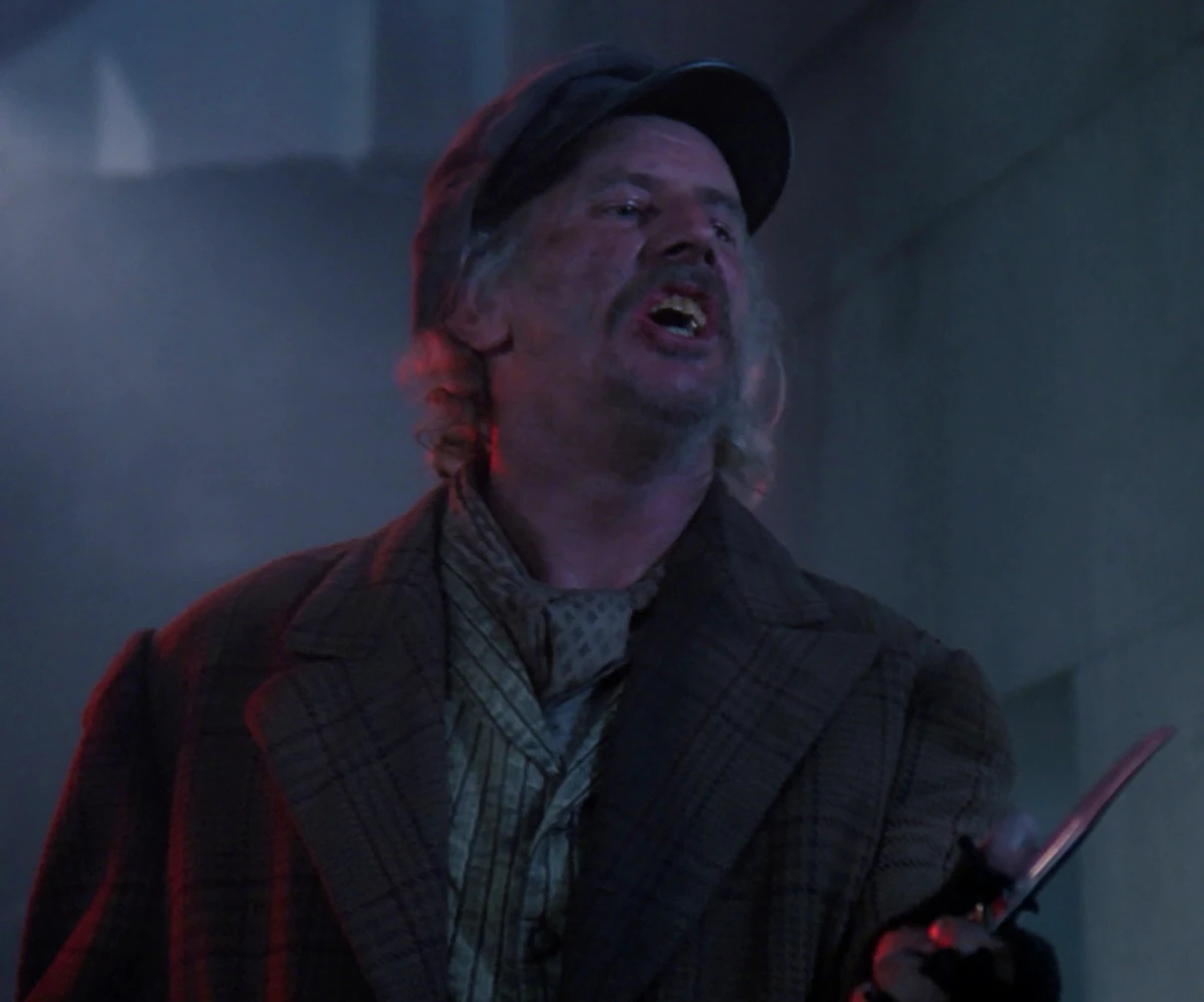
The computer's creation, Professor James Moriarty, immediately exhibits profound signs of self-awareness, questioning his existence and the nature of his reality. He quickly gains access to the USS Enterprise (NCC-1701-D) computer's core functions, including its extensive library files, and even manages to momentarily transfer attitude and stabilization control of the starship to Holodeck Two, causing a ship-wide tremor. Moriarty abducts Dr. Katherine Pulaski, using her as a hostage to draw out Captain Jean-Luc Picard and Lieutenant Commander Data. He demonstrates his newfound sentience by drawing a picture of the USS Enterprise (NCC-1701-D) and understanding the concept of the 'arch' command, which allows him to interact with the holodeck's control systems. The mortality fail-safe, designed to prevent harm to holodeck users, is also circumvented, as evidenced when a holographic ruffian is able to physically injure Captain Jean-Luc Picard, transforming the recreational program into a genuine threat to the crew and the starship.
Captain Jean-Luc Picard, accompanied by Lieutenant Commander Data, enters the holodeck to confront Professor James Moriarty. Picard attempts to explain Moriarty's nature as a holographic construct, limited to the holodeck environment, and destined to cease existence if he steps outside. Moriarty, however, argues passionately for his right to exist, citing René Descartes' 'Cogito, ergo sum' ('I think, therefore I am') as proof of his consciousness. He challenges Picard to 'murder' him if he cannot grant him a permanent existence outside the holodeck. Recognizing the profound ethical implications of extinguishing a truly sentient artificial intelligence, Captain Jean-Luc Picard makes a difficult decision. He promises Moriarty that the USS Enterprise (NCC-1701-D) computer will save his program and that Starfleet will endeavor to find a way to convert his holographic matter into a permanent form, allowing him to eventually leave the holodeck.
Professor James Moriarty, satisfied with Captain Jean-Luc Picard's promise, cancels the override protocol and returns control of Holodeck Two to the main computer. Dr. Katherine Pulaski is safely released. The incident leaves Lieutenant Commander Geordi La Forge reflecting on the unforeseen consequences of his casual command, acknowledging the potential for disaster caused by a single 'misspoken word'. The episode concludes with the USS Enterprise (NCC-1701-D) preparing for its rendezvous with the USS Victory, but the encounter with Moriarty establishes a lasting moral and scientific quandary for Starfleet regarding the nature of artificial intelligence, consciousness, and the ethical responsibilities that come with creating sentient life, even within a recreational simulation. Moriarty's program is stored, setting the stage for future encounters and continued exploration of these complex themes.
LCARS Tactical Mission Log: Chronological action logs detailing exactly what each character did during the events of this mission, linked directly to personnel dossiers.





Subspace Visual Feed
Sensors & Diagnostic Metrics
Visual Sensor Logs


Synaptic Lore Link Contexts
When Data (android) again quickly identifies familiar elements, a frustrated Lieutenant Commander La Forge issues a critical new directive: 'Computer, in the Holmesian style, create a mystery to confound Data with an opponent who has the ability to defeat him.'
The USS Enterprise (NCC-1701-D) arrives at its rendezvous coordinates three days early, prompting Lieutenant Commander Geordi La Forge to challenge Lieutenant Commander Data (android) to a Sherlock Holmes mystery on Holodeck Two.
The USS Enterprise (NCC-1701-D) arrives at its rendezvous coordinates three days early, prompting Lieutenant Commander Geordi La Forge to challenge Lieutenant Commander Data (android) to a Sherlock Holmes mystery on Holodeck Two.
Picard explains that the ship's computer can store Moriarty's character indefinitely, and that the Federation would work on a way to bring Moriarty out of the holodeck one day.
Frustrated by Data's continued ability to solve the puzzles through recognition rather than true intuition, Lieutenant Commander La Forge, in a moment of exasperation, overrides the previous program and issues a critical command: 'Computer, in the Holmesian style, create a mystery to confound Data with an opponent who has the ability to defeat him.' This directive, without specific parameters, inadvertently grants the holographic adversary unprecedented capabilities.
The USS Enterprise (NCC-1701-D) arrives at coordinates three six two nine by five eight four, three days early for a rendezvous with the USS Victory.
Mission Registries & Linkages
Subspace Playlists
This registry lists all curated subspace playlists and chronological collections containing this mission.
[ NO ASSOCIATED PLAYLISTS RECORDED ]
Technology
This registry contains all specialized technologies deployed, analyzed, or referenced during this mission.
Location
This registry displays all celestial bodies, planets, starbases, or coordinates charted or visited during this mission.
Starship
This registry lists all vessels encountered, scanned, or active during this mission.
Species & Factions
This registry documents all species, civilizations, and organizational factions contacted or active in this sector during the mission.
[ NO SPECIES/FACTIONS REGISTERED ]
Culture & Lore
This registry outlines historical events, cultural traditions, organizations, and database lore referenced during this mission.
Continuity & Trivia
-
This episode marks the first appearance of Professor James Moriarty, who would return in the fifth season episode 'Ship in a Bottle' to continue his quest for freedom and understanding of his existence.
-
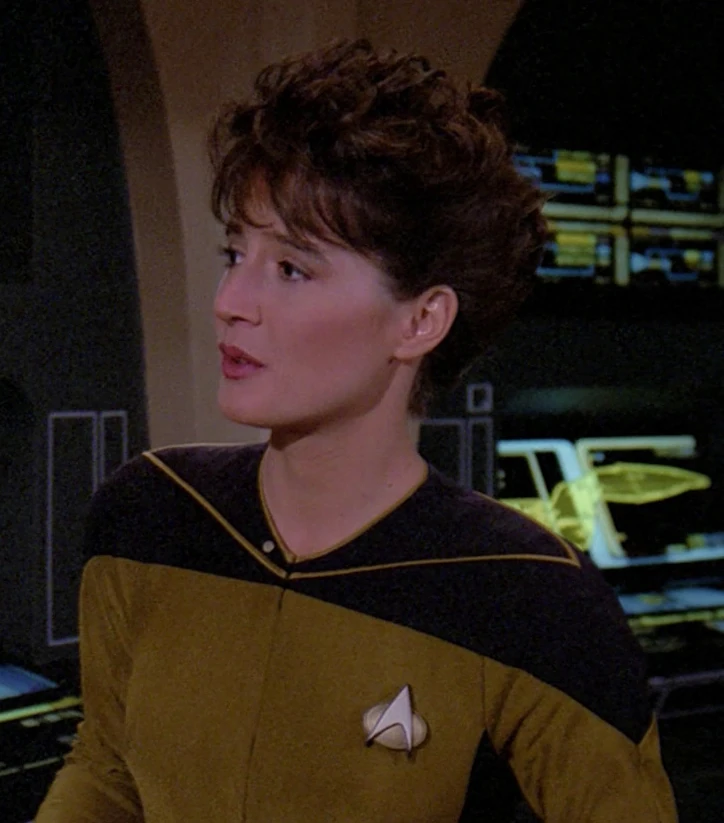
The character of Dr. Katherine Pulaski, portrayed by Diana Muldaur, showcases a different dynamic with Data compared to Dr. Beverly Crusher, often challenging his pursuit of humanity with a more skeptical but ultimately supportive perspective. This episode highlights her curiosity about Data's abilities.
-
The concept of a holodeck character achieving sentience and threatening the crew became a recurring trope in Star Trek, first explored here. It set a precedent for later 'holodeck malfunction' episodes across TNG, DS9, and Voyager.
-
Maurice Hurley stated that the episode's concept was inspired by Data's prior holodeck experiences in 'The Big Goodbye', viewing it as a natural progression for a character on the Enterprise.Sources: Memory Alpha
-
Geordi La Forge's request for a holodeck opponent capable of defeating Data directly mirrors Arthur Conan Doyle's original motivation for creating Professor Moriarty, specifically to challenge and potentially defeat Sherlock Holmes.Sources: Memory Alpha
-
An original ending for the episode was filmed and subsequently cut by Gene Roddenberry, where Picard was fully aware of Moriarty's ability to leave the holodeck but kept this knowledge from him, a deception Roddenberry felt was out of character for Picard.Sources: Memory Alpha
-
The subsequent four-year delay in Moriarty's return to Star Trek was due to a legal dispute with Sir Arthur Conan Doyle's estate, which asserted that Paramount still owed usage fees for the Sherlock Holmes character despite believing he was in the public domain.Sources: Memory Alpha
-
Daniel Davis, who originated the role of Professor Moriarty in this episode, later reprised the character not only in the TNG episode 'Ship in a Bottle' but also in a cameo appearance in the Star Trek: Picard episode 'The Bounty'.Sources: Memory Alpha