Mission Briefing
The USS Enterprise (NCC-1701-D) arrives at Tanuga IV to observe the development of Krieger Wave technology, a potential new power source being pioneered by Doctor Nel Apgar. Commander William Riker and Lieutenant Commander Geordi La Forge lead the initial away team, with Commander Riker later remaining on the research station for a private discussion. However, as Commander Riker prepares to beam back to the USS Enterprise (NCC-1701-D), the station unexpectedly explodes, killing Doctor Apgar. Chief Investigator Krag of the Tanugan security force swiftly beams aboard the USS Enterprise (NCC-1701-D) and accuses Commander Riker of murder, demanding his immediate extradition. Captain Jean-Luc Picard staunchly refuses to surrender his First Officer without a thorough investigation, citing the regulations of the United Federation of Planets. He proposes a novel solution: utilizing the Holodeck to recreate the events leading up to the explosion based on depositions from all witnesses. This innovative approach promises a complex inquiry into conflicting perspectives, as Captain Picard strives to uncover the truth amidst a web of accusations, all while the USS Enterprise (NCC-1701-D) begins to experience unexplained radiation bursts.
LCARS Tactical Mission Registry: A detailed reconstruction of chronological events and narrative progression compiled from historical logs and mission briefs.
The USS Enterprise (NCC-1701-D) arrives at Tanuga Four to assess Doctor Nel Apgar's progress on Krieger Wave technology, a potential new power source. Commander William Riker and Lieutenant Commander Geordi La Forge lead the away team. Following their mission, Commander William Riker remains on the Tanuga Four research station for a private conversation with Doctor Nel Apgar. As Commander William Riker beams back to the USS Enterprise (NCC-1701-D), the research station explodes, killing Doctor Nel Apgar. Chief Investigator Krag of the Tanugan security force immediately beams aboard the USS Enterprise (NCC-1701-D) and accuses Commander William Riker of murder, demanding his extradition. Captain Jean-Luc Picard, citing Federation regulations, refuses to surrender his First Officer without a thorough investigation, proposing a unique solution: using the USS Enterprise (NCC-1701-D)'s holodeck to reconstruct the events leading to the explosion based on witness depositions. This 'Rashomon'-style approach sets the stage for a complex inquiry into truth and perception.
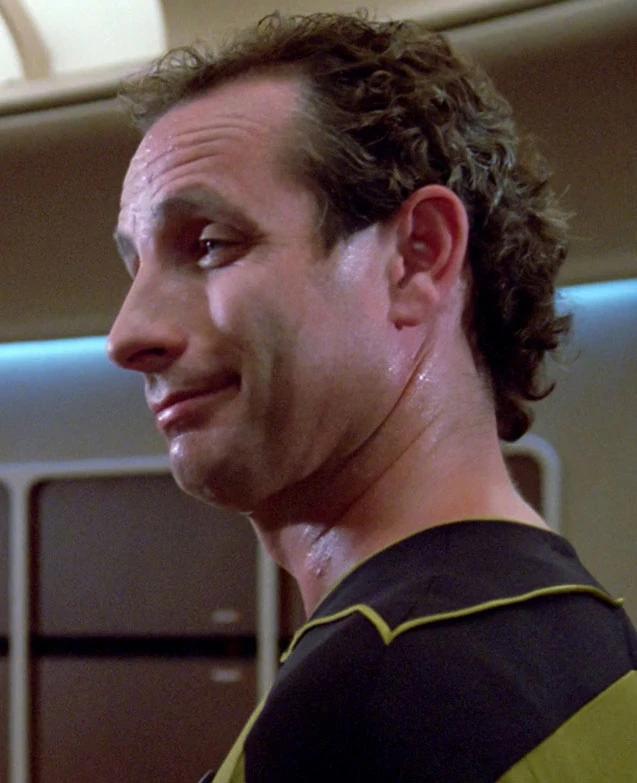
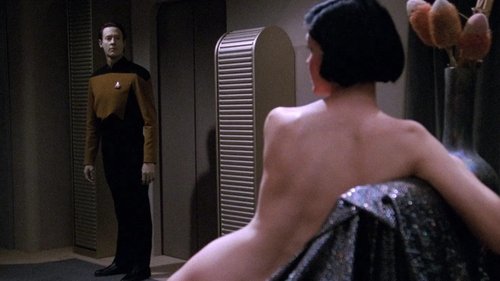
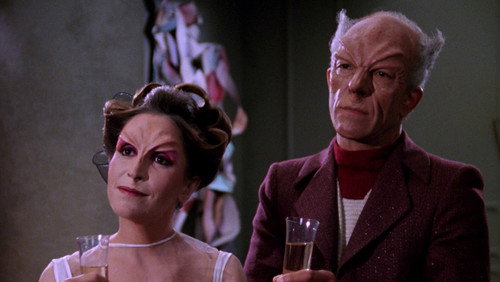
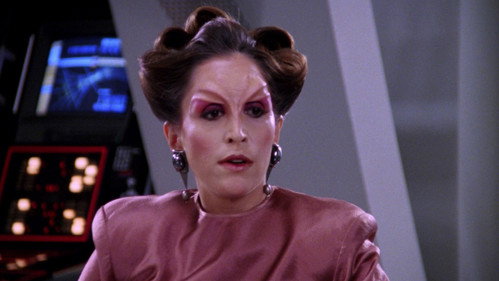
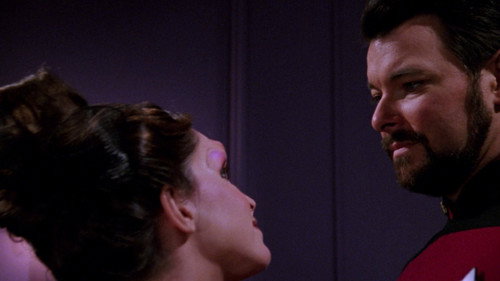
Commander William Riker's holodeck simulation is the first to be presented. It depicts his professional interactions with Doctor Nel Apgar, his wife Manua Apgar, and assistant Tayna. Manua Apgar is shown to be flirtatious, insisting Commander William Riker and Lieutenant Commander Geordi La Forge stay on the station. Later, Manua Apgar enters Commander William Riker's guest quarters, making advances which Commander William Riker rebuffs. Doctor Nel Apgar then discovers them, misinterpreting the situation and angrily accusing Commander William Riker of an affair, threatening to ruin his Starfleet career. The next morning, Doctor Nel Apgar confronts Commander William Riker about his report, fearing Starfleet's suspicion regarding his requests for extra dicosilium. Commander William Riker then beams out, and the station explodes. Chief Investigator Krag, however, presents Tanugan sensor data indicating an energy pulse from Commander William Riker's exact position just before transport, suggesting he fired a phaser. Simultaneously, the USS Enterprise (NCC-1701-D) begins experiencing mysterious, recurring radiation bursts, which Data, Lieutenant Commander Geordi La Forge, and Wesley Crusher begin to investigate.
Manua Apgar's holodeck simulation offers a starkly different account. In her version, Commander William Riker is the aggressor, making unwanted advances and attempting to assault her in her guest quarters. Doctor Nel Apgar discovers the struggle and intervenes, threatening Commander William Riker's career. Commander William Riker, in this version, responds with a veiled threat, stating that reporting the incident would be a 'terrible mistake.' Commander William Riker vehemently denies Manua Apgar's depiction, but Counselor Deanna Troi, using her empathic abilities, cannot detect any deception from Manua Apgar, highlighting the subjective nature of memory and perception. Following this, Tayna's deposition is presented, where Doctor Nel Apgar, distraught, instructs Tayna and Manua Apgar to beam down to Tanuga Four, expressing fear of Commander William Riker and a determination to protect his work. Tayna's testimony concludes with her conviction that Commander William Riker murdered Doctor Nel Apgar. With these conflicting accounts, Chief Investigator Krag asserts that he has established motive, method, and opportunity, demanding Commander William Riker's extradition, leaving Captain Jean-Luc Picard in a difficult position.
As Captain Jean-Luc Picard grapples with the decision to extradite Commander William Riker, the USS Enterprise (NCC-1701-D) crew makes a critical breakthrough. Data, Lieutenant Commander Geordi La Forge, and Wesley Crusher discover that the mysterious radiation bursts plaguing the ship are, in fact, Krieger Waves, originating from Doctor Nel Apgar's lambda field generator on Tanuga Four. Crucially, they realize that the holodeck's recreation of Doctor Nel Apgar's lab, including the Krieger Wave converter, is also generating these waves. This proves that Doctor Nel Apgar had successfully developed the converter, despite his claims of 'setbacks' and needing 'more time.' Captain Jean-Luc Picard deduces that Doctor Nel Apgar was lying about his progress, motivated by Manua Apgar's desire for 'rewards' beyond what Starfleet offered. Doctor Nel Apgar's true ambition was to weaponize Krieger Waves for immense profit, selling them to factions like the Romulans or Ferengi, evidenced by his requests for excessive dicosilium to build larger reflective coils. His fear of Starfleet discovering his illicit intentions, compounded by the perceived affair with Manua Apgar, provided a powerful motive for murder.
Captain Jean-Luc Picard unveils his theory: Doctor Nel Apgar, fearing exposure and the loss of his lucrative weapon project, decided to murder Commander William Riker. He planned to activate the Krieger Wave converter at the precise moment Commander William Riker was beaming out, intending to make his death appear as a transporter accident. However, something went awry. Lieutenant Commander Geordi La Forge explains that the energy pulse, instead of destroying Commander William Riker, reflected off the transporter beam and bounced back to the station's reactor core, causing the explosion that killed Doctor Nel Apgar himself. The crucial piece of evidence is the 'point zero zero one four second variance' in the timing of the energy pulse, which perfectly accounts for the time it would take for the pulse to reflect from the transporter beam back to the reactor. A final holodeck demonstration, synchronized with the next energy discharge from the planet's field generator, visually confirms this hypothesis. Faced with irrefutable evidence, Chief Investigator Krag withdraws his extradition request and apologizes to Commander William Riker, who is fully exonerated. The USS Enterprise (NCC-1701-D) then departs Tanuga Four, leaving the tragic 'matter of perspective' behind.
LCARS Tactical Mission Log: Chronological action logs detailing exactly what each character did during the events of this mission, linked directly to personnel dossiers.




Subspace Visual Feed
Sensors & Diagnostic Metrics
Visual Sensor Logs


Synaptic Lore Link Contexts
To uncover the truth behind the conflicting accounts, Captain Jean-Luc Picard proposes a unique solution: utilizing the USS Enterprise (NCC-1701-D)'s holodeck to meticulously reconstruct the events based on witness depositions, setting the stage for a complex inquiry into truth and perception.
The USS Enterprise (NCC-1701-D) arrives at Tanuga Four to evaluate Doctor Nel Apgar's advancements in Krieger Wave technology, a promising new power source.
The USS Enterprise (NCC-1701-D) arrives at Tanuga Four to evaluate Doctor Nel Apgar's advancements in Krieger Wave technology, a promising new power source.
He says that Riker will be given the opportunity to prove his innocence – in the Tanugan jurisprudence, the accused is "guilty until proven innocent," while the Federation's own works on the opposite basis.
Krag asks if Riker has anything to add, such as firing a phaser.Chief Investigator Krag, however, presents Tanugan sensor data indicating an energy pulse from Commander William Riker's exact position just before transport, suggesting he fired a phaser.
Troi explains that Apgar would not have made substantial profits from selling a new power source to Starfleet, but he could have made a much greater profit by turning it into a new weapon and selling it to the Romulans, the Ferengi, and other adversarial species.Doctor Nel Apgar's true ambition was to weaponize Krieger Waves for immense profit, selling them to factions like the Romulans or Ferengi, evidenced by his requests for excessive dicosilium to build larger reflective coils.
Troi explains that Apgar would not have made substantial profits from selling a new power source to Starfleet, but he could have made a much greater profit by turning it into a new weapon and selling it to the Romulans, the Ferengi, and other adversarial species.Doctor Nel Apgar's true ambition was to weaponize Krieger Waves for immense profit, selling them to factions like the Romulans or Ferengi, evidenced by his requests for excessive dicosilium to build larger reflective coils.
He planned to activate the Krieger Wave converter at the precise moment Commander William Riker was beaming out, intending to make his death appear as a transporter accident.
Mission Registries & Linkages
Subspace Playlists
This registry lists all curated subspace playlists and chronological collections containing this mission.
Technology
This registry contains all specialized technologies deployed, analyzed, or referenced during this mission.
Location
This registry displays all celestial bodies, planets, starbases, or coordinates charted or visited during this mission.
Starship
This registry lists all vessels encountered, scanned, or active during this mission.
Species & Factions
This registry documents all species, civilizations, and organizational factions contacted or active in this sector during the mission.
Culture & Lore
This registry outlines historical events, cultural traditions, organizations, and database lore referenced during this mission.
Continuity & Trivia
-
Guest star Mark Margolis, who portrays the deceased Dr. Nel Apgar, later gained widespread recognition for his iconic role as the cartel enforcer Hector Salamanca in the critically acclaimed series *Breaking Bad* and its prequel, *Better Call Saul*.
-
The script for "A Matter of Perspective" underwent an uncredited "gang-bang" rewrite by the entire writing staff, which was Ronald D. Moore's first assignment after joining the team.Sources: Memory Alpha
-
Scientific consultant David Krieger provided the ingenious solution for the episode's central mystery, suggesting the holodeck construct merely reflect an external radiation source, an idea that led to the naming of the "Krieger waves" after him.Sources: Memory Alpha
-
Director Cliff Bole described "A Matter of Perspective" as "one of the toughest shows I've ever shot" due to the immense challenge of maintaining continuity while filming scenes from three different perspectives.Sources: Memory Alpha
-
Executive Producer Michael Piller considered the episode's intricate script "the best murder mystery" he had ever developed, even likening it to *The Big Sleep* in space, despite his disappointment with the final on-screen execution.Sources: Memory Alpha
-
Captain Picard is never again depicted painting after this episode, with a deleted scene revealing he threw red paint at his canvas following Data's critical assessment of his artwork.Sources: Memory Alpha