Mission Briefing
The USS Enterprise-D crew awakens after an unexpected encounter with a wormhole, only to find themselves grappling with a series of perplexing discrepancies. While Lieutenant Commander Data insists they were unconscious for mere seconds, Dr. Beverly Crusher's botanical experiments and other subtle clues suggest a much longer period has passed. As Captain Jean-Luc Picard and his command staff investigate, Data's uncharacteristic evasiveness and seemingly fabricated data raise serious concerns about his integrity and what truly transpired during the missing time. The crew must unravel this growing mystery, which threatens to undermine their trust in one of their most reliable officers.
LCARS Tactical Mission Registry: A detailed reconstruction of chronological events and narrative progression compiled from historical logs and mission briefs.
The USS Enterprise-D, having completed an early mission at Harrakis V, grants its crew personal time. Captain Jean-Luc Picard introduces Guinan to his Dixon Hill holodeck program, set in 1940s San Francisco. Their role-playing is interrupted when Lieutenant Commander Data reports the discovery of a T-Tauri type star with an M-class planet near the Ngame Nebula. As the USS Enterprise-D approaches, a small, unstable wormhole appears, flinging the vessel 0.54 parsecs away and rendering the entire crew unconscious, except for Data, whose positronic system is immune. Upon awakening, Data informs Jean-Luc Picard that only thirty seconds have passed, and the USS Enterprise-D proceeds on its original course.
However, inconsistencies quickly emerge. Dr. Beverly Crusher discovers that her Diomedian scarlet moss, part of an incubation experiment, has shown a full day's growth, not thirty seconds. Simultaneously, a probe launched to the mysterious M-class planet reports a hydrogen-helium composition, contradicting earlier readings. Data attempts to explain these discrepancies with an obscure 22nd century physicist's theory, Pell Underhill, but Geordi La Forge and Dr. Beverly Crusher remain unconvinced. Jean-Luc Picard, initially dismissing these as 'minor mysteries' and setting a course for Evadne IV, soon authorizes investigations into the ship's chronometer and transporter traces, suspecting Data's unusual behavior.
The investigations reveal compelling evidence of a missing day. Ensign Locklin's cellular electrolyte concentration shows a significant deviation, confirming Dr. Beverly Crusher's suspicions. Geordi La Forge discovers the ship's chronometer was tampered with, and a new security program inserted, a task only he or Data could perform. Further, Dr. Beverly Crusher finds that Lieutenant Worf's wrist was broken and expertly repaired, implying the crew was conscious for at least part of the 'missing' day. Data's continued evasiveness, even when confronted with the threat of a court-martial, deepens Jean-Luc Picard's suspicions. A second probe to the T-Tauri system confirms the planet is indeed M-class, proving Data fabricated the first probe's data. The mystery intensifies when Counselor Deanna Troi experiences a terrifying hallucination, seeing a stranger in her own reflection, prompting Jean-Luc Picard to order the USS Enterprise-D back to the T-Tauri system.
Upon returning to the T-Tauri system, an energy pulse passes through the shields, and Counselor Deanna Troi becomes possessed by an alien entity, declaring 'the plan has failed.' Data, in a desperate attempt to salvage the situation, pleads for more time. When pressed by Jean-Luc Picard on the bridge, Data finally reveals that Jean-Luc Picard himself ordered him to lie. The possessed Deanna Troi then explains the truth: the M-class planet is the homeworld of the Paxans, a violently xenophobic and highly advanced race who terraformed their planet to conceal it. The 'wormhole' is an energy field designed to render intruders unconscious in biochemical stasis and transport their ship away. Data's immunity to the stasis foiled their initial plan, leading to Jean-Luc Picard's original decision to erase the crew's short-term memories and Data's knowledge to protect the Paxans' privacy.
The Paxan representative, still possessing Deanna Troi, warns that the first attempt to 'undo' the contact failed because too many 'clues' were left behind, piquing human curiosity. To prevent the destruction of the USS Enterprise-D, Jean-Luc Picard successfully negotiates for a second chance. The crew meticulously works to reconfigure the computer and records, eliminating all evidence of the encounter, including the Diomedian scarlet moss, Worf's wrist injury, and the chronometer tampering. Data is once again instructed to retain knowledge of the Paxans but conceal it from everyone, including Jean-Luc Picard. The crew is put back into stasis, their memories erased, and upon revival, the events unfold as if for the first time, with Data recommending a probe and Jean-Luc Picard dispatching a hazard advisory to Starfleet before the USS Enterprise-D departs for Evadne IV.
LCARS Tactical Mission Log: Chronological action logs detailing exactly what each character did during the events of this mission, linked directly to personnel dossiers.


Subspace Visual Feed
Sensors & Diagnostic Metrics
Visual Sensor Logs

Synaptic Lore Link Contexts
The USS Enterprise-D concluded its mission ahead of schedule at Harrakis V, enabling Captain Jean-Luc Picard to allocate additional personal time to the crew before the episode's primary narrative begins.The USS Enterprise-D, having completed an early mission at Harrakis V, grants its crew personal time.
Captain Jean-Luc Picard utilizes Holodeck number 4 to share his Dixon Hill program with Guinan, an activity that is cut short by Lieutenant Commander Data's detection of the T-Tauri system.Captain Jean-Luc Picard introduces Guinan to his Dixon Hill holodeck program, set in 1940s San Francisco.
While traversing the Ngame Nebula, the USS Enterprise-D's Lieutenant Commander Data identifies a T-Tauri type star and an M-class planet, which precipitates the first encounter with what is perceived as a 'wormhole'.Their role-playing is interrupted when Lieutenant Commander Data reports the discovery of a T-Tauri type star with an M-class planet near the Ngame Nebula.
Evadne IV serves as both the USS Enterprise-D's initial target following a wormhole event and its ultimate destination after a subsequent memory alteration, marking a return to its primary mission objectives.Jean-Luc Picard, initially dismissing these as 'minor mysteries' and setting a course for Evadne IV, soon authorizes investigations into the ship's chronometer and transporter traces, suspecting Data's unusual behavior.
Geordi La Forge states that the USS Enterprise-D's impulse engine systems show no damage after the ship's sudden passage through a wormhole, confirming its readiness for operation.
Dr. Beverly Crusher's Diomedian scarlet moss experiment, kept within incubators, exhibits a full day's growth, which serves as a key indicator that more time has elapsed than initially noted by Lieutenant Commander Data.
Geordi La Forge verifies that the USS Enterprise-D's warp drive systems remain fully operational following an unforeseen transit through a wormhole, allowing for continued interstellar journeys.
Lieutenant Commander Data employs geophysical information from Tethys III to configure the initial probe, causing the M-class planet to register as a hydrogen-helium world and thereby obscuring its true nature from the crew.
Worf confirms that the photon torpedoes on the USS Enterprise-D are armed as the vessel re-enters the T-Tauri system, anticipating a possible engagement with an enigmatic energy field.
The M-class planet within the T-Tauri system is identified as the Paxan homeworld, a world that the xenophobic Paxans modified through terraforming to hide their presence from any unwelcome visitors.
Jean-Luc Picard, initially dismissing these as 'minor mysteries' and setting a course for Evadne IV, soon authorizes investigations into the ship's chronometer and transporter traces, suspecting Data's unusual behavior.
Mission Registries & Linkages
Subspace Playlists
This registry lists all curated subspace playlists and chronological collections containing this mission.

Technology
This registry contains all specialized technologies deployed, analyzed, or referenced during this mission.
Location
This registry displays all celestial bodies, planets, starbases, or coordinates charted or visited during this mission.
Starship
This registry lists all vessels encountered, scanned, or active during this mission.
[ NO STARSHIPS REGISTERED ]
Species & Factions
This registry documents all species, civilizations, and organizational factions contacted or active in this sector during the mission.
[ NO SPECIES/FACTIONS REGISTERED ]
Culture & Lore
This registry outlines historical events, cultural traditions, organizations, and database lore referenced during this mission.
[ NO CULTURE/LORE RECORDED ]
Production & Archival Linkages
This registry documents behind-the-scenes production references, draft concepts, star charts, or archival cataloging links officially connected to this mission.
"In their first encounter, the Paxans' energy field functions as a tractor beam, effectively immobilizing the USS Enterprise-D and preventing it from engaging warp speed within their star system."
Continuity & Trivia
-
This episode marks the first time Brent Spiner (Data) publicly sang on Star Trek, performing 'Pop Goes The Weasel' for Spot.
-
The initial concept for 'Clues' involved the Enterprise finding itself on a planet where Data was revered as a god, a story idea that was later recycled and developed into the TNG episode 'Thine Own Self'.
-
The Paxans, the energy beings responsible for the deception, were conceived as a way to create an antagonist capable of subtly manipulating the Enterprise crew without directly confronting them, playing on the theme of hidden truths.
-
Executive Producer Michael Piller was so impressed with Joe Menosky's rewrite of the 'Clues' script that he offered Menosky a staff writing position on Star Trek: The Next Generation.Sources: Memory Alpha
-
The 'Red Dwarf Programme Guide' noted an 'uncanny' resemblance between the story of 'Clues' and the earlier Red Dwarf episode 'Thanks for the Memory'.Sources: Memory Alpha
-
Director Les Landau employed longer and more fluid camera takes to visually differentiate flashback sequences from scenes set in the present.Sources: Memory Alpha
-
'Clues' is considered a 'bottle show,' meaning it was largely filmed on existing sets to economize on production costs.Sources: Memory Alpha
-
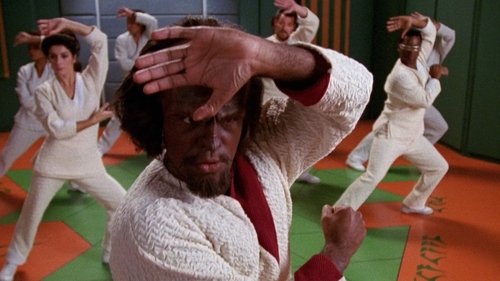
This episode marks the first on-screen appearance of Worf practicing his Klingon martial art, mok'bara.Sources: Memory Alpha