Mission Briefing
The USS Enterprise-D, while charting the Argolis cluster for potential colonization, detects a distress signal emanating from a small moon. An away team investigates and discovers the wreckage of a Borg scout ship with a single, adolescent survivor. Despite initial concerns about the Borg's nature and the potential threat, Doctor Beverly Crusher insists on providing medical aid to the injured drone. Captain Jean-Luc Picard makes the controversial decision to bring the Borg aboard the USS Enterprise-D, securing it in a detention cell.
This unexpected encounter sparks a profound ethical dilemma among the crew. Captain Jean-Luc Picard, still haunted by his own assimilation as Locutus of Borg, initially proposes a drastic plan: to use the survivor as a biological weapon by introducing a destructive invasive program into its neural network, which would then spread throughout the entire Borg Collective. However, as Lieutenant Commander Geordi La Forge works with the Borg, he begins to see it not as a drone, but as an individual, even giving it the name 'Hugh.' This burgeoning individuality challenges the crew's perception of the Borg and forces them to confront the moral implications of their proposed actions.
LCARS Tactical Mission Registry: A detailed reconstruction of chronological events and narrative progression compiled from historical logs and mission briefs.
The USS Enterprise-D, under the command of Captain Jean-Luc Picard, is charting the Argolis cluster for potential colonization when it intercepts a distress signal emanating from a small moon. An away team, led by Commander William T. Riker and accompanied by Doctor Beverly Crusher and Lieutenant Worf, investigates and discovers the wreckage of a small Borg scout ship. To their surprise, they find a single, adolescent Borg survivor, badly injured. Despite Lieutenant Worf's recommendation to kill the Borg and Doctor Beverly Crusher's initial humanitarian plea to stabilize him at the crash site, Captain Jean-Luc Picard orders the Borg beamed aboard the USS Enterprise-D to a secured detention cell. This decision is not without internal conflict, as Counselor Deanna Troi attempts to address Captain Jean-Luc Picard's lingering trauma from his assimilation as Locutus of Borg, a concern he dismisses.
Once the Borg is secured, Captain Jean-Luc Picard, along with Lieutenant Commander Geordi La Forge and Lieutenant Commander Data, devises a plan to use the survivor as a weapon. The strategy involves repairing the Borg's damaged biochips and then introducing an invasive programming sequence—a geometric paradox—into its neural network. This 'virus' would then spread throughout the entire Borg Collective upon the survivor's return, causing a total systems failure and effectively annihilating the Borg. Doctor Beverly Crusher expresses strong ethical objections to this plan, arguing that it constitutes genocide and that the Borg survivor, whom she sees as a patient, is being used as an instrument of destruction. Commander William T. Riker and Lieutenant Worf, however, support the plan, viewing it as a necessary act of war against an implacable enemy that has declared war on the Federation's way of life.
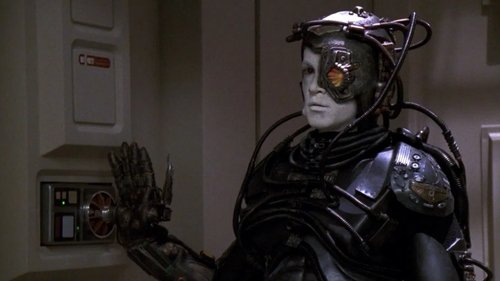
As Lieutenant Commander Geordi La Forge works on the Borg's implants and conducts perceptual tests, he begins to interact with the individual. He gives the Borg a name, 'Hugh,' and starts to perceive him not as a drone, but as a lonely, lost individual. Hugh, in turn, begins to express nascent signs of individuality, referring to himself as 'Hugh' rather than 'we' and forming a bond with Lieutenant Commander Geordi La Forge. Guinan, a survivor of a Borg assimilation herself, initially urges Captain Jean-Luc Picard to proceed with the plan, warning of the Borg's relentless nature. However, after Lieutenant Commander Geordi La Forge encourages her to speak with Hugh, Guinan experiences a profound shift. Hugh's admission of loneliness and his nascent understanding of individuality deeply affect her, leading her to question the morality of the proposed annihilation.
Guinan confronts Captain Jean-Luc Picard, challenging him to speak with Hugh directly before enacting the plan. Reluctantly, Captain Jean-Luc Picard engages Hugh in conversation, initially attempting to reassert his authority as Locutus of Borg. However, Hugh's newfound individuality, his concern for Lieutenant Commander Geordi La Forge's life, and his defiant declaration, 'I will not assist you. No. I am Hugh,' profoundly impact Captain Jean-Luc Picard. This encounter forces Captain Jean-Luc Picard to abandon the genocidal plan, recognizing that using Hugh in such a way would make Starfleet no better than the Borg. The crew then debates alternative solutions, considering erasing Hugh's memory or granting him asylum. Ultimately, Captain Jean-Luc Picard decides to return Hugh to the crash site with his memories intact, hoping that the spark of individuality he has gained will spread through the Borg Collective, potentially altering them from within. Hugh, understanding the danger he poses to the USS Enterprise-D, chooses to return to the Borg, despite his desire to stay with Lieutenant Commander Geordi La Forge. The USS Enterprise-D then hides in the star's chromosphere as a Borg scout ship arrives to retrieve Hugh, leaving the future of the Borg Collective uncertain.
LCARS Tactical Mission Log: Chronological action logs detailing exactly what each character did during the events of this mission, linked directly to personnel dossiers.


Subspace Visual Feed
Sensors & Diagnostic Metrics
Visual Sensor Logs


Synaptic Lore Link Contexts
As Lieutenant Commander Geordi La Forge works on the Borg's implants and conducts perceptual tests, he begins to interact with the individual.
The strategy involves repairing the Borg's damaged biochips and then introducing an invasive programming sequence—a geometric paradox—into its neural network.
Mission Registries & Linkages
Subspace Playlists
This registry lists all curated subspace playlists and chronological collections containing this mission.
[ NO ASSOCIATED PLAYLISTS RECORDED ]
Technology
This registry contains all specialized technologies deployed, analyzed, or referenced during this mission.
Location
This registry displays all celestial bodies, planets, starbases, or coordinates charted or visited during this mission.
Starship
This registry lists all vessels encountered, scanned, or active during this mission.
[ NO STARSHIPS REGISTERED ]
Species & Factions
This registry documents all species, civilizations, and organizational factions contacted or active in this sector during the mission.
[ NO SPECIES/FACTIONS REGISTERED ]
Culture & Lore
This registry outlines historical events, cultural traditions, organizations, and database lore referenced during this mission.
[ NO CULTURE/LORE RECORDED ]
Continuity & Trivia
-
The character of Hugh, portrayed by Jonathan Del Arco, was originally intended to be killed off at the end of the episode. However, the creative team, particularly Executive Producer Rick Berman, was so impressed with the character's development and Del Arco's performance that they decided to keep him alive, leading to his return in subsequent TNG episodes and later in 'Star Trek: Picard.'
-
This episode marks a significant turning point in the Federation's understanding and portrayal of the Borg. Prior to 'I, Borg,' the Collective was presented as an monolithic, utterly alien threat. Hugh's emergence as an individual introduced the concept that drones could be freed or develop independent thought, humanizing the Borg in a way that profoundly influenced future series like 'Voyager.'
-
René Echevarria, the writer of 'I, Borg,' initially pitched a story where the Enterprise would send a Borg drone back to the Collective with a virus. This core idea was retained, but the focus shifted heavily onto the ethical dilemma presented by Hugh's developing individuality, making the 'virus' not technological but philosophical.
-
The title of the episode, 'I, Borg,' is an intentional allusion to Isaac Asimov's book 'I, Robot,' which in turn referenced Robert Graves' 'I, Claudius,' and also forms a pun on the word 'cyborg.'Sources: Memory Alpha
-
Writer René Echevarria was embarrassed to discover that Hugh used the pronoun 'I' earlier than intended in the episode, asking 'Do I have a name?,' but the scene had already been filmed before the error could be corrected.Sources: Memory Alpha
-
Jeri Taylor likened Hugh to the titular character of the film 'Edward Scissorhands,' a characterization that influenced both the casting of Jonathan Del Arco and director Robert Lederman's approach to the role.Sources: Memory Alpha
-
During filming, director Robert Lederman and actor Jonathan Del Arco used a 'Borg meter' to track Hugh's personal evolution, with 'one' representing fully Borg and 'ten' being nearly Human, allowing for precise character development in each scene.Sources: Memory Alpha
-
While many praised the episode, Executive Producer Michael Piller noted that some fans felt 'I, Borg' 'betrayed the vision of the Borg' by humanizing them more than they wished to see.Sources: Memory Alpha