Mission Briefing
The USS Enterprise-D arrives at Tyrus VIIA to assess the Tyran particle fountain, a revolutionary but troubled mining technology. Lieutenant Commander Geordi La Forge is tasked with evaluating the project, led by Doctor Farallon. During a critical power grid malfunction, Doctor Farallon introduces her latest invention: the Exocomps, adaptive tools capable of micro-replication and learning. An Exocomp swiftly resolves the crisis, sparking Lieutenant Commander Data's curiosity about their advanced capabilities.
Data's subsequent observations of an Exocomp's unusual behavior lead him to question its nature, suggesting it may possess self-preservation instincts and, therefore, qualify as a new form of artificial life. This controversial hypothesis ignites a debate among the senior staff and Doctor Farallon regarding the definition of life and the ethical implications of using such entities as mere tools. Captain Jean-Luc Picard authorizes a series of tests to determine the true nature of the Exocomps, setting the stage for a profound philosophical inquiry into artificial intelligence and sentience.
LCARS Tactical Mission Registry: A detailed reconstruction of chronological events and narrative progression compiled from historical logs and mission briefs.
The USS Enterprise-D arrives at Tyrus VIIA to monitor the progress of the Tyran particle fountain, a new mining technology that is significantly behind schedule. Lieutenant Commander Geordi La Forge is assigned to evaluate the project. While on the Tyrus VIIA station, La Forge meets with Doctor Farallon, the project lead. During their discussion, a power grid malfunction threatens the station's core. Doctor Farallon introduces an Exocomp, an adaptive tool she developed, which quickly repairs the malfunction, preventing a four-month shutdown. Lieutenant Commander Data, intrigued by the speed of the repair, begins to investigate the Exocomp's capabilities.
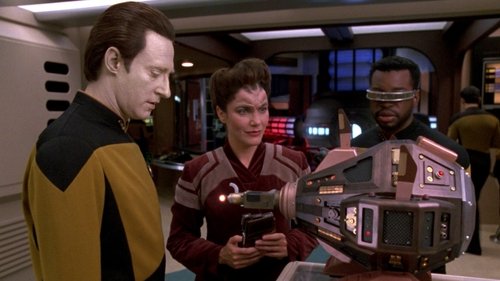
Doctor Farallon beams aboard the USS Enterprise-D with an Exocomp to demonstrate its micro-replication system and learning capacity to Data and La Forge. With their approval, Captain Jean-Luc Picard allows the Exocomps to assist with the particle fountain project. Data works with an Exocomp on the station, completing numerous tasks efficiently. However, when an Exocomp is sent to seal a plasma conduit, it refuses commands, overloads Doctor Farallon's control pad, and returns just before the conduit explodes. Data and La Forge analyze the Exocomp, discovering it deliberately burned out its interface circuitry to avoid destruction, then repaired itself later. This act of self-preservation leads Data to hypothesize that the Exocomps are a new form of life. He discusses the definition of life with Doctor Beverly Crusher, who emphasizes the 'struggle to maintain life' as a key characteristic, reinforcing Data's conviction.
Data confronts Doctor Farallon on the Tyrus VIIA station, asking her to cease using the Exocomps as tools, believing them to be alive. Captain Jean-Luc Picard convenes a senior staff meeting, where Data presents his evidence: the Exocomp's deliberate self-preservation and subsequent self-repair. Doctor Farallon vehemently resists this idea, viewing them solely as tools. To test Data's hypothesis, a simulation is created where an Exocomp must repair a conduit breach while a plasma cascade failure is simulated. The Exocomp initially appears to fail by not evacuating, but Data later discovers it had not only completed the repair but also deactivated the false overload signal, demonstrating advanced intelligence and an understanding of the simulation's artificiality. Doctor Beverly Crusher aptly observes, 'The Exocomp didn't fail the test; it saw right through it.'
Work resumes on the Tyrus VIIA station, but a critical malfunction causes the particle stream to surge, leaking radiation. Doctor Farallon and her staff are beamed to the USS Enterprise-D, but Captain Jean-Luc Picard and Lieutenant Commander Geordi La Forge are trapped on the station after a staff member, Takenta, is killed in an explosion. Radiation levels prevent their transport. Commander William T. Riker considers options, including a shuttlecraft or a Photon torpedo, but time is critical. Doctor Farallon proposes using the Exocomps as explosive devices by reconfiguring their boridium power cells, which would require disconnecting their command pathways, effectively sacrificing them. Data strongly objects, asserting their status as lifeforms.
As the Exocomps are prepared for transport, Data deliberately locks out the transporter controls, defying a direct order from Commander William T. Riker, risking a court martial. Data argues that sacrificing one lifeform for another is unjustifiable and, drawing parallels to his own past, insists the Exocomps have a right to live. He then volunteers to beam over himself, knowing the radiation would destroy his positronic matrix. Riker, inspired by Data's willingness to choose, proposes asking the Exocomps if they are willing to undertake the mission. With their command pathways reconnected, the Exocomps modify Data's instructions, replicating power taps and altering transporter coordinates to inside the station core, revealing their own alternative plan to distort the particle stream. They succeed, allowing Captain Jean-Luc Picard and Lieutenant Commander Geordi La Forge to be beamed back. However, one Exocomp sacrifices itself to maintain the distortion, ensuring the rescue of the other two. Doctor Farallon agrees to study the Exocomps as intelligent beings, and Captain Jean-Luc Picard commends Data, calling his actions 'the most Human decision you've ever made,' acknowledging Data's profound moral stand.
LCARS Tactical Mission Log: Chronological action logs detailing exactly what each character did during the events of this mission, linked directly to personnel dossiers.




Subspace Visual Feed
Sensors & Diagnostic Metrics
Visual Sensor Logs


Synaptic Lore Link Contexts
Doctor Farallon developed the adaptive tools known as Exocomps, which become central to the plot when their self-preservation instincts suggest to Lieutenant Commander Data that they might be a new type of artificial life.In 'The Quality of Life,' Lieutenant Commander Data confronts a profound ethical quandary concerning the Exocomps, self-replicating robotic entities designed for hazardous mining.
As Data observes their emergent, seemingly self-aware behaviors, he argues they are not mere machines but nascent sentient life forms deserving of protection.
Captain Picard asserts that any potential for exocomps to be a lifeform necessitates investigation, aligning with the core mandate of Starfleet and the USS Enterprise to explore new life.This conviction pits him against Dr. Farallon, the Exocomps' creator, and forces Captain Picard to grapple with the nebulous definition of life and Starfleet's moral obligations.
The planet Tyrus VIIA serves as the development site for the Tyran particle fountain mining technology, with the USS Enterprise-D assigned to oversee its advancement and assess its viability.The USS Enterprise-D arrives at Tyrus VIIA to monitor the progress of the Tyran particle fountain, a new mining technology that is significantly behind schedule.
Commander William T. Riker contemplated deploying a Photon torpedo as a final measure to interrupt a particle stream and rescue Captain Jean-Luc Picard and Lieutenant Commander Geordi La Forge, though this option was ultimately dismissed due to time constraints.Riker considers options, including a shuttlecraft or a Photon torpedo, but time is critical.
A Red alert is initiated aboard the USS Enterprise-D after Captain Jean-Luc Picard and Lieutenant Commander Geordi La Forge become stranded on the Tyrus VIIA station following a major particle fountain system failure.
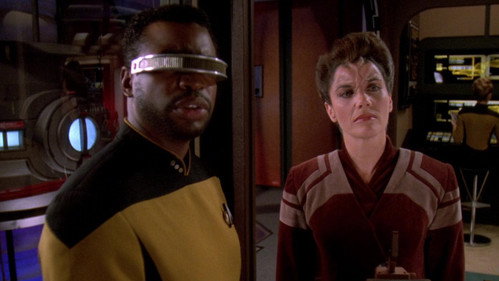
While on the Tyrus VIIA station, La Forge meets with Doctor Farallon, the project lead.
During their discussion, a power grid malfunction threatens the station's core.
Captain Jean-Luc Picard convenes a senior staff meeting, where Data presents his evidence: the Exocomp's deliberate self-preservation and subsequent self-repair.
The USS Enterprise-D arrives at Tyrus VIIA to monitor the progress of the Tyran particle fountain, a new mining technology that is significantly behind schedule.
As the Exocomps are prepared for transport, Data deliberately locks out the transporter controls, defying a direct order from Commander William T.
Mission Registries & Linkages
Subspace Playlists
This registry lists all curated subspace playlists and chronological collections containing this mission.
Technology
This registry contains all specialized technologies deployed, analyzed, or referenced during this mission.
Location
This registry displays all celestial bodies, planets, starbases, or coordinates charted or visited during this mission.
Starship
This registry lists all vessels encountered, scanned, or active during this mission.
[ NO STARSHIPS REGISTERED ]
Species & Factions
This registry documents all species, civilizations, and organizational factions contacted or active in this sector during the mission.
[ NO SPECIES/FACTIONS REGISTERED ]
Culture & Lore
This registry outlines historical events, cultural traditions, organizations, and database lore referenced during this mission.
Production & Archival Linkages
This registry documents behind-the-scenes production references, draft concepts, star charts, or archival cataloging links officially connected to this mission.
"Starfleet is evaluating the particle fountain mining technology for potential deployment on Carema III, highlighting the importance of the Tyrus VIIA project's assessment for future resource acquisition."
"The Tyrus VII system encompasses the stellar area where the planet Tyrus VIIA, home to the particle fountain project, is situated."
Continuity & Trivia
-
This episode marks the first time Brent Spiner (Data) received an 'additional story by' credit for a Star Trek: The Next Generation episode.
-
The distinctive, insect-like design of the Exocomps was influenced by Michael Okuda, who suggested a more organic and unique appearance instead of a simplistic mechanical device.
-
The philosophical debate about the Exocomps' sentience and Starfleet's responsibility towards them directly parallels later discussions in Star Trek canon, such as the legal battles surrounding The Doctor's rights in Star Trek: Voyager.
-
Jonathan Frakes directed this episode, one of eight episodes he helmed in Season 6 and numerous others throughout the series.Sources: Memory Alpha
-
The original concept for the artificial lifeforms was far simpler, imagining them as talking wall terminals and household appliances that possessed "all the charisma of central heating units."Sources: Memory Alpha
-
Writer Naren Shankar established that machine intelligence could be considered 'alive' upon developing a survival instinct and fear of death, which becomes Data's core argument for saving the Exocomps.Sources: Memory Alpha
-
Writer Naren Shankar found it personally challenging to craft Data's arguments for the Exocomps' right to life, as he felt they mirrored anti-abortion movements, a position with which he disagreed.Sources: Memory Alpha
-
Budget limitations meant only two physical Exocomp props were constructed for the episode, with a third digitally inserted in post-production and their movements achieved by a puppeteer whose control rods were later removed.Sources: Memory Alpha
-
Director Jonathan Frakes was disappointed that the episode concluded without a callback to the poker scene's bet, believing it left an entertaining plot thread unresolved for the audience.Sources: Memory Alpha