Mission Briefing
The USS Enterprise, under the command of Captain James T. Kirk, answers a distress call from a seemingly barren planet. A landing party, consisting of Captain James T. Kirk, First Officer Spock, Doctor Leonard McCoy, and Yeoman Thompson, beams down only to be confronted by Rojan and Kelinda, advanced beings known as Kelvans. These extra-galactic visitors from the Andromeda Galaxy quickly assert their formidable power, paralyzing the landing party and seizing control of the USS Enterprise. The Kelvans reveal their desperate plan: their home galaxy faces destruction, necessitating a journey to the Milky Way Galaxy, which they intend to conquer and occupy.
With Starfleet’s flagship commandeered and its crew rendered helpless, Captain James T. Kirk and his officers face an unprecedented threat from an alien species whose technology and ambition vastly outstrip the United Federation of Planets’ defenses. The very fate of the Milky Way Galaxy hangs in the balance as the crew grapples with how to reclaim their ship and protect their home from these powerful, emotionless invaders.
LCARS Tactical Mission Registry: A detailed reconstruction of chronological events and narrative progression compiled from historical logs and mission briefs.
The USS Enterprise, under the command of Captain James T. Kirk, responds to a distress call originating from a seemingly barren planet. A landing party, consisting of Captain James T. Kirk, First Officer Spock, Doctor Leonard McCoy, and Yeoman Thompson, beams down to investigate. They are quickly confronted by two humanoid figures, Rojan and Kelinda, who reveal themselves to be Kelvans, an extra-galactic species from the Andromeda galaxy. Rojan, the Kelvan leader, immediately asserts his authority, paralyzing the landing party with a neural field and declaring his intention to commandeer the USS Enterprise. He explains that their home galaxy is facing imminent destruction due to high radiation levels, necessitating a 300-year journey to the Milky Way galaxy, which they intend to conquer and occupy. The Kelvans demonstrate their advanced capabilities by effortlessly disabling the USS Enterprise's systems and taking control of the starship, with Hanar and Tomar securing key areas like the bridge, engineering, and life support.
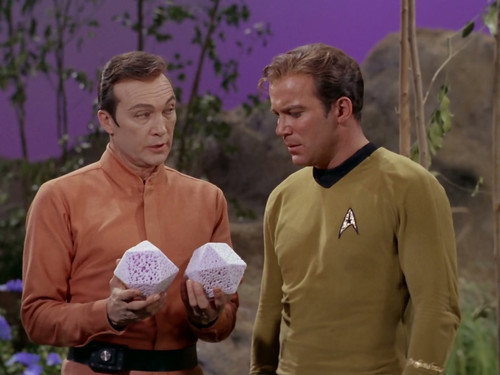
The Kelvans proceed to modify the USS Enterprise's engines, enabling intergalactic travel at speeds far exceeding Federation technology, reducing the journey to Andromeda to a mere three hundred years. During a mind-meld, First Officer Spock discovers the Kelvans' true forms: immense, tentacled beings with superior intellects who have adopted humanoid 'shells' for practicality within the starship. To conserve resources for the long voyage, Rojan initiates a 'neutralizing operation,' transforming non-essential crew members into compact, dehydrated polyhedrons. Captain James T. Kirk is forced to witness the horrifying death of Yeoman Thompson, who is reduced to a handful of dust. Realizing that direct combat is futile against the Kelvans' advanced technology and their impervious paralysis field, Captain James T. Kirk devises a daring, unconventional strategy: to subtly expose the emotionless Kelvans to the full, overwhelming spectrum of human experiences and emotions, hoping to 'humanize' them and divert them from their destructive mission.
The plan begins with a ruse to get First Officer Spock and Doctor Leonard McCoy back to the USS Enterprise. Doctor Leonard McCoy feigns a severe illness for First Officer Spock, who enters a Vulcan trance to appear near death. This deception convinces Hanar to beam them aboard the USS Enterprise for medical attention. Once in sickbay, Doctor Leonard McCoy continues the charade, administering fake medication to First Officer Spock. Meanwhile, First Officer Spock and Chief Engineer Montgomery Scott discover that the Kelvan power source in engineering is protected by an impenetrable material, rendering direct sabotage impossible. As a last resort, Chief Engineer Montgomery Scott and First Officer Spock devise a suicidal plan to detonate the USS Enterprise's matter-anti-matter reactors at the galactic barrier, preventing the Kelvans from leaving the Milky Way galaxy, but Captain James T. Kirk rejects this, holding onto his humanization strategy.
The USS Enterprise successfully breaches the galactic barrier, a feat that previously destroyed the Kelvans' own ship, showcasing the starship's resilience. With the barrier crossed, Rojan proceeds with the neutralization of most of the remaining crew, leaving only Captain James T. Kirk, First Officer Spock, Doctor Leonard McCoy, and Chief Engineer Montgomery Scott as 'essential personnel.' The humanization strategy intensifies. Chief Engineer Montgomery Scott introduces Tomar to Saurian brandy and then Scotch whisky, leading to his rapid intoxication and incapacitation. Doctor Leonard McCoy administers 'high-potency vitamin concentrate' (actually a stimulant) to Hanar, causing him to become increasingly irritable and insubordinate. Captain James T. Kirk engages Kelinda, teaching her about human affection and 'love' through a kiss, which visibly sparks jealousy and anger in Rojan. First Officer Spock subtly manipulates Rojan's burgeoning emotions, pointing out his jealousy and lack of control over Kelinda, further pushing him towards human emotional responses.
The cumulative effect of these human experiences culminates in a dramatic confrontation. Hanar openly defies Rojan on the bridge, while Tomar is rendered helpless by alcohol. Rojan, consumed by jealousy and rage, physically attacks Captain James T. Kirk, a stark departure from his former emotionless Kelvan nature. Captain James T. Kirk seizes this moment to confront Rojan, highlighting his transformation: 'You're reacting with the emotions of a human. You are a human.' He argues that by the time the USS Enterprise reaches Kelva in three centuries, the Kelvans aboard will be so thoroughly humanized that they will be considered aliens and enemies by their own people. First Officer Spock reinforces this, suggesting Rojan has an opportunity to forge his own destiny rather than blindly follow an ancient order. Captain James T. Kirk offers the Kelvans a new path: to find uninhabited planets within the Milky Way galaxy for colonization, extending friendship instead of conquest. Rojan, now fully experiencing and understanding human emotions, accepts this offer. He returns command of the USS Enterprise to Captain James T. Kirk, and the starship turns back towards the Milky Way galaxy, with the Kelvans choosing a new future as friends, embracing their new human forms and the complex emotions that come with them.
LCARS Tactical Mission Log: Chronological action logs detailing exactly what each character did during the events of this mission, linked directly to personnel dossiers.





Subspace Visual Feed
Sensors & Diagnostic Metrics
Visual Sensor Logs



Synaptic Lore Link Contexts
They are swiftly confronted by two humanoid figures, Rojan and Kelinda, who identify themselves as Kelvans, an extra-galactic species from the distant Andromeda galaxy.
They are swiftly confronted by two humanoid figures, Rojan and Kelinda, who identify themselves as Kelvans, an extra-galactic species from the distant Andromeda galaxy.
These descendants could report on the suitability of the Milky Way Galaxy for Kelvan conquest and occupation.He reveals their home galaxy faces destruction, necessitating a 300-year journey to the Milky Way galaxy, which they intend to conquer and occupy.
Rojan, their leader, immediately asserts control, paralyzing the landing party with an unknown neural field and declaring his intention to commandeer the USS Enterprise.
Kirk then says that there's no reason to do all of this by force and he proposes to take the Kelvan problem to the Federation.
Scotty confounds the universal translator and starts pouring something green, mangling its origin (the Ganymede moon of Jupiter).
First Officer Spock reinforces this, suggesting Rojan has an opportunity to forge his own destiny rather than blindly follow an ancient order.
You are a human.' He argues that by the time the USS Enterprise reaches Kelva in three centuries, the Kelvans aboard will be so thoroughly humanized that they will be considered aliens and enemies by their own people.
The Kelvans proceed to modify the USS Enterprise's engines, enabling intergalactic travel at speeds far exceeding Federation technology, reducing the journey to Andromeda to a mere three hundred years.
Mission Registries & Linkages
Subspace Playlists
This registry lists all curated subspace playlists and chronological collections containing this mission.
[ NO ASSOCIATED PLAYLISTS RECORDED ]
Technology
This registry contains all specialized technologies deployed, analyzed, or referenced during this mission.
Location
This registry displays all celestial bodies, planets, starbases, or coordinates charted or visited during this mission.
Starship
This registry lists all vessels encountered, scanned, or active during this mission.
[ NO STARSHIPS REGISTERED ]
Species & Factions
This registry documents all species, civilizations, and organizational factions contacted or active in this sector during the mission.
Culture & Lore
This registry outlines historical events, cultural traditions, organizations, and database lore referenced during this mission.
Production & Archival Linkages
This registry documents behind-the-scenes production references, draft concepts, star charts, or archival cataloging links officially connected to this mission.
"The rotating biobed normally situated in sickbay was removed to allow McCoy and Tomar to roll the gurney carrying Spock to the biofunction monitor."
"Direct references to two previous episodes were made. After Rojan mentions the galactic barrier, Kirk says, "We've been there." () Even Spock repeats his analysis of the barrier word for word: "Density negative. Radiation negative. Energy negative." When the landing party is detained in a cave, Kirk recalls their imprisonment on Eminiar VII and Spock's use of a mind-meld to fool the guards. ()"
"Direct references to two previous episodes were made. After Rojan mentions the galactic barrier, Kirk says, "We've been there." () Even Spock repeats his analysis of the barrier word for word: "Density negative. Radiation negative. Energy negative." When the landing party is detained in a cave, Kirk recalls their imprisonment on Eminiar VII and Spock's use of a mind-meld to fool the guards. ()"
Continuity & Trivia
-
The concept of transforming crew members into compact, dehydrated blocks for storage was inspired by real-world astronaut food and the idea of preserving provisions for long voyages.
-
The distinctive Kelvan probe model, seen at the beginning of the episode, was later reused as the formidable 'Planet Killer' machine in the iconic second season episode, "The Doomsday Machine."
-
To create the unique, alien aesthetic of the Kelvan control room, the Enterprise bridge set was extensively re-dressed, utilizing creative lighting, projections, and set pieces to give it a completely transformed appearance.
-
The episode's title is a direct quotation from William Shakespeare's Romeo and Juliet, Act II, Scene 2, which Captain Kirk even recites to Kelinda.Sources: Memory Alpha
-
The story's core concept originated from Gene Roddenberry's first-ever produced science fiction script, 'The Secret Weapon of 117' (1956), which notably starred Ricardo Montalban as an alien overwhelmed by human sensations.Sources: Memory Alpha
-
Writer Jerome Bixby's initial script was considerably darker, featuring crew executions, Kirk's torture, and a plan for Kelvans to breed human slaves, but these elements were removed after NBC objections and concerns about similarity to 'The Cage'.Sources: Memory Alpha
-
The idea to transform crew members into geometric objects was suggested by Gene Roddenberry while he was playing with a dodecahedron gifted to him by D.C. Fontana, though the prop ultimately used on screen was a cuboctahedron.Sources: Memory Alpha
-
Scotty's quarters, which are only seen in this episode, are notably decorated with various Scottish items, including a red and black tartan kilt, bagpipes, a Scottish targe, and a claymore.Sources: Memory Alpha