Mission Briefing
The USS Voyager becomes unexpectedly trapped in a geosynchronous orbit around a unique planet that rotates at an extraordinary speed. This planet's tachyon core creates a severe space-time differential, causing time to pass hundreds of times faster on its surface than in normal space. As a result, the crew of Voyager observes centuries of the planet's civilization unfold in a matter of hours.
Voyager's presence, appearing as a new 'star' in the sky, inadvertently becomes a catalyst for the planet's rapid technological and cultural development, inspiring everything from religion to science. The crew grapples with the ethical implications of their accidental influence and the Prime Directive, while simultaneously trying to find a way to escape the planet's powerful gravimetric field before their own ship begins to experience the accelerated aging effects.
LCARS Tactical Mission Registry: A detailed reconstruction of chronological events and narrative progression compiled from historical logs and mission briefs.
The USS Voyager, while investigating a planet rotating at an astonishing 58 times per minute, becomes ensnared in a gravimetric gradient, pulling it into a geosynchronous orbit. This unique celestial body possesses a tachyon core, which creates a profound space-time differential: for every second that passes on Voyager, nearly a day elapses on the planet's surface. This phenomenon means that the crew observes centuries of planetary development in mere hours. Voyager's initial arrival coincides with a seismic event, interpreted by the planet's early civilization as the manifestation of a new deity, 'Ground Shaker' or 'Light Bringer', supplanting their traditional god, Tahal. The ship itself appears as a new, bright star in their sky, becoming an object of worship and later, scientific curiosity. Commander Chakotay and Lieutenant B'Elanna Torres are particularly fascinated by the rapid evolution of the civilization, which quickly progresses from a pre-medieval state to an industrial age, building fortified structures to withstand the constant 'ground-shaking' caused by Voyager's presence.
As the centuries pass on the planet, observed by the Voyager crew, the civilization develops advanced astronomical observatories. A scientist on the planet, using a telescope, manages to observe Voyager and attempts to make contact via radio transmissions, sending mathematical sequences and, eventually, a personal message. Seven of Nine detects these transmissions, and Commander Chakotay realizes the need to slow down the accelerated frequency to interpret them. The message reveals the planet's culture and mythology, centered around the 'Sky Ship' and the tremors it causes. Captain Kathryn Janeway convenes a senior staff briefing, where the crew debates the implications of the Prime Directive regarding first contact with this pre-warp society, especially given their inadvertent influence on its development. To gather crucial data without violating the Prime Directive, Captain Janeway dispatches The Doctor on an undercover mission to the planet's surface, leveraging his holomatrix's immunity to the temporal differential.
However, the mission encounters a critical complication when the signal to beam The Doctor back is lost. By the time Lieutenant B'Elanna Torres and Captain Kathryn Janeway successfully re-establish contact and retrieve him, three years have passed on the planet's surface, while only minutes have elapsed on Voyager. The Doctor, overjoyed to be back, recounts his experiences, including living in an apartment, sharing it with a roommate named Mareeza, and witnessing a war between rival states that destroyed his dwelling. He explains that Voyager's presence has been a powerful catalyst for the planet's technological and cultural advancement, inspiring invention, religion, music, art, and even children's toys. He brings back centuries of meteorological and seismic data, which the crew uses to attempt an escape. Their initial attempt to break orbit fails, causing increased seismic activity on the planet and forcing an immediate abort.
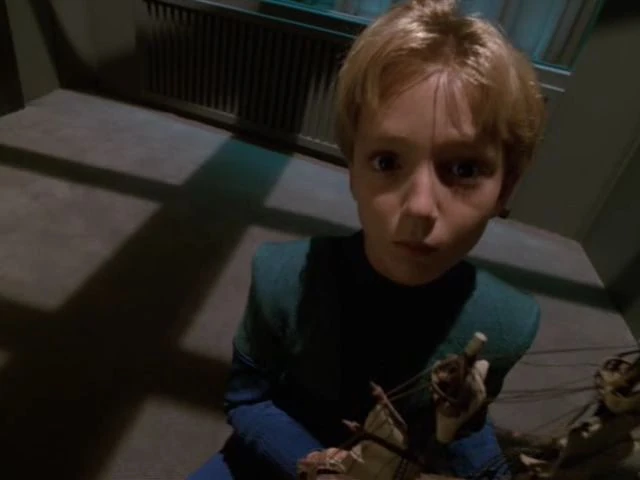
Simultaneously, the planet's space race culminates with a space capsule, 'Orbital 1', reaching Voyager. Its two-person crew, Gotana-Retz and Terrina, board the ship, initially perceiving the Voyager crew as being in stasis due to the extreme time differential. Upon entering Voyager's time-frame, they collapse. In Sickbay, The Doctor manages to save Gotana-Retz, but Terrina tragically succumbs to the transition. Gotana-Retz, grappling with the realization that everyone he knew on his home world is long dead, agrees to help Captain Kathryn Janeway interpret The Doctor's data. He shares his childhood memories of the 'Sky Ship' toy and the prayer associated with it, expressing his wonder at seeing his 'first dream come true'. Despite the personal cost, he commits to assisting Voyager. However, the situation rapidly escalates when Seven of Nine detects warp experimentation and subsequent antimatter torpedo and tricobalt device attacks launched by the now highly advanced Gotana species, causing significant damage to Voyager's shields.
Facing imminent destruction, Captain Kathryn Janeway convinces Gotana-Retz to return to his planet with Voyager's specifications, hoping he can persuade his people to cease hostilities and assist their departure. Before he leaves, The Doctor asks Gotana-Retz to find any descendants of a 'son' he had during his time on the planet, Jason Tabreez, and tell them about him, a poignant moment highlighting The Doctor's evolving humanity. Gotana-Retz returns to his world, now a vastly advanced technological metropolis. After another planetary year, two ships from his species appear, deploying a tractor beam to pull Voyager clear of the gravimetric gradient. Gotana-Retz, now an old man, uses a temporal compensator to return to Voyager one last time to say goodbye. As Voyager finally departs, the 'Sky Ship' winks out of existence for the people of Gotana, leaving Gotana-Retz to gaze wistfully at the sky, a testament to the profound, unintended impact Voyager had on an entire civilization.
LCARS Tactical Mission Log: Chronological action logs detailing exactly what each character did during the events of this mission, linked directly to personnel dossiers.







Subspace Visual Feed
Sensors & Diagnostic Metrics
Visual Sensor Logs


Synaptic Lore Link Contexts
This unprecedented Prime Directive dilemma forces Janeway to grapple with the ethical implications of their accidental influence on an entire world, culminating in a desperate attempt to disengage from the planet's grip while facing the very civilization they inadvertently helped create.
As time passes, the planet's inhabitants quickly change to a pre-medieval level of technology.For Voyager, hours pass, but on the planet below, millennia unfold, giving rise to an entire civilization that perceives the Federation starship as a fixed, celestial body – their 'Sky-Ship.' As the rapidly evolving society progresses from primitive observation to advanced spacefaring technology, they begin to view Voyager not as a star, but as a potential threat or even a god.
However, the situation rapidly escalates when Seven of Nine detects warp experimentation and subsequent antimatter torpedo and tricobalt device attacks launched by the now highly advanced Gotana species, causing significant damage to Voyager's shields.
This unique celestial body possesses a tachyon core, which creates a profound space-time differential: for every second that passes on Voyager, nearly a day elapses on the planet's surface.
A scientist on the planet, using a telescope, manages to observe Voyager and attempts to make contact via radio transmissions, sending mathematical sequences and, eventually, a personal message.
After another planetary year, two ships from his species appear, deploying a tractor beam to pull Voyager clear of the gravimetric gradient.
However, the situation rapidly escalates when Seven of Nine detects warp experimentation and subsequent antimatter torpedo and tricobalt device attacks launched by the now highly advanced Gotana species, causing significant damage to Voyager's shields.
The USS Voyager, while investigating a planet rotating at an astonishing 58 times per minute, becomes ensnared in a gravimetric gradient, pulling it into a geosynchronous orbit.
Mission Registries & Linkages
Subspace Playlists
This registry lists all curated subspace playlists and chronological collections containing this mission.
[ NO ASSOCIATED PLAYLISTS RECORDED ]
Technology
This registry contains all specialized technologies deployed, analyzed, or referenced during this mission.
Location
This registry displays all celestial bodies, planets, starbases, or coordinates charted or visited during this mission.
Starship
This registry lists all vessels encountered, scanned, or active during this mission.
Species & Factions
This registry documents all species, civilizations, and organizational factions contacted or active in this sector during the mission.
Culture & Lore
This registry outlines historical events, cultural traditions, organizations, and database lore referenced during this mission.
Production & Archival Linkages
This registry documents behind-the-scenes production references, draft concepts, star charts, or archival cataloging links officially connected to this mission.
"In the observatory on Gotana, the hole in which the large telescope is encased in is a reuse of the framework of the Cardassian circular airlock hatch from Star Trek: Deep Space Nine. One of the hatches later reappears in , on Penk's starship, and later in the seventh season episode , in the Otrin's species cave settlement."
"In the observatory on Gotana, the hole in which the large telescope is encased in is a reuse of the framework of the Cardassian circular airlock hatch from Star Trek: Deep Space Nine. One of the hatches later reappears in , on Penk's starship, and later in the seventh season episode , in the Otrin's species cave settlement."
Continuity & Trivia
-
The concept of a planet with vastly accelerated time was first explored in the 1957 short story 'The Endochronic Man' by Isaac Asimov, though 'Blink of an Eye' offers a unique Star Trek spin on the premise.
-
Guest star Daniel Dae Kim, famous for his roles in 'Lost' and 'Hawaii Five-O,' appears as the astronaut Gotana-Retz, who eventually makes contact with Voyager.
-
The episode features a shuttlecraft, the 'Cochrane,' being left behind on the accelerated planet for generations. When it is retrieved, it is considered an ancient artifact by the planet's inhabitants, highlighting the extreme temporal differential.
-
Guest star Obi Ndefo had previously appeared in the Star Trek universe as Drex, Martok's son, in the Star Trek: Deep Space Nine season four premiere "The Way of the Warrior".Sources: Memory Alpha
-
The set piece for the large telescope in the planet's observatory was a reuse of a Cardassian circular airlock hatch framework from Star Trek: Deep Space Nine, which also reappeared in other Voyager episodes.Sources: Memory Alpha
-
This episode earned a distinction in the book ''Star Trek 101'', being listed as one of the "Ten Essential Episodes" from ''Star Trek: Voyager''.Sources: Memory Alpha
-
The episode's premise, involving a starship observing a rapidly evolving society on a planet with accelerated time, shares a notable similarity with Robert L. Forward's 1980 novel ''Dragon's Egg''.Sources: Memory Alpha
-
Unlike the radiation-induced hyper-acceleration of the Scalosians in the original series episode 'Wink of an Eye,' the accelerated life of Kelemane's species is a natural phenomenon caused by their homeworld's unique properties.Sources: Memory Alpha