Mission Briefing
Ensign Melora Pazlar, an Elaysian officer from a low-gravity homeworld, arrives on Deep Space Nine, presenting unique challenges for Starfleet personnel. Her physiology requires special accommodations, including a customized wheelchair and a low-gravity environment in her quarters, which Chief Miles O'Brien and Doctor Julian Bashir work to provide. Melora, fiercely independent, struggles with the perception that her physical needs make her less capable, leading to initial friction with her new colleagues, including Commander Benjamin Sisko and Lieutenant Jadzia Dax.
Doctor Bashir, however, is captivated by Melora's spirit and begins to develop a romantic interest. Simultaneously, Quark finds himself in a perilous situation when Fallit Kot, a former Yridian associate with a grudge, arrives on the station, explicitly threatening Quark's life. These two seemingly disparate plotlines unfold as Melora navigates her new environment and Bashir explores a potential medical breakthrough that could change her life, while Quark desperately tries to evade a deadly threat.
LCARS Tactical Mission Registry: A detailed reconstruction of chronological events and narrative progression compiled from historical logs and mission briefs.
The episode 'Melora' introduces Ensign Melora Pazlar, the first Elaysian to join Starfleet, whose physiology is adapted to a low-gravity homeworld. Her arrival on Deep Space Nine presents significant challenges, as the station's standard gravity environment is debilitating for her. Doctor Julian Bashir and Lieutenant Jadzia Dax are tasked with preparing special accommodations, including a modified wheelchair and a low-gravity field in her quarters. Chief Miles O'Brien also installs ramps throughout the Cardassian-designed station to aid her mobility. Melora, fiercely independent, initially resists any perceived special treatment, even objecting to Dax accompanying her on a survey mission into the Gamma Quadrant, believing it implies she is incapable. Her strong-willed nature and defensiveness are evident in her interactions with Commander Benjamin Sisko and Doctor Bashir, though Bashir, intrigued by her, eventually manages to break through her guarded exterior and invites her to dinner.
During their dinner at the Klingon restaurant, Melora's unique background is further highlighted by her fluent Klingon and preference for 'live' racht. Doctor Bashir shares a personal story about a childhood experience on Invernia II, where he witnessed an Invernian girl's death, which partly inspired his medical career. This shared vulnerability begins to forge a deeper connection between them. Later, Melora suffers a minor accident in a storage bay, reinforcing Bashir's point that even in space, everyone depends on one another. Back in her quarters, Melora invites Bashir to experience her low-gravity environment, where they share a moment of weightlessness and their first kiss, solidifying their burgeoning romance. Meanwhile, a secondary plot unfolds involving Quark and a former Yridian associate named Fallit Kot, who has arrived on Deep Space Nine with the explicit intention of killing Quark, seeking revenge for Quark's perceived betrayal that led to Kot's eight-year incarceration in a labor camp for Romulan ale trafficking. Constable Odo, while disliking Quark, is nonetheless committed to upholding the law and warns Quark to carry a commbadge.
Inspired by Nathaniel Teros's neuromuscular adaptation theory, Doctor Bashir begins developing a treatment to allow Melora to function in normal gravity without her servo controls or wheelchair. The initial treatment is successful, allowing Melora to stand and walk for short periods, much to the amazement of Commander Sisko and Chief O'Brien. However, this new ability comes with a significant trade-off: she would no longer be able to comfortably return to her low-gravity homeworld or utilize the low-gravity field in her quarters, as it would confuse her motor cortex and risk loss of fine motor control. This dilemma weighs heavily on Melora, who discusses it with Dax, comparing her situation to 'The Little Mermaid' fable, where the mermaid trades her magical life for legs, but loses her ability to return to the sea. This internal conflict highlights the profound personal sacrifice required for her newfound 'independence'.
The two storylines violently converge when Fallit Kot, after completing a deal with Ashrock for the Rings of Paltriss and gold-pressed latinum, double-crosses and shoots Ashrock. Kot then takes Quark, Dax, and Melora hostage aboard the Runabout Orinoco, demanding to be released from Deep Space Nine. Commander Sisko, Chief O'Brien, and Doctor Bashir pursue in the Runabout Rio Grande. During the standoff, Kot, to demonstrate his resolve, shoots Melora, causing her servo controls to overload and her to collapse. Believing her dead, Bashir is devastated. However, Melora, regaining consciousness, uses her Elaysian physiology to her advantage. With the runabout's artificial gravity temporarily offline, she is able to propel herself through the air and subdue Kot, slamming him into a bulkhead. Sisko and Bashir then transport aboard, apprehending Kot and securing the hostages.
In the aftermath, Doctor Bashir and Melora return to the Klingon restaurant. Despite the success of the treatment and the potential for a life in normal gravity, Melora makes the difficult decision not to continue with the neuromuscular adaptation therapy. She realizes that while the treatment offers a different kind of freedom, it would fundamentally change who she is, making her 'not Elaysian anymore.' She expresses gratitude to Bashir for helping her understand that true independence doesn't mean refusing all help, but rather learning to depend on others. The episode concludes with them holding hands, listening to the Klingon chef's folk song, as Melora expresses her desire to remember this moment, signifying her acceptance of her identity and her appreciation for the connection she has found with Bashir, even if their paths ultimately diverge due to their differing physiologies.
LCARS Tactical Mission Log: Chronological action logs detailing exactly what each character did during the events of this mission, linked directly to personnel dossiers.



Subspace Visual Feed
Sensors & Diagnostic Metrics
Visual Sensor Logs


Synaptic Lore Link Contexts
It was, in fact, Pazlar herself who had sent him the design and specifications, due to the fact that her normal anti-grav unit won't work on Deep Space 9, a situation that Bashir likens to the troubles they had with integrating Starfleet cargo lifts.
Using a walking stick, she makes it to the entranceway before Dax and Bashir appear round the corner.
Before Dax can reply, Chief O'Brien interrupts them, explaining that he has done the best he can with installing ramps but that the Cardassian design has made it difficult.Chief Miles O'Brien also installs ramps throughout the Cardassian-designed station to aid her mobility.
It was, in fact, Pazlar herself who had sent him the design and specifications, due to the fact that her normal anti-grav unit won't work on Deep Space 9, a situation that Bashir likens to the troubles they had with integrating Starfleet cargo lifts.
Dax expresses amazement that the specifications are even in the replicator's database, saying she hasn't seen a wheelchair in over three hundred years.
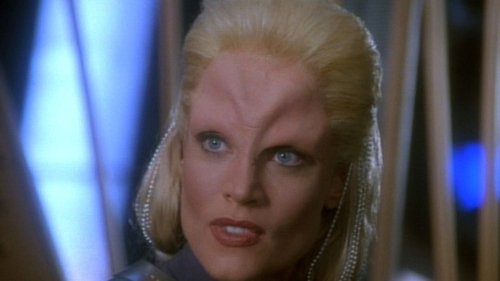
Ensign Melora Pazlar is the first Elaysian to join Starfleet, and as such, requires special accommodations."In this compelling Deep Space Nine installment, Doctor Bashir finds his medical prowess—and heart—tested by Melora Pazlar, a Starfleet environmental specialist from a low-gravity planet, accustomed to a unique physiology.
Doctor Bashir and Lieutenant Dax are in the infirmary, testing out a wheelchair designed for Ensign Pazlar.Doctor Julian Bashir and Lieutenant Jadzia Dax are tasked with preparing special accommodations, including a modified wheelchair and a low-gravity field in her quarters.
In Quark's, a Yridian man named Ashrock is admiring one of the Rings of Paltriss.Meanwhile, a secondary plot unfolds involving Quark and a former Yridian associate named Fallit Kot, who has arrived on Deep Space Nine with the explicit intention of killing Quark, seeking revenge for Quark's perceived betrayal that led to Kot's eight-year incarceration in a labor camp for Romulan ale trafficking.
Melora tells Dax of two Academy friends who got engaged, even though they were being assigned to different ships.
As they lay in their course, Melora asks the computer if there are any Vulcan etudes on file then asks it to play something by Delvok.
Back in the infirmary, Melora is laid down on a biobed while Bashir runs some tests on her.
Helping her back to the turbolift, the two of them head to the habitat ring.
Dax compares her situation to The Little Mermaid, an old Earth fable by Hans Christian Andersen.
Kot asks if the phasers are online but Dax refuses to fire on the Rio Grande and, if he kills her, he won't be able to fly the ship himself.
Doctor Bashir shares a personal story about a childhood experience on Invernia II, where he witnessed an Invernian girl's death, which partly inspired his medical career.
The two storylines violently converge when Fallit Kot, after completing a deal with Ashrock for the Rings of Paltriss and gold-pressed latinum, double-crosses and shoots Ashrock.
Chief Miles O'Brien also installs ramps throughout the Cardassian-designed station to aid her mobility.
Later, Melora suffers a minor accident in a storage bay, reinforcing Bashir's point that even in space, everyone depends on one another.
This shared vulnerability begins to forge a deeper connection between them.
Mission Registries & Linkages
Subspace Playlists
This registry lists all curated subspace playlists and chronological collections containing this mission.
Technology
This registry contains all specialized technologies deployed, analyzed, or referenced during this mission.
Location
This registry displays all celestial bodies, planets, starbases, or coordinates charted or visited during this mission.
Starship
This registry lists all vessels encountered, scanned, or active during this mission.
Species & Factions
This registry documents all species, civilizations, and organizational factions contacted or active in this sector during the mission.
Culture & Lore
This registry outlines historical events, cultural traditions, organizations, and database lore referenced during this mission.
Production & Archival Linkages
This registry documents behind-the-scenes production references, draft concepts, star charts, or archival cataloging links officially connected to this mission.
"In The New Trek Programme Guide, the authors comment that: "as noted in the dialogue, ["Melora"] is a reworking of Hans Christian Andersen's mermaid tale that deals cleverly with issues regarding disability, and bravely ensures that Melora is as tough and flawed as any 'normal' character. Like the little mermaid she is only 'disabled' when out of her natural environment. It would have been very right-on to have had an Elaysian on board the Voyager". (The New Trek Programme Guide, p. 329)"
"A character like Melora Pazlar was initially to be Deep Space 9's science officer, because the producers liked the idea of a character who came from a low-gravity environment. However, due to the difficulty and expense of recreating the effect constantly, the character was replaced by the Trill Jadzia Dax. ()"
Continuity & Trivia
-
Dax's line 'I've never seen Julian fall for anyone so quickly' was originally written for Kira, but Terry Farrell requested it be given to her character.
-
Actress Daphne Ashbrook, who played Melora Pazlar, previously auditioned for the role of Jadzia Dax on Star Trek: Deep Space Nine.
-
This episode marks the first on-screen appearance of the Starfleet Runabout's aft torpedo launcher, which fires a spread of three torpedoes.
-
Melora Pazlar was originally intended to be Deep Space Nine's science officer, but the concept of a character from a low-gravity environment was deemed too expensive and difficult to constantly recreate, leading to the creation of Jadzia Dax instead.
-
Writer Evan Carlos Somers, who himself used a wheelchair, conceived the episode "Melora" as a direct response to the TNG episode "Ethics," aiming to portray a disabled character who finds acceptance without needing a "cure."
-
Due to the Deep Space Nine sets' smaller corridors, Melora's initially planned anti-gravity wheelchair was replaced with a simpler, 21st-century-style design, with an in-universe explanation that Cardassian technology was incompatible with Federation anti-grav systems.
-
Actor Siddig El Fadil (Dr. Bashir) found filming the low-gravity kissing scene challenging, describing the tight harness as a "steel bathing suit" and recalling how he and Daphne Ashbrook would spin and bump heads.