Astrometrics Node: Vulcan

Xenobiology & Cultural Archive Dossier
History & Origins
The Vulcans, or Vulcanians, were a warp-capable humanoid species from the planet Vulcan. They were widely renowned for their strict adherence to logic and reason as well as their remarkable stoicism. In 2161, their homeworld became a founding member of the United Federation of Planets. Vulcans were known by the Borg as Species 3259.
In 2154, T'Pol stated that Vulcans had evolved on Vulcan. Roughly a century later, however, Spock theorized that the Vulcans might be descendants of the Arretans. According to Narek, the myth of Ganmadan dated back to before the Romulan and Vulcan ancestors first arrived on Vulcan. In 2369, evidence was discovered that several species including the Romulans, and therefore also the Vulcans, could be traced back to DNA that had been seeded on many planets by ancient humanoids 4.5 billion years ago.
The Vulcans were once an extremely violent and emotional people who waged almost constant warfare on one another. Paranoia and homicidal rage were common. They believed in a variety of gods, such as war, peace, and death. As their level of technology increased, the Vulcans eventually reached a point where their violent nature threatened the extinction of their own species. In an effort to avoid this fate, a Vulcan named Surak developed a new philosophy, thereby igniting the Time of Awakening. Surak maintained that the root cause of all the problems on Vulcan lay in the uncontrolled outpouring of the people's emotions. His followers swore to live their lives by an ethical system devised by Surak and based purely on logical principles. Emotions were to be controlled and repressed.
Although this new philosophy spread rapidly across Vulcan, a minority, many of whom were known as 'those who march beneath the raptor's wings', rejected Surak's ideals. A destructive war began, including the use of atomic bombs, and among the victims was Surak himself. Eventually, however, those who opposed logic left Vulcan and founded colonies elsewhere – most notably on the planet Romulus, where they founded what eventually became the Romulan Star Empire. At some point in history, the Romulans and the Vulcans engaged in a hundred-year-long war against one another. The war was instigated by the actions of a member of the Q Continuum.
Another group that rejected Surak's philosophy was known as the 'V'tosh ka'tur', or 'Vulcans without logic'. The V'tosh ka'tur believed in controlling emotions by allowing themselves to actively experience them rather than suppressing them. Some of these also left Vulcan, and took up a nomadic existence. Many turned to crime, however, and subsequently sent for rehabilitation at facilities such as the Ankeshtan K'til Retreat. A prime example of a V'tosh ka'tur was Sybok, who underwent failed rehabilitation at Ankeshtan K'Til for involvement in piracy before ultimately trying to use emotion rather than logic to find answers to the creation of the universe.
The Vulcans conducted a series of survey missions to the Sol system, as early as 1957. Vulcans were, in fact, one of the first species to develop warp drive, though a century passed between the first warp flight and the breaking of the warp 2 barrier. T'Pol told Jonathan Archer that Vulcans 'don't share' Humans' 'enthusiasm for space exploration,' but a Syrrannite on Vulcan later advised Jonathan Archer that this may not have been true. The official First Contact between Vulcans and Humans came on April 5, 2063, when a Vulcan survey ship, the T'Plana-Hath, detected the warp flight of Zefram Cochrane's Phoenix. The Vulcans met with Zefram Cochrane at his launch site on the day following the flight.
Subsequently, the Vulcans offered their technological guidance to Humans, but were criticized on Earth for holding back their development. A century after First Contact, the High Command had become worried about Humans, who, like Vulcans, had had devastating wars, but after which had rebuilt and started traveling to the stars much faster. There were those on the High Command who wondered what Humans would achieve in the century to come, and did not like the answer.
By the mid-22nd century, Vulcan culture had strayed from the path that Surak had originally laid out for them, to the point that Surak's katra did not recognize it as the culture he had helped to create. They had ceased being explorers and the High Command, once devoted to that goal, had instead become involved in a conflict with the neighboring Andorians. The Vulcan High Command used an ancient monastery at P'Jem as a secret listening post to spy on the Andorians until June 2151, when the listening post was discovered by the Andorians and a landing party from the Enterprise NX-01. Later, the Humans helped negotiate a peace between the Vulcans and Andorians over a disputed class D planetoid known to the Vulcans as Paan Mokar.
Vulcans also became less tolerant of political and philosophical challenges towards the High Command's operations, notably engaging in purges of the Syrrannite group, who claimed that Vulcan society was no longer following the teachings of Surak. These tensions came to a head in a crisis called the Vulcan Reformation, which resulted in the overthrow of the High Command (and its leader, V'Las, who was secretly allied with the Romulans), as well as a restructuring of the Vulcan government including the dissolution of the High Command. T'Pau became a minister in this government. A less aggressive policy towards Earth was also adopted.
By the 21st and 22nd centuries, the Vulcans had also made contact with the Cardassians, Trill, Tholians, Klingons (as early as 2016), and scores of other races. As of the 23rd century, Vulcan had never been conquered in its collective memory. That memory went so far back that Vulcans could not conceive of a conqueror.
By the 24th century, Vulcan remained one of the principal United Federation of Planets members, and was deeply involved at all levels of that society. Vulcans were present in the Federation colonies found within the Demilitarized Zone established between the United Federation of Planets and the Cardassian Union by the terms of the Federation-Cardassian Treaty of 2370; they were among the colonists' representatives during discussions with the Cardassians concerning terrorist attacks by the anti-Cardassian Maquis movement established in the Zone. At least one Vulcan, Sakonna, acted as a gun runner and interrogator for the Maquis and made use of her people's ability to mind meld in the latter role.
The Vulcans' tradition of exploration continued; in the 24th century, a Vulcan ship was the first to make formal contact with a Gamma Quadrant civilization, upon encountering the Wadi. The Vulcans were at the forefront of exploration in the Gamma Quadrant, encountering the Rakhari and finding the remains of the Hur'q civilization. In the 24th century, the Vulcan ministry of security was known as the V'Shar. By 2369, the Vulcans had a saying known to the United Federation of Planets: 'We're here to serve.'
Despite the enmity between the United Federation of Planets and the Romulan Star Empire, some Vulcans and Romulans, guided by United Federation of Planets Ambassador Spock, attempted to forge a more cordial relationship between the cousins, ultimately hoping to reunify the two cultures. Many of these efforts met with little success for many years. Following the supernova of the Romulus star in 2387 that led to the destruction of both Romulus and Remus, the displaced Romulans would eventually be welcomed to Vulcan. In the centuries after Spock's work began, the two peoples achieved peace and reunification. By the 32nd century, the planet had been renamed Ni'Var, the Vulcan word for 'two form', to reflect the joined cultures.
Mirror Universe
History turned out much differently for the Vulcans of the mirror universe. When the Vulcans made first contact with Earth of this universe in 2063, Zefram Cochrane shot the first Vulcan to publicly set foot on Terran soil, believing his vessel to be the vanguard of an intended invasion. The Terrans stormed the T'Plana-Hath and studied Vulcan technology. Eventually, the Vulcans were conquered by the Terran Empire. By the 2150s, Vulcans were considered slaves to Terrans and not treated as equals. Vulcans later participated in a rebellion against the Terran Empire in the 2250s. By 2267, the half-Vulcan Spock had become first officer of a starship and eventually rose to the top of the Terran Empire itself. After the Terran Empire was conquered by the Klingon-Cardassian Alliance, Vulcans served as slaves to the Klingon-Cardassian Alliance. Using fans, several of them cooled Kira Nerys, the Intendant, aboard Terok Nor. Some Vulcans, such as Tuvok, joined the Terran Rebellion.
Alternate Reality
In the alternate reality, the planet Vulcan was destroyed by a Romulan named Nero in 2258. Over six billion Vulcans were killed, with an estimated ten thousand survivors. After witnessing the atrocity, Spock noted in his acting captain's log that the Vulcan species had become endangered. Spock's prime reality counterpart founded a colony for the survivors, which, by the following year, had been settled and named New Vulcan.
Biology & Physiology
Species which shared some physiological and behavioral traits with Vulcans were categorized as Proto-Vulcan humanoids. One example of this were the Mintakans. In addition, Rigelian physiology was very similar to that of Vulcans.
Vulcans were generally similar to Humans in appearance, distinguished mainly by their pointed ears and upswept eyebrows. Their skin color was most commonly pale with a bronze or greenish tint, though some had brown skin. Vulcan physiognomy could resemble Humans of European, Asian, or African descent. Most Vulcans had straight, glossy black hair, though brown and/or curly hair was also possible. Vulcans had body hair similar to Humans, and some males could be very hirsute. Vulcan males were capable of growing facial hair, but most chose to shave it. Vulcan teeth included anterior tricuspids, which could be protected from decay for decades by sealing them with a trifluorinate compound.
In contrast to their external similarities, Vulcan internal anatomy differed radically from that of Humans. For instance, their heart was where a Human's liver would normally be, and beat several hundred times per minute. Vulcans also had no appendix. They did, however, have mitochondria. Vulcan blood was copper-based and was copper- or rust-colored when deoxygenated in the veins and green when oxygenated, in the arteries, or when bleeding. Bruises and dermal abrasions took on a greenish color. Vulcan body chemistry used little, if any, sodium chloride compared to that of Humans.
Vulcans possessed a highly efficient respiratory system to extract the oxygen they needed from Vulcan's thin atmosphere. They were most comfortable in high temperatures. A Vulcan of advanced age could become more sensitive to lower temperatures. The Vulcan digestive tract was highly adaptable. Although alien foods, notably Human food, would occasionally disagree with a Vulcan, given time, their body could adapt to the alien food. Vulcan hearing was very sensitive. Vulcan females possessed a heightened sense of smell. T'Pol used a regularly injected nasal numbing agent to suppress the smell of Humans. By the 24th century, where regrowing body parts was easier, those on missions can opt for cauterization of scent receptors by a doctor. Having evolved on a planet which was mostly desert, Vulcans developed ways of surviving in desert conditions. For example, they could survive for several days without water and had inner eyelids which protected their eyes.
Vulcans had a superior metabolism to Humans. Caffeine and saponins had little effect on them, and they were also far less vulnerable to the effects of tropolisine. Vulcans were also capable of surviving for long durations without food or sleep. Under stress, Vulcans could do without sleep for weeks. Tuvok once claimed that, as a Vulcan, he was capable of going without sleep for two weeks, although, shortly after making this claim, he fell asleep in the command chair after having gone a little over ten days without sleep. Vulcans were, on average, three times physically stronger than Humans, and had considerably faster reflexes. Vulcans were very sensitive to nitrous oxide gas, which rapidly rendered them unconscious. They were also highly sensitive to neutronic radiants. Vulcans typically had a lifespan of two hundred years or more. Their aging was correspondingly slower; a Vulcan of age 65 had the appearance of a a 20th century Human in their late 20s, and was considered in their 'quarter-life'.
Brain
Perhaps the most interesting aspect of the Vulcan physiology was the brain. The Doctor described the Vulcan brain as 'a puzzle, wrapped inside an enigma, housed inside a cranium.' The Doctor also noted how 'the Vulcan brain never ceases to amaze me.' A Vulcan's brain was in direct control of most of the bodily functions, acting as a control unit for many organs. Despite this, a Vulcan body from which the brain had been removed was capable of functioning and even walking around (albeit in a zombie-like state) with a portable life support system. Unlike most humanoid species, traumatic memories were not only psychologically disturbing to Vulcans, but had physical consequences as well. The Vulcan brain, in reordering neural pathways, could literally lobotomize itself.
Vulcans learned to gain conscious control of many of these functions, allowing them to regulate their bodies to a high degree by simple will-power. When injured, a Vulcan could go into a trance-like state, using this ability to concentrate all of his or her energy on repairing the injury. However, Vulcans did have certain levels of pain they were unable to suppress, forcing them to endure the experience. This trance could be self-induced and gave the physical appearance of near-death. It was similar, in principle, to Vulcan neuro-pressure techniques which could be used to relax the mind and body. The substance trellium-D acted as a neurotoxin to Vulcans, destroying the neural pathways which controlled their emotions. Treatment had to be provided quickly after exposure; otherwise, the damage was irreversible.
The most famous aspect of the Vulcan brain were the inherent telepathic abilities, such as the mind meld. Vulcans were natural touch-telepaths. Though considerable training was required to utilize this ability to the fullest (like performing the fal-tor-pan), simpler contacts did not require any concentration, training, or even conscious knowledge of the act. Vulcans called focal points in the bioelectric field of the brain qui'lari. Stronger minds were capable of non-contact telepathic projection and scanning, usually over short distances, but sometimes even over interstellar distances. Another psionic ability of the Vulcan race was the telepathic suggestion or compulsion, consciously performed by Spock, Sybok, Tuvok, and T'Pol, and unconsciously performed by Sarek. Although Vulcans did not, typically, allow themselves to experience uncontrolled strong emotions, they could sense them in others. Vulcans were capable of performing a synaptic pattern displacement, or the transfer of one individual's consciousness into another. The psycho-suppression system responsible for the Vulcan suppression of emotions was located in the mesiofrontal cortex.
Approximately every seven years, adult Vulcans had to endure pon farr, the Vulcan mating period. It was marked by intense emotions and primal urges (known as plak tow, or 'blood fever') that could kill the Vulcan if not satisfied. Physiological symptoms included elevated dopamine levels and fever. For such an orderly society of quiet sobriety, the madness which accompanied the outbreak of pon farr was an unavoidable evil. In 'Bounty', T'Pol experienced an accelerated pon farr caused by exposure to a pathogen. Despite the abnormal trigger stimulus, T'Pol indicated to Phlox that her symptoms were entirely normal for a Vulcan in her 'condition'.
Medical Conditions
There were several diseases from which the Vulcan species suffered, including Pa'nar Syndrome, Tuvan Syndrome, Bendii Syndrome, and Choriocytosis.
Hybridization
Vulcans and Humans could not reproduce without medical intervention according to 2150s medical knowledge. Phlox explained how he was able to figure out how to make it possible for many alien species to reproduce, including Vulcans and Humans. In 2155, Terra Prime extremists created a binary clone from T'Pol and Charles Tucker III. The child, whom they called Elizabeth, had many genetic flaws due to the method of her creation and she died. In 2230, Spock was born on Vulcan to Sarek and Amanda Grayson. The Vulcan heritage in Vulcan-Human hybrids was dominant, with copper-based blood, pointed ears, and the full range of Vulcan abilities.
Society & Culture
Vulcans were generally non-violent, but logic dictated that combat was sometimes necessary. Vulcans could and did use weapons and practiced martial arts called tal-shaya and Suus Mahna.
Vulcans considered death to be the completion of a journey. Therefore, they did not fear it happening; however, the loss of one's katra was to be avoided if possible, since the katra lived on beyond the physical death. They also practiced euthanasia for the infirm and elderly, and saw nothing wrong with practicing ritual suicide when they reached a certain infirmity with age. As they knew death was an inevitability, they believed that fear of death was ultimately illogical.
The government on Vulcan was a representative democracy. Individual political advancement was based on meritocratic principles. Although Vulcans were highly integrated into the United Federation of Planets, in the 23rd century, some Vulcans viewed service in Starfleet to be less prestigious than attending the Vulcan Science Academy, though in the twilight years of that century, this apparently became much less of an issue. Furthermore, among all the United Federation of Planets members whose people served in Starfleet, Vulcans were the only ones to be accommodated with starships crewed entirely by their own species, such as the USS Intrepid and the USS T'Kumbra. Vulcans played a game known as kal-toh. Vulcans had a traditional funeral dirge. Vulcans occasionally gave gifts. However, Vulcan custom did not include receiving a gift back from a recipient.
Naming
Vulcans possessed family names, although they were pronounceable by Humans only after many years of practice. Many Vulcan females had names beginning with 'T’ and particularly 'T'P' (T'Pol, T'Pring, T'Pau, T'Mir, T'Pel, T'Pan), but not all (Valeris, Sakonna, Saavik, Selar); many males had names beginning with 'S' (Spock, Sarek, Sybok, Surak, Stonn, Soval); again, though, there was variation (Tuvok, Lojal, Vorik, Taurik, Koss).
Education
Naturally, the development of a Vulcan's lifelong devotion towards logic was encouraged at a very early age. Vulcan parents utilized careful and gentle methods to train their infants in primary logic. Vulcan children learned, by example, how to detach themselves from their emotions as well, and it often aided in difficult childhood situations. Despite logic being paramount in education, Vulcan children were allowed much freedom as well, and enjoyed a number of passions their controlled states allowed them to coordinate. As parents, Vulcans never restricted their children from real life. Doing so only hindered their ability to develop their own identity. A Vulcan parent's attachment to their children could not be described as an emotion. They were part of the parent's identity and the parent was incomplete without them. Children at Vulcan nursery schools danced. When they were older, they learned in skill domes. The Vulcan Learning Center employed these. A Vulcan program suitable for young children which taught basic problem solving skills was available at Deep Space 9's school in 2370. The Vulcan Science Academy and Vulcan Medical Institute were two notable post-secondary institutions.
Logic and Emotions
Contrary to stereotype, Vulcans possess strong emotions. They use meditation as a way to suppress those emotions. For instance, emotions like remorse, relief, joy, and embarrassment were all displayed by Spock when he thought James T. Kirk was dead and then saw him alive. Indeed, Vulcan emotions were far more intense, violent, and passionate than those of many other species, including even Humans. It was this passionate, explosive emotionality that Vulcans blamed for the vicious cycle of wars which nearly devastated their planet. As such, they focused their mental energies on mastering them. The essence of their logical society was in arriving at the truth through logical process. Emotions were illogical, thus making them impure, and deterrent to truth. Vulcans were born with the same emotions that afflicted their violent ancestors, but continual mental conditioning generally gave them the impassivity they sought. Though not all could arrive at the ultimate pure logical state, the exacting process of mental control gave Vulcans enough to conform to the ideals of Vulcan society. The ultimate level of logical thought was achieved through the attainment of kolinahr, which was said to purge them of all remaining emotions.
Attitudes to Deception
Vulcans were renowned for their honesty, and indeed it has been claimed that 'Vulcans could not lie.' However, they would do so for what they perceived as logical reasons, though they rarely referred to their dishonesty as 'lying.' For instance, an elder denied the existence of technology and spies at the monastery at P'Jem in order to protect an ongoing surveillance operation. Also, T'Pol's second foremother, T'Mir, directly lied to another Vulcan, telling the commander of a rescue party that her crewmate had died in a crash, so that he could remain on Earth to 'study' Humanity. In 2259 of the alternate reality, Spock managed to deceive Khan Noonien Singh into transporting armed advanced long-range torpedoes aboard the USS Vengeance, as Khan Noonien Singh believed they still carried members of his crew. Khan Noonien Singh wasn't aware that Spock had anticipated his betrayal and removed Khan Noonien Singh's crew from the torpedoes with the intent to detonate them and disable the USS Vengeance. When Khan Noonien Singh stated that he'd know if they weren't his, Spock assured him that 'Vulcans do not lie' and that 'the torpedoes were his'. This demonstrated that Vulcans, while still technically telling the truth, didn't always necessarily tell the entire truth if it was to their advantage. Tuvok at one point stated, when responding to Seven of Nine questioning him as to whether Vulcans were capable of lying 'we are capable of telling lies. However, I have never found it prudent or necessary to do so.' T'Rina, the President of Ni'Var as the Vulcan homeworld was renamed by the 32nd century, showed a willingness to lie in 3191, engaging in an elaborate deception to Primarch Ruhn of the Breen Imperium while negotiating with him.
Spirituality
The Vulcans held a number of spiritual beliefs. Their religious system was polytheistic. They also believed in the katra, the soul and consciousness of a person, which could be transferred psionically prior to death. Meditation was a central component of Vulcan life. The Vulcan Sh'vhal type ship of the late 24th century was known to feature a dedicated meditation chamber that the crew could use alone or in small groups. What little is known about Vulcan religious beliefs indicates that, beginning prior to the Time of the Awakening, they were polytheistic. Surak's teachings became the primary focus of Vulcan spirituality/mysticism, but, as late as the 23rd century, it was still not unheard of to find Vulcans honoring the traditional gods. There were, however, no demons in Vulcan literature.
Romantic Relationships
When Vulcan children came of age, having sometimes been betrothed to childhood companions by age seven, underwent the pon farr, the link compelled them to follow through with full marital rituals, which cemented their relationship. It was traditional for the female to propose marriage by presenting a necklace to the male. She may signal her intention to do so by wearing ritual mating colors on an auspicious date, such as the anniversary of a first courtship event. If, for whatever reason, the female did not wish to go through with the marriage, then the ceremony of koon-ut-kal-if-fee ('marriage or challenge') was invoked. The male fought for the right to keep his mate against a challenger of her choosing. The female became the property of the male who won the contest, unless he chose to release her. The koon-ut-kal-if-fee was a fight to the death. As of 2266, hearsay held that Vulcan men treated their women strangely. According to Spock, it was 'undignified for a woman to play servant to a man that is not hers' as his reason for throwing food (from Christine Chapel) against the wall. Yet, a century earlier, T'Pol brought Jonathan Archer food and blankets in sickbay, and in an alternate timeline, tended to him as a nursemaid. Touching each other with both the middle- and the forefinger was a custom practiced by married couples and was part of the Vulcan marriage ceremony. It could also help to calm down male Vulcans during pon farr.
Food and Drink
Most Vulcans were primarily vegetarians. They also did not touch food with their hands unless wearing special gloves. The V'tosh ka'tur were a major exception to these rules, however. Vulcans were fermenting wines, notably Vulcan port, during the 21st century. However, there have been varying portrayals of Vulcan alcohol consumption. Spock once stated his people were 'spared the dubious benefits of alcohol', and T'Pol claimed Vulcans did not drink wine. Yet, Tuvok offered to drink wine in a holodeck simulation, and Spock has been depicted drinking wine and other non-synthetic alcohol in 'Strange New Worlds'. It has been suggested that some beverages may have contained synthehol rather than alcohol, which is not as intoxicating. Guests in a Vulcan household were expected to rise before sunrise to prepare the morning meal. Plomeek broth was considered a traditional Vulcan breakfast.
Holidays
Notable Vulcan holidays included Kal Rekk, Rumarie, and Tal-Shanar.
Science and Technology
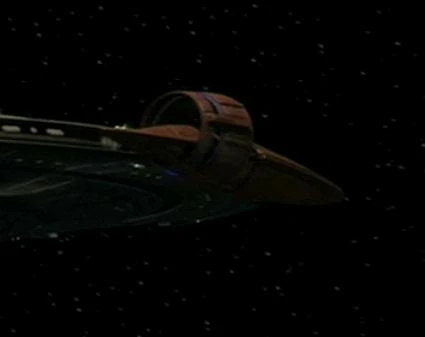
Vulcans were an advanced warp-capable species. Their technology included Vulcan starships and various Vulcan starship classes.
■ Correlative Archive Mappings (Explicit Registry Connections)
Explicit database relations. Unmarked links are manually or structurally verified; links with 🤖 are established via AI analysis.
Synaptic Diagnostics (Outgoing Mentions)
Subspace Neural Link Diagnostics: Links marked with the 🤖 AI insignia are synaptic linkages dynamically reconstructed from local summaries, while unmarked links indicate official Starfleet database entries registered in primary archives.
Automatically mapped connection based on archive scanning.After the Terran Empire was conquered by the Klingon-Cardassian Alliance, Vulcans served as slaves to the Klingon-Cardassian Alliance.
Automatically mapped connection based on archive scanning.The ultimate level of logical thought was achieved through the attainment of kolinahr, which was said to purge them of all remaining emotions. Vulcans were renowned for their honesty, and indeed it has been claimed that 'Vulcans could not lie.' However, they would do so for what they perceived as logical reasons, though they rarely referred to their dishonesty as 'lying.' For instance, an elder denied the existence of technology and spies at the monastery at P'Jem in order to protect an ongoing surveillance operation.
Automatically mapped connection based on archive scanning.Vulcans were present in the Federation colonies found within the Demilitarized Zone established between the United Federation of Planets and the Cardassian Union by the terms of the Federation-Cardassian Treaty of 2370; they were among the colonists' representatives during discussions with the Cardassians concerning terrorist attacks by the anti-Cardassian Maquis movement established in the Zone.
Automatically mapped connection based on archive scanning.At least one Vulcan, Sakonna, acted as a gun runner and interrogator for the Maquis and made use of her people's ability to mind meld in the latter role.
Automatically mapped connection based on archive scanning.Approximately every seven years, adult Vulcans had to endure pon farr, the Vulcan mating period.
Automatically mapped connection based on archive scanning.Eventually, however, those who opposed logic left Vulcan and founded colonies elsewhere – most notably on the planet Romulus, where they founded what eventually became the Romulan Star Empire.
Automatically mapped connection based on archive scanning.Although Vulcans were highly integrated into the United Federation of Planets, in the 23rd century, some Vulcans viewed service in Starfleet to be less prestigious than attending the Vulcan Science Academy, though in the twilight years of that century, this apparently became much less of an issue.
Automatically mapped connection based on archive scanning.Eventually, the Vulcans were conquered by the Terran Empire.
Automatically mapped connection based on archive scanning.Some Vulcans, such as Tuvok, joined the Terran Rebellion. In the alternate reality, the planet Vulcan was destroyed by a Romulan named Nero in 2258.
Automatically mapped connection based on archive scanning.In 2161, their homeworld became a founding member of the United Federation of Planets.
Vulcans were present in the Federation colonies found within the Demilitarized Zone established between the United Federation of Planets and the Cardassian Union by the terms of the Federation-Cardassian Treaty of 2370; they were among the colonists' representatives during discussions with the Cardassians concerning terrorist attacks by the anti-Cardassian Maquis movement established in the Zone.
By the 32nd century, the planet had been renamed Ni'Var, the Vulcan word for 'two form', to reflect the joined cultures. History turned out much differently for the Vulcans of the mirror universe.
However, I have never found it prudent or necessary to do so.' T'Rina, the President of Ni'Var as the Vulcan homeworld was renamed by the 32nd century, showed a willingness to lie in 3191, engaging in an elaborate deception to Primarch Ruhn of the Breen Imperium while negotiating with him. The Vulcans held a number of spiritual beliefs.
In 2259 of the alternate reality, Spock managed to deceive Khan Noonien Singh into transporting armed advanced long-range torpedoes aboard the USS Vengeance, as Khan Noonien Singh believed they still carried members of his crew.
A Vulcan program suitable for young children which taught basic problem solving skills was available at Deep Space 9's school in 2370.
The war was instigated by the actions of a member of the Q Continuum.
Vulcans were present in the Federation colonies found within the Demilitarized Zone established between the United Federation of Planets and the Cardassian Union by the terms of the Federation-Cardassian Treaty of 2370; they were among the colonists' representatives during discussions with the Cardassians concerning terrorist attacks by the anti-Cardassian Maquis movement established in the Zone.
Spock's prime reality counterpart founded a colony for the survivors, which, by the following year, had been settled and named New Vulcan. Species which shared some physiological and behavioral traits with Vulcans were categorized as Proto-Vulcan humanoids.
The Vulcans conducted a series of survey missions to the Sol system, as early as 1957.
As their level of technology increased, the Vulcans eventually reached a point where their violent nature threatened the extinction of their own species.
Vulcans were, in fact, one of the first species to develop warp drive, though a century passed between the first warp flight and the breaking of the warp 2 barrier.
They had ceased being explorers and the High Command, once devoted to that goal, had instead become involved in a conflict with the neighboring Andorians.
Yet, Tuvok offered to drink wine in a holodeck simulation, and Spock has been depicted drinking wine and other non-synthetic alcohol in 'Strange New Worlds'.
Furthermore, among all the United Federation of Planets members whose people served in Starfleet, Vulcans were the only ones to be accommodated with starships crewed entirely by their own species, such as the USS Intrepid and the USS T'Kumbra.
By the 21st and 22nd centuries, the Vulcans had also made contact with the Cardassians, Trill, Tholians, Klingons (as early as 2016), and scores of other races.
According to Narek, the myth of Ganmadan dated back to before the Romulan and Vulcan ancestors first arrived on Vulcan.
By the 21st and 22nd centuries, the Vulcans had also made contact with the Cardassians, Trill, Tholians, Klingons (as early as 2016), and scores of other races.
Eventually, however, those who opposed logic left Vulcan and founded colonies elsewhere – most notably on the planet Romulus, where they founded what eventually became the Romulan Star Empire.
The official First Contact between Vulcans and Humans came on April 5, 2063, when a Vulcan survey ship, the T'Plana-Hath, detected the warp flight of Zefram Cochrane's Phoenix.
The Vulcan brain, in reordering neural pathways, could literally lobotomize itself.
T'Pol told Jonathan Archer that Vulcans 'don't share' Humans' 'enthusiasm for space exploration,' but a Syrrannite on Vulcan later advised Jonathan Archer that this may not have been true.
A prime example of a V'tosh ka'tur was Sybok, who underwent failed rehabilitation at Ankeshtan K'Til for involvement in piracy before ultimately trying to use emotion rather than logic to find answers to the creation of the universe.
By the 21st and 22nd centuries, the Vulcans had also made contact with the Cardassians, Trill, Tholians, Klingons (as early as 2016), and scores of other races.
Subsequently, the Vulcans offered their technological guidance to Humans, but were criticized on Earth for holding back their development.
Following the supernova of the Romulus star in 2387 that led to the destruction of both Romulus and Remus, the displaced Romulans would eventually be welcomed to Vulcan.
By 2369, the Vulcans had a saying known to the United Federation of Planets: 'We're here to serve.' Despite the enmity between the United Federation of Planets and the Romulan Star Empire, some Vulcans and Romulans, guided by United Federation of Planets Ambassador Spock, attempted to forge a more cordial relationship between the cousins, ultimately hoping to reunify the two cultures.
The Vulcans' tradition of exploration continued; in the 24th century, a Vulcan ship was the first to make formal contact with a Gamma Quadrant civilization, upon encountering the Wadi.
A destructive war began, including the use of atomic bombs, and among the victims was Surak himself.
Recorded Visitations
This list displays officially verified Starfleet database logs for episodes and movies where this species or faction was actively encountered or officially recorded.
■ Synaptic Diagnostics (Incoming Mentions) (In-Text References)
Reconstructed text references. Unmarked entries are canonical database linkages; links with 🤖 are derived from LCARS text analysis.
Other locations, starships, technologies, or cultural files containing direct textual references to this profile.
Subspace Scan Mentions: This list records episodes where this species or faction was not officially registered as a primary profile detail, but is mentioned by name within the episode's plot summary or dialogue transcripts.
■ Associated Technologies & Weapons (Database Registry)
Technologies and weapons commonly utilized or invented by this species or faction.

■ Associated Starships & Vessels (Vessel Registry)
Starships operated by or affiliated with this species or faction.


■ Vulcan Members & Faction Personnel (Dossier Registry)
Explicit members and affiliated personnel resolved from structured dossier metadata.


■ Associated Characters & Personnel (Textual References)
Character dossiers referencing this species or faction; links with 🤖 indicate AI-derived connections.


