Mission Briefing
The United Federation of Planets and the Bajoran Republic embark on a joint science mission with the Cardassian government to establish a permanent communications link through the Bajoran wormhole. This ambitious project aims to foster peace and monitor the Gamma Quadrant, following the recent Bajoran-Cardassian Treaty. However, the mission is immediately complicated by the arrival of Vedek Yarka, a Bajoran religious leader, who warns Commander Benjamin Sisko that an ancient Bajoran prophecy, Trakor's Third Prophecy, foretells doom if the Cardassians are allowed to proceed. The prophecy speaks of 'three vipers' returning to their 'nest in the sky' and attempting to 'peer through the temple gates,' which Vedek Yarka interprets as the Cardassian scientists destroying the Celestial Temple, or the wormhole itself. Benjamin Sisko, a Starfleet officer, struggles to reconcile his scientific duty with the deeply held religious beliefs of the Bajoran people, particularly as events begin to eerily align with the prophecy's cryptic warnings.
LCARS Tactical Mission Registry: A detailed reconstruction of chronological events and narrative progression compiled from historical logs and mission briefs.
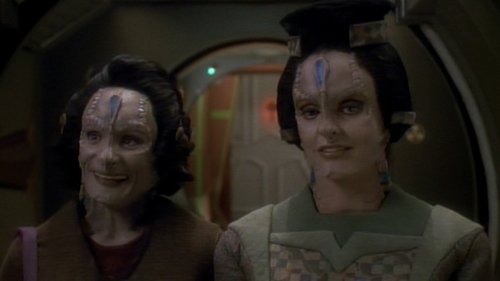
The episode 'Destiny' opens on Deep Space Nine with Commander Benjamin Sisko and Odo discussing the arrival of two Cardassian scientists, Ulani Belor and Gilora Rejal, who are part of the first joint Bajoran, Cardassian, and United Federation of Planets science mission. Their objective is to establish a permanent communications link through the Bajoran wormhole to the Gamma Quadrant, a project crucial for monitoring the Dominion and fostering peace after the Bajoran-Cardassian Treaty. Odo, ever cautious, has implemented security measures, while Benjamin Sisko emphasizes the importance of making the Cardassians feel like guests to promote better relations with the Bajoran Republic. Lieutenant Jadzia Dax expresses skepticism about the Cardassian transceiver designs, and Quark, ever the entrepreneur, attempts to capitalize on the Cardassian presence by offering them 'real' Kanar and planning new gaming concessions, much to Odo's and Benjamin Sisko's chagrin. The initial optimism is quickly challenged when Vedek Yarka arrives, urgently warning Benjamin Sisko that the mission will bring destruction, citing Trakor's Third Prophecy, which foretells 'three vipers' returning to their 'nest in the sky' and attempting to 'peer through the temple gates,' leading to the wormhole's destruction. Benjamin Sisko, a Starfleet officer, dismisses the prophecy as superstition, while Major Kira Nerys, a devout Bajoran, finds herself increasingly conflicted.
The arrival of the Cardassian scientists, Ulani Belor and Gilora Rejal, is initially smooth, though Major Kira Nerys remains visibly uncomfortable with their presence, despite her diplomatic welcome. During a briefing in the wardroom, Gilora Rejal's confidence in their transceiver design clashes with Chief Miles O'Brien's engineering experience, particularly regarding phase variance. The situation takes a dramatic turn when Ulani Belor announces the unexpected arrival of a third Cardassian scientist, Dejar, fulfilling Vedek Yarka's prophecy of 'three vipers.' This revelation deeply unsettles Major Kira Nerys, who begins to question Benjamin Sisko's dismissal of the prophecy. Odo's investigation into Vedek Yarka reveals he was defrocked for opposing the Bajoran-Cardassian Treaty, leading Benjamin Sisko to believe the Vedek is manipulating the prophecy to scuttle the peace efforts. Odo, however, subtly suggests that Benjamin Sisko's own discomfort with his role as the Emissary might be influencing his judgment. Meanwhile, Gilora Rejal's interactions with Chief Miles O'Brien become increasingly awkward, as she misinterprets his irritability as romantic interest, leading to a humorous but uncomfortable cross-cultural misunderstanding in a Jefferies tube.
The USS Defiant, with Benjamin Sisko, Major Kira Nerys, Lieutenant Jadzia Dax, Ulani Belor, and Dejar aboard, travels to the Gamma Quadrant to deploy the communications relay. Just as they prepare to deploy it, sensors detect a rogue comet with high concentrations of silithium, which Major Kira Nerys immediately identifies as the 'sword of stars' from Trakor's Third Prophecy. Despite Major Kira Nerys's growing conviction that the prophecy is unfolding, Benjamin Sisko maintains his Starfleet officer's perspective, insisting on a 'concrete, solid, Starfleet' reason to halt the mission. He views the comet as a natural phenomenon and the 'vipers' as mere scientists. The first attempt to activate the relay's carrier wave in the Delta band frequency fails, but a subsequent attempt using the theta band frequency causes a massive neutrino surge, destabilizing the Bajoran wormhole and increasing its gravity well. The wormhole's instability pulls the silithium comet off course, sending it directly towards the wormhole. If the comet enters, the silithium will cause a cascade reaction, collapsing the Bajoran wormhole permanently, thus fulfilling another part of the prophecy.
Back on Deep Space Nine, the science team convenes, where Lieutenant Jadzia Dax explains the carrier wave created a subspace inversion. Ulani Belor reveals that the Cardassian Science Ministry, under military jurisdiction, downplayed the risk of subspace inversion in their data to avoid making the project seem 'unnecessarily dangerous.' Dejar, who has been suspiciously quiet, suggests a new team will be assembled, further raising suspicions. Chief Miles O'Brien proposes modifying the USS Defiant's phaser array to vaporize the comet evenly, preventing it from fracturing. Benjamin Sisko, still wrestling with the prophecy, consults Lieutenant Jadzia Dax, who advises him to make his own decisions rather than letting prophecies dictate them. He decides to proceed with the plan. However, during the attempt to destroy the comet, the modified phasers malfunction, firing a standard burst that shatters the comet into three fragments, now hurtling towards the Bajoran wormhole. Gilora Rejal then exposes Dejar as a member of the Obsidian Order, revealing her sabotage of the phaser coupling to ensure the mission's failure and undermine the Bajoran-Cardassian Treaty. Dejar is confined to quarters, and the team must find a new solution.
With the wormhole's imminent collapse, Ulani Belor suggests generating a subspace field around the fragments to contain the silithium. Chief Miles O'Brien proposes using the USS Defiant's warp drive, but the ship is too large. Benjamin Sisko decides to pilot a shuttlepod, with Major Kira Nerys joining him, acknowledging her role in helping the Emissary. They successfully maneuver the shuttlepod between the three comet fragments and activate a subspace field, containing the silithium as they are dragged through the Bajoran wormhole. Although the field loses some integrity, they emerge safely in the Alpha Quadrant. Miraculously, the silithium trail left by the fragments in the wormhole creates a subspace filament, allowing the communications relay's test signal to pass through, effectively achieving the mission's goal. Major Kira Nerys realizes the true interpretation of Trakor's Third Prophecy: the 'three vipers' were the comet fragments, 'peering through the temple gates' was the attempt to establish the relay, 'burning the temple gates' was the silithium's reaction creating the communication pathway, and the 'sword of stars' was the comet's silithium tail used by the Emissary. The episode concludes with Gilora Rejal bidding a fond farewell to Chief Miles O'Brien, and Vedek Yarka apologizing to Benjamin Sisko for his distrust, revealing that Trakor's Fourth Prophecy, also concerning the Emissary, will soon come to pass.
LCARS Tactical Mission Log: Chronological action logs detailing exactly what each character did during the events of this mission, linked directly to personnel dossiers.


Subspace Visual Feed
Sensors & Diagnostic Metrics
Visual Sensor Logs


Synaptic Lore Link Contexts
He illustrates the benefits of the communication relay for Bajor, how they will be able to communicate with ships on the other side of the wormhole and facilitate exploration, how they can monitor the Dominion in case of attack, but the Vedek dismisses the benefits as irrelevant, sure that they are on the verge of a great disaster.The episode culminates in an extraordinary, reality-bending encounter with the enigmatic Wormhole Aliens, challenging the crew's rational understanding and forcing Sisko to make a choice that could unravel the destiny of Bajor.
In a profound exploration of faith versus science, Captain Sisko finds himself at a crucial crossroads as a joint Federation-Cardassian endeavor threatens the very fabric of Bajoran prophecy.
When Chief O'Brien and Cardassian scientist Ulani Belor attempt to establish a subspace relay within the Bajoran Wormhole, ancient texts foretell the wormhole's destruction should three "aliens" venture inside.
A team of Cardassian scientists is coming to the station to assist us in deploying a subspace relay in the Gamma Quadrant.In a profound exploration of faith versus science, Captain Sisko finds himself at a crucial crossroads as a joint Federation-Cardassian endeavor threatens the very fabric of Bajoran prophecy.
A team of Cardassian scientists is coming to the station to assist us in deploying a subspace relay in the Gamma Quadrant.
She asks the Ferengi where he has managed to obtain real kanar, to which he explains he has had three cases of it sitting in his storeroom since the Occupation and there hasn't been much call for it the past few years.
She asks the Ferengi where he has managed to obtain real kanar, to which he explains he has had three cases of it sitting in his storeroom since the Occupation and there hasn't been much call for it the past few years.
O'Brien explains he had to make some modifications in order to meet Starfleet codes and regulations which require a secondary backup system.As the Defiant and two Cardassian ships prepare for the crossing, Sisko, torn between his Starfleet duty and his role as the Emissary, must confront the potentially catastrophic consequences of ignoring deeply held spiritual beliefs.
After a brief introduction, she too welcomes them on behalf of the Bajoran Provisional Government, hoping this project will mark a new era of peace between Bajor and Cardassia though she is clearly uncomfortable with the situation.Odo, ever cautious, has implemented security measures, while Benjamin Sisko emphasizes the importance of making the Cardassians feel like guests to promote better relations with the Bajoran Republic.
After a brief introduction, she too welcomes them on behalf of the Bajoran Provisional Government, hoping this project will mark a new era of peace between Bajor and Cardassia though she is clearly uncomfortable with the situation.
He illustrates the benefits of the communication relay for Bajor, how they will be able to communicate with ships on the other side of the wormhole and facilitate exploration, how they can monitor the Dominion in case of attack, but the Vedek dismisses the benefits as irrelevant, sure that they are on the verge of a great disaster.
Sisko welcomes them both to Deep Space 9 on behalf of the Federation and Starfleet Command, while Kira stands in silence.
Sisko welcomes them both to Deep Space 9 on behalf of the Federation and Starfleet Command, while Kira stands in silence.The episode 'Destiny' opens on Deep Space Nine with Commander Benjamin Sisko and Odo discussing the arrival of two Cardassian scientists, Ulani Belor and Gilora Rejal, who are part of the first joint Bajoran, Cardassian, and United Federation of Planets science mission.
She reveals that Dejar is a member of the Obsidian Order and was assigned to them for security.Gilora Rejal then exposes Dejar as a member of the Obsidian Order, revealing her sabotage of the phaser coupling to ensure the mission's failure and undermine the Bajoran-Cardassian Treaty.
Lieutenant Jadzia Dax expresses skepticism about the Cardassian transceiver designs, and Quark, ever the entrepreneur, attempts to capitalize on the Cardassian presence by offering them 'real' Kanar and planning new gaming concessions, much to Odo's and Benjamin Sisko's chagrin.
However, during the attempt to destroy the comet, the modified phasers malfunction, firing a standard burst that shatters the comet into three fragments, now hurtling towards the Bajoran wormhole.
Chief Miles O'Brien proposes modifying the USS Defiant's phaser array to vaporize the comet evenly, preventing it from fracturing.
With the wormhole's imminent collapse, Ulani Belor suggests generating a subspace field around the fragments to contain the silithium.
Chief Miles O'Brien proposes using the USS Defiant's warp drive, but the ship is too large.
Mission Registries & Linkages
Subspace Playlists
This registry lists all curated subspace playlists and chronological collections containing this mission.
Technology
This registry contains all specialized technologies deployed, analyzed, or referenced during this mission.
Location
This registry displays all celestial bodies, planets, starbases, or coordinates charted or visited during this mission.
Starship
This registry lists all vessels encountered, scanned, or active during this mission.
[ NO STARSHIPS REGISTERED ]
Species & Factions
This registry documents all species, civilizations, and organizational factions contacted or active in this sector during the mission.
Culture & Lore
This registry outlines historical events, cultural traditions, organizations, and database lore referenced during this mission.
Production & Archival Linkages
This registry documents behind-the-scenes production references, draft concepts, star charts, or archival cataloging links officially connected to this mission.
"A laser torch is an engineering tool used by Gilora Rejal while working with Chief Miles O'Brien on the station's systems. O'Brien eventually takes it from her to complete the modifications himself, asserting his expertise."
"Phasers are the primary weapon system of the USS Defiant, which Chief Miles O'Brien attempts to modify to destroy the comet. The phaser array is sabotaged by Dejar, leading to the comet fracturing instead of vaporizing."
"Replicators are used on Deep Space Nine to provide Cardassian food for the visiting scientists, demonstrating Starfleet's efforts to accommodate their guests. Quark also boasts that his Cardassian delicacies are 'fresh, not replicated'."
"The self-sealing stem bolt is mentioned in the background information as one of the 'silly names' created by Peter Allan Fields that Ira Steven Behr liked to bring back, though it does not appear in the episode's dialogue."
"A subspace field is proposed by Ulani Belor as a method to contain the silithium from the comet fragments, preventing a cascade reaction in the wormhole. Benjamin Sisko and Major Kira Nerys use a shuttlepod's warp drive to generate this field."
"Tractor beams are considered as a method to deflect the comet, but Lieutenant Jadzia Dax and Gilora Rejal conclude they would only cause the comet to fragment further, creating a larger problem."
"The USS Defiant's warp drive is initially considered by Chief Miles O'Brien to generate a subspace field around the comet fragments. Ultimately, a shuttlepod's warp drive is used for this purpose due to maneuverability constraints."
"Sisko's behavior in this episode, and his attitude to his role as Emissary, contrast sharply with how he would ultimately feel about being a religious icon. Throughout the fourth, fifth, sixth and seventh seasons, Sisko would become more and more comfortable with his position in the eyes the Bajoran people, a process which is played out over the course of the fourth season episode (where he is forced to fight for his right to be Emissary) and the fifth season episode (where he receives visions of the future from the Prophets), as well as in his interactions with the Prophets in episodes like , , , and the series finale ."
"Sisko's behavior in this episode, and his attitude to his role as Emissary, contrast sharply with how he would ultimately feel about being a religious icon. Throughout the fourth, fifth, sixth and seventh seasons, Sisko would become more and more comfortable with his position in the eyes the Bajoran people, a process which is played out over the course of the fourth season episode (where he is forced to fight for his right to be Emissary) and the fifth season episode (where he receives visions of the future from the Prophets), as well as in his interactions with the Prophets in episodes like , , , and the series finale ."
Continuity & Trivia
-
This episode marks Les Landau's directorial debut for *Star Trek: Deep Space Nine*, though he had previously directed several episodes of *Star Trek: The Next Generation*.
-
The unique visual effects for the wormhole sequence, particularly the spiritual encounter with the Prophets, utilized a blend of early computer-generated imagery and traditional optical effects, pushing the boundaries of television production at the time.
-
The episode's story was initially pitched as a prophecy of happiness and joy, but producers found it unexciting, prompting Ronald D. Moore to suggest transforming it into a "prophecy of doom" to increase dramatic tension.Sources: Memory Alpha
-
An earlier story concept for "Destiny" involved Starfleet attempting to remove Commander Sisko from his Emissary role, with a "pencil-pushing officer" named Marlowe (an homage to Heart of Darkness) sent to discredit him, only to become entangled in the prophecy's fulfillment himself.Sources: Memory Alpha
-
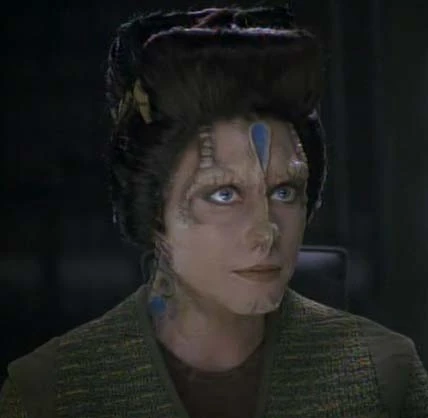
While in full Cardassian makeup for her role as Gilora Rejal, actress Tracy Scoggins reportedly walked around the Paramount lot "scaring schoolchildren on buses," which led to a call from studio security to the Deep Space Nine set.Sources: Memory Alpha
-
The communication relay station was a redressed and modified reuse of the Amargosa observatory model from Star Trek Generations, while the comet featured in the episode was a physical model created by Tony Meininger, not a computer-generated image.Sources: Memory Alpha
-
Despite his initial script contribution, co-writer David S. Cohen expressed strong dissatisfaction with the final episode, claiming none of his dialogue made it in and that he still gets "a headache" watching it.Sources: Memory Alpha