Mission Briefing
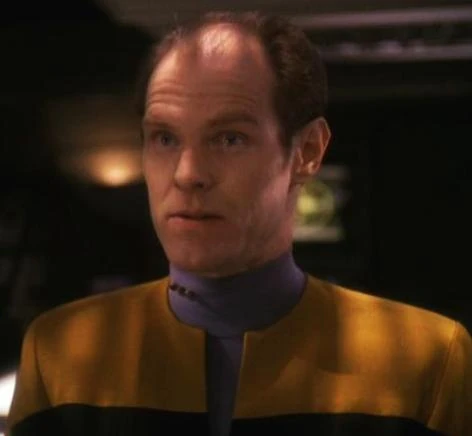
Doctor Julian Bashir's plans for a medical conference are abruptly interrupted when Deputy Director Luther Sloan of Starfleet Department of Internal Affairs arrives on Deep Space Nine. Sloan announces a severe security breach, suspecting a senior staff member of covertly aiding the Dominion. All senior officers are confined to quarters, and Bashir quickly becomes the primary suspect in a rigorous investigation.
Sloan's interrogations delve into Bashir's past, questioning his loyalty and suggesting he may be an unwitting Dominion operative due to repressed memories. As the pressure mounts, Bashir finds himself isolated and accused, struggling to prove his innocence against a mounting tide of circumstantial evidence and psychological manipulation.
LCARS Tactical Mission Registry: A detailed reconstruction of chronological events and narrative progression compiled from historical logs and mission briefs.
Doctor Julian Bashir is preparing for a medical conference on Casperia Prime when Chief Miles O'Brien dislocates his shoulder in a holosuite kayaking accident, which Bashir promptly fixes. The next morning, Captain Benjamin Sisko summons all senior officers to Operations, where Deputy Director Luther Sloan of Starfleet Department of Internal Affairs announces a major security breach on Deep Space Nine, suspecting a senior staff member of passing information to the Dominion. All senior staff are relieved of duty and confined to quarters, and Bashir's conference trip is cancelled. Bashir's replicator is offline, and he is soon summoned for questioning. Sloan, initially charming, discusses Bashir's past experiences, including his imprisonment at Internment Camp 371 and his work with genetically enhanced Humans. Bashir is dismissed, but later finds his quarters tampered with and receives a cut-off message from Miles O'Brien, who reveals Sloan's questions were all about Bashir, confirming the doctor is the primary suspect.
Sloan's second interrogation of Julian Bashir takes a much sterner tone. He presses Bashir on discrepancies regarding his time at Internment Camp 371, specifically claiming General Martok stated Bashir was in solitary for seven days, not five, and questioning the ease of his escape, suggesting the Dominion intentionally allowed it. Sloan introduces the concept of engramatic dissociation, positing that Bashir was 'broken' by the Dominion, coerced into spying, and had his memories repressed, making him an unwitting agent. When Bashir denies these allegations and demands legal counsel, Sloan has him publicly escorted in irons across the Promenade to a holding cell, a humiliating spectacle for the Starfleet officer. Captain Benjamin Sisko visits Bashir, revealing that Odo discovered Sloan's son was killed by a Jem'Hadar patrol, providing a potential motive for Sloan's intense focus on Bashir. Sloan confirms this, believing Bashir supplied the intelligence that led to his son's death. Sisko asserts his authority as commanding officer, demanding to be present at all future interrogations to protect Bashir's rights.
During the subsequent interrogation, Luther Sloan brings up Julian Bashir's past actions, including his attempt to cure Jem'Hadar of their Ketracel-white addiction on Bopak III and his controversial recommendation for Starfleet to surrender to the Dominion after working with genetically enhanced Humans. Captain Benjamin Sisko defends Bashir, arguing that these incidents, while perhaps showing poor judgment, do not prove treason. Sloan counters by highlighting Bashir's long-standing deception regarding his own genetic enhancements, questioning his honesty and loyalty. After the interrogation, Bashir apologizes to Sisko for his past lies, but firmly denies any possibility of being a Dominion agent with repressed memories. Later that night, Sloan returns, presenting a Starfleet Special Order 66715, authorizing him to 'neutralize security threats' and demanding Bashir sign a confession or face maximum-security imprisonment for the duration of the Dominion War. Bashir defiantly refuses, but before he can be taken, he is suddenly transported off Deep Space Nine by a Cardassian-style transporter beam.
Julian Bashir finds himself aboard a Cardassian warship, where a holographic Weyoun welcomes him 'home,' claiming Bashir is a Dominion operative who has undergone this debriefing process multiple times. Weyoun attempts to convince Bashir that he willingly became a spy to save lives, with his memories repressed. He even offers Bashir scones and tea, mirroring Bashir's earlier request. This repetition, combined with Weyoun's insistence on repressed memories, makes Bashir realize that Weyoun is using the same tactics as Sloan. He deduces that Sloan is the true traitor, working with the Dominion. The 'Cardassian ship' then comes under attack, and Major Kira Nerys and Commander Worf beam aboard to rescue Bashir, returning him to the USS Defiant. Back on the 'Defiant,' everyone believes Bashir is a spy. When Bashir tries to explain his theory about Sloan, he is dismissed. He turns to Miles O'Brien for support, but O'Brien shoves him without pain, despite his earlier dislocated shoulder. Bashir tests O'Brien by mentioning 'springball' instead of 'kayaking,' and O'Brien's agreement confirms Bashir's suspicion: none of it is real.
The USS Defiant bridge disappears, revealing Julian Bashir is in a holodeck, surrounded by three men in black uniforms, including Luther Sloan. Sloan explains that the entire elaborate scenario was a test of Bashir's loyalty, using a neuro-synaptic relay implant behind his ear to record his responses. He admits they only allowed Bashir an hour's sleep to heighten stress for accurate results. Sloan reveals he is not with Internal Affairs but with Section 31, a covert, autonomous organization established by the original Starfleet Charter, tasked with protecting the United Federation of Planets by any means necessary, operating outside conventional Starfleet oversight. Bashir expresses strong disapproval of Section 31's methods and blatant disregard for Federation principles. Sloan attempts to recruit Bashir, citing his intelligence, resourcefulness, fascination with covert operations, and genetic enhancements. Bashir refuses, threatening to expose Section 31, but Sloan remains unfazed, confident Bashir will eventually agree. Sedated, Bashir is returned to Deep Space Nine. Captain Benjamin Sisko, Major Kira Nerys, and Odo discuss the incident. Starfleet Command offers no confirmation or denial of Section 31's existence, implying a conspiracy. Odo compares Section 31 to the Romulan Tal Shiar and the Cardassian Obsidian Order. Sisko, recognizing Section 31 will return, instructs Bashir to accept their next recruitment offer to infiltrate and dismantle the organization from within, setting the stage for Bashir to become a real spy.
LCARS Tactical Mission Log: Chronological action logs detailing exactly what each character did during the events of this mission, linked directly to personnel dossiers.





Subspace Visual Feed
Sensors & Diagnostic Metrics
Visual Sensor Logs


Synaptic Lore Link Contexts
In the night, Sloan visits Bashir to tell him he has an order from Starfleet Command allowing him to "neutralize threats" to security, and he plans to put Bashir in a maximum-security prison until the war is over unless Bashir is willing to sign a full confession.This pivotal episode introduces the Federation's hidden, darker side, challenging the crew's ideals and forcing Bashir to confront the true nature of loyalty and security during the Dominion War.
Sloan confirms he is not part of Internal Affairs, rather he is part of a covert organization known as Section 31, which he claims was part of the original Starfleet Charter but answers to no one.As Commander Sisko, Chief O'Brien, and Dax rally to his defense, they uncover a shocking truth: Sloan is not merely Starfleet Intelligence, but a member of Section 31, a clandestine organization operating in the shadows, unburdened by Starfleet's ethical constraints.
However, things do not seem right as she escorts him to the wardroom; a pair of officers carrying phaser rifles run past them in the corridor, but Bashir is told not to worry about it.
Now in his quarters, Bashir orders breakfast from the replicator, but finds it out of order.Bashir's replicator is offline, and he is soon summoned for questioning.
In the night, Sloan visits Bashir to tell him he has an order from Starfleet Command allowing him to "neutralize threats" to security, and he plans to put Bashir in a maximum-security prison until the war is over unless Bashir is willing to sign a full confession.Starfleet Command offers no confirmation or denial of Section 31's existence, implying a conspiracy.
According to the Vorta, Bashir has gone through the same debriefing process a number of times, and the fact that the doctor does not believe his story does not surprise him.
During the subsequent interrogation, Luther Sloan brings up Julian Bashir's past actions, including his attempt to cure Jem'Hadar of their Ketracel-white addiction on Bopak III and his controversial recommendation for Starfleet to surrender to the Dominion after working with genetically enhanced Humans.
Bashir defiantly refuses, but before he can be taken, he is suddenly transported off Deep Space Nine by a Cardassian-style transporter beam.
Doctor Julian Bashir is preparing for a medical conference on Casperia Prime when Chief Miles O'Brien dislocates his shoulder in a holosuite kayaking accident, which Bashir promptly fixes.
The USS Defiant bridge disappears, revealing Julian Bashir is in a holodeck, surrounded by three men in black uniforms, including Luther Sloan.
Sloan, initially charming, discusses Bashir's past experiences, including his imprisonment at Internment Camp 371 and his work with genetically enhanced Humans.
Sloan explains that the entire elaborate scenario was a test of Bashir's loyalty, using a neuro-synaptic relay implant behind his ear to record his responses.
Sloan, initially charming, discusses Bashir's past experiences, including his imprisonment at Internment Camp 371 and his work with genetically enhanced Humans.
Captain Benjamin Sisko visits Bashir, revealing that Odo discovered Sloan's son was killed by a Jem'Hadar patrol, providing a potential motive for Sloan's intense focus on Bashir.
During the subsequent interrogation, Luther Sloan brings up Julian Bashir's past actions, including his attempt to cure Jem'Hadar of their Ketracel-white addiction on Bopak III and his controversial recommendation for Starfleet to surrender to the Dominion after working with genetically enhanced Humans.
Odo compares Section 31 to the Romulan Tal Shiar and the Cardassian Obsidian Order.
Odo compares Section 31 to the Romulan Tal Shiar and the Cardassian Obsidian Order.
Odo compares Section 31 to the Romulan Tal Shiar and the Cardassian Obsidian Order.
Bashir defiantly refuses, but before he can be taken, he is suddenly transported off Deep Space Nine by a Cardassian-style transporter beam.
Sloan reveals he is not with Internal Affairs but with Section 31, a covert, autonomous organization established by the original Starfleet Charter, tasked with protecting the United Federation of Planets by any means necessary, operating outside conventional Starfleet oversight.
Mission Registries & Linkages
Subspace Playlists
This registry lists all curated subspace playlists and chronological collections containing this mission.
Technology
This registry contains all specialized technologies deployed, analyzed, or referenced during this mission.
Location
This registry displays all celestial bodies, planets, starbases, or coordinates charted or visited during this mission.
Starship
This registry lists all vessels encountered, scanned, or active during this mission.
[ NO STARSHIPS REGISTERED ]
Species & Factions
This registry documents all species, civilizations, and organizational factions contacted or active in this sector during the mission.
Culture & Lore
This registry outlines historical events, cultural traditions, organizations, and database lore referenced during this mission.
Production & Archival Linkages
This registry documents behind-the-scenes production references, draft concepts, star charts, or archival cataloging links officially connected to this mission.
"This episode marks the first appearance of Luther Sloan (William Sadler) on the series. It also introduces Section 31 to Star Trek. The idea for Section 31 was Ira Steven Behr's and was the culmination of his attempts to look into the darker aspects of the utopia created by Gene Roddenberry, to look under the surface of the idyllic Federation to see if everything was really as perfect as it appeared to be. He began this examination in the episode , with the line "It's easy to be a saint in paradise," and his investigation continued in episodes like (where Quark points out that Humans are far from perfect), / (where the hell that Humanity went through to get to Roddenberry's utopia is examined), / (where those who protect paradise are shown as fanatical enough as to be willing to destroy it for its own 'safety'), (where Michael Eddington compares the Federation to the Borg) and (where a less than successful 24th century Human from Earth is introduced). Section 31 was the culmination of this process of examination, a covert organization within Starfleet who could be said to be the "weasels under the coffee table" to which Behr referred in relation to . As Behr explains, "Why is Earth a paradise in the twenty-fourth century? Well, maybe it's because there's someone watching over it and doing the nasty stuff that no one wants to talk about." () The very idea that such an organization as Section 31 could exist within Starfleet would have been completely alien to Gene Roddenberry's original vision, and as such, Section 31 represents one of 's most controversial ideas, provoking debate among many fans of both and ."
"– Sloan suggests that the fact that Worf's runabout was left orbiting Internment Camp 371 meant that the Dominion perhaps allowed Bashir to escape."
"This episode marks the first appearance of Luther Sloan (William Sadler) on the series. It also introduces Section 31 to Star Trek. The idea for Section 31 was Ira Steven Behr's and was the culmination of his attempts to look into the darker aspects of the utopia created by Gene Roddenberry, to look under the surface of the idyllic Federation to see if everything was really as perfect as it appeared to be. He began this examination in the episode , with the line "It's easy to be a saint in paradise," and his investigation continued in episodes like (where Quark points out that Humans are far from perfect), / (where the hell that Humanity went through to get to Roddenberry's utopia is examined), / (where those who protect paradise are shown as fanatical enough as to be willing to destroy it for its own 'safety'), (where Michael Eddington compares the Federation to the Borg) and (where a less than successful 24th century Human from Earth is introduced). Section 31 was the culmination of this process of examination, a covert organization within Starfleet who could be said to be the "weasels under the coffee table" to which Behr referred in relation to . As Behr explains, "Why is Earth a paradise in the twenty-fourth century? Well, maybe it's because there's someone watching over it and doing the nasty stuff that no one wants to talk about." () The very idea that such an organization as Section 31 could exist within Starfleet would have been completely alien to Gene Roddenberry's original vision, and as such, Section 31 represents one of 's most controversial ideas, provoking debate among many fans of both and ."
"At the end of this episode, when discussing that Section 31 is similar to the Romulan Tal Shiar and the Cardassian Obsidian Order, Bashir asks Sisko, "But what would that say about us? That we're no different than our enemies? That when push comes to shove, we're willing to throw away our principles in order to survive?", to which Sisko replies, "I wish I had an answer for you." In the very next episode, Sisko would be forced to ask himself this same question, and he would also get his answer."
"– where it is discovered that Bashir had been replaced by a Changeling some time prior."
"This episode marks the first appearance of Luther Sloan (William Sadler) on the series. It also introduces Section 31 to Star Trek. The idea for Section 31 was Ira Steven Behr's and was the culmination of his attempts to look into the darker aspects of the utopia created by Gene Roddenberry, to look under the surface of the idyllic Federation to see if everything was really as perfect as it appeared to be. He began this examination in the episode , with the line "It's easy to be a saint in paradise," and his investigation continued in episodes like (where Quark points out that Humans are far from perfect), / (where the hell that Humanity went through to get to Roddenberry's utopia is examined), / (where those who protect paradise are shown as fanatical enough as to be willing to destroy it for its own 'safety'), (where Michael Eddington compares the Federation to the Borg) and (where a less than successful 24th century Human from Earth is introduced). Section 31 was the culmination of this process of examination, a covert organization within Starfleet who could be said to be the "weasels under the coffee table" to which Behr referred in relation to . As Behr explains, "Why is Earth a paradise in the twenty-fourth century? Well, maybe it's because there's someone watching over it and doing the nasty stuff that no one wants to talk about." () The very idea that such an organization as Section 31 could exist within Starfleet would have been completely alien to Gene Roddenberry's original vision, and as such, Section 31 represents one of 's most controversial ideas, provoking debate among many fans of both and ."
"At the end of this episode, when discussing that Section 31 is similar to the Romulan Tal Shiar and the Cardassian Obsidian Order, Bashir asks Sisko, "But what would that say about us? That we're no different than our enemies? That when push comes to shove, we're willing to throw away our principles in order to survive?", to which Sisko replies, "I wish I had an answer for you." In the very next episode, Sisko would be forced to ask himself this same question, and he would also get his answer."
"Odo refers to the Obsidian Order in the past tense, referring to the organization's destruction in ."
"The Romulans have the Tal Shiar, the Cardassians had the Obsidian Order...""
"– Sloan suggests that the fact that Worf's runabout was left orbiting Internment Camp 371 meant that the Dominion perhaps allowed Bashir to escape."
"At the end of this episode, when discussing that Section 31 is similar to the Romulan Tal Shiar and the Cardassian Obsidian Order, Bashir asks Sisko, "But what would that say about us? That we're no different than our enemies? That when push comes to shove, we're willing to throw away our principles in order to survive?", to which Sisko replies, "I wish I had an answer for you." In the very next episode, Sisko would be forced to ask himself this same question, and he would also get his answer."
"The Romulans have the Tal Shiar, the Cardassians had the Obsidian Order...""
"At the end of this episode, when discussing that Section 31 is similar to the Romulan Tal Shiar and the Cardassian Obsidian Order, Bashir asks Sisko, "But what would that say about us? That we're no different than our enemies? That when push comes to shove, we're willing to throw away our principles in order to survive?", to which Sisko replies, "I wish I had an answer for you." In the very next episode, Sisko would be forced to ask himself this same question, and he would also get his answer."
"– where Bashir worked with a group of genetically enhanced savants and temporarily became convinced that the Federation could save billions of lives if it were to surrender to the Dominion."
Continuity & Trivia
-
This episode marks the first appearance of Section 31, a secretive and controversial organization operating outside of Starfleet's jurisdiction, which would become a significant element in later Star Trek series and novels.
-
"Inquisition" was directed by Michael Dorn, who famously portrays Worf. This was his first directorial credit for Star Trek: Deep Space Nine, having previously directed episodes of Star Trek: Voyager.
-
The concept of Section 31, and its methods of operating beyond Starfleet regulations for the 'greater good', sparked considerable debate among fans about the ethical compromises the Federation might make to ensure its survival, particularly during the Dominion War.
-
The episode's initial concept was a humorous, Kafka-esque story about Julian Bashir dealing with bureaucratic red tape after receiving a parking ticket, before Ira Steven Behr transformed it into a dark interrogation by a covert Starfleet organization.Sources: Memory Alpha
-
Producers originally considered Martin Sheen for the role of Luther Sloan but ultimately cast William Sadler, believing he possessed the necessary power as an actor to keep viewers questioning his character's true nature.Sources: Memory Alpha
-
Uniquely, 'Inquisition' is one of the few Star Trek episodes to lack a B-story, a narrative choice made to maintain the illusion that all characters other than Bashir within the holodeck setting were holograms.Sources: Memory Alpha
-
Luther Sloan's character was named after the Peter Breck character from the 1963 Samuel Fuller film, *Shock Corridor*.Sources: Memory Alpha
-
A subtle, fan-noticed detail occurs when Julian Bashir appears to 'flip the bird' to Sloan as he leaves Ops after their initial meeting, approximately 4 minutes and 35 seconds into the episode.Sources: Memory Alpha