Mission Briefing
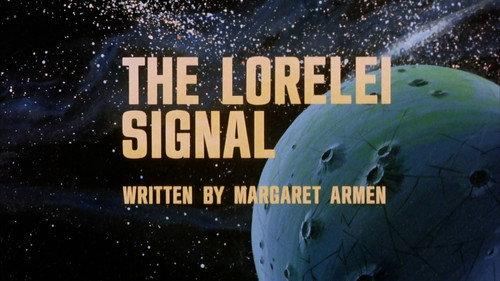
The USS Enterprise (NCC-1701) investigates a sector of space where numerous Federation and other starships have mysteriously vanished over 150 years, precisely every 27.346 star years. As they approach the next predicted disappearance, a powerful subspace radio signal emanates from the distant Taurean system. This signal, perceived as music by Lieutenant Nyota Uhura, exerts a strange, compelling influence on the male crew members, including Captain James T. Kirk, Spock, and Chief Engineering Officer Montgomery Scott, causing them to experience vivid audio-visual suggestions and an irresistible urge to follow its source. Female crew members, however, remain unaffected.
Concerned by the escalating effects on his male crew, James T. Kirk leads a scouting party to Planet Two in the Taurean system to investigate the source of the enigmatic signal. Upon arrival, they discover an advanced civilization and are greeted by a group of beautiful, blond humanoid females. The true nature of the signal and the intentions of these inhabitants soon become apparent, posing a grave and rapidly accelerating threat to the male members of the USS Enterprise (NCC-1701) and potentially all men aboard.
LCARS Tactical Mission Registry: A detailed reconstruction of chronological events and narrative progression compiled from historical logs and mission briefs.
The USS Enterprise (NCC-1701) embarks on a mission into an uncharted sector of space, where a chilling pattern of starship disappearances has been observed over the past 150 years, occurring precisely every 27.346 star years. As the next disappearance window approaches, Captain James T. Kirk orders a Yellow Alert. Lieutenant Nyota Uhura detects a powerful subspace radio signal, which she perceives as music, but Science Officer Spock identifies as a probe originating from the distant Taurean system. The signal exerts a profound, compelling influence on the male crew members, including James T. Kirk, Spock, and Chief Engineering Officer Montgomery Scott, causing them to experience vivid audio-visual suggestions and an irresistible urge to follow its source. Spock likens his vision to a 'Vulcan marriage drum,' while James T. Kirk sees a beautiful woman, and Doctor Leonard McCoy envisions magnolias in blossom. Notably, female crew members like Nyota Uhura and Nurse Christine Chapel remain entirely unaffected by the phenomenon, prompting James T. Kirk to call Doctor Leonard McCoy to the bridge for a medical assessment, though he too is already under the signal's sway.
Under the signal's growing influence, James T. Kirk leads a scouting party, consisting of himself, Spock, Leonard McCoy, and Lieutenant Carver, to Planet Two in the Taurean system. They discover structures of 'fantastic architecture,' indicative of an incredibly advanced, yet seemingly absent, civilization. Despite Spock's logical caution regarding a 'visual compulsion' and the need to determine the extent of its influence, James T. Kirk, feeling no immediate danger, leads the group into the main complex. Inside, they are greeted by Theela, the 'Head Female,' and other blond humanoid women, who reveal their knowledge of the men's identities, obtained through an 'opto-aud' device. Theela invites the crew to a feast, where the men consume a potent 'nectar' and are subsequently led to 'slumber chambers' to rest, falling into a deep, unnatural sleep. James T. Kirk's log entry reflects his euphoric state, describing the place as 'the answer to all a man's dreams,' highlighting the deceptive allure of their captors.
Aboard the USS Enterprise (NCC-1701), Nurse Christine Chapel and Lieutenant Nyota Uhura analyze the probe data, discovering that the signal is 'severely enervating to humanoid males,' causing increasing weakness and potential death. Recognizing the gravity of the situation and with Montgomery Scott incapacitated by euphoria, Nyota Uhura, as the senior unaffected officer, assumes command of the USS Enterprise (NCC-1701) and orders an all-woman security detail to the transporters. Meanwhile, on Planet Two, the landing party awakens to find themselves greatly aged and weakened, each wearing a glowing headband. Spock, retaining more of his faculties due to his Vulcan physiology, theorizes that these headbands are 'polarized conductors' designed to transfer their 'vital energy' or 'life forces' to the women, explaining the women's increased vitality and the men's rapid aging, estimated at 'ten years per day.' Leonard McCoy grimly calculates they will be dead in four days. Recognizing the dire threat to the entire male crew, Spock volunteers to return to the temple to locate their communicators and contact the ship, leveraging his longer lifespan and internal structure.
Spock successfully uses the 'opto-aud' in the temple to locate their equipment and contacts the USS Enterprise (NCC-1701), requesting an 'all-female rescue party' before being recaptured by Theela's women. Nyota Uhura, Christine Chapel, and a female security detachment transport down to Planet Two, where Theela's initial hostility is met with Uhura's determination. The security officers use phasers on stun to incapacitate the alien women, allowing them to locate the now extremely aged Spock in the slumber chambers. They transport him back to the USS Enterprise (NCC-1701)'s sickbay. Concurrently, James T. Kirk, Leonard McCoy, and Lieutenant Carver, attempting to escape, become trapped in a giant urn that rapidly fills with rainwater during an approaching thunderstorm. From sickbay, Spock, despite his weakened state, instructs a female engineer to divert all available USS Enterprise (NCC-1701) energy, except for minimum life support, into the deflector shields to block the planet's life-draining probe. Nyota Uhura returns to the surface and threatens to destroy the temple, compelling Theela to reveal her species' tragic history via the 'opto-aud.' She explains that their homeworld died, forcing them to Planet Two, where surface radiation drained humanoid energy. The women developed a 'glandular secretion' to survive and manipulate male brains, draining their life force to revitalize themselves every 27 years, making them 'eternal prisoners' unable to age, die, or bear children.
Theela, under duress, uses the 'opto-aud' to reveal the location of James T. Kirk and the others, showing them drowning in water. Nyota Uhura quickly deduces they are trapped in the urn in the garden, not a natural body of water. She and a security officer use their phasers on setting one to destroy the urn, releasing the trapped crew members, who are then quickly transported to the USS Enterprise (NCC-1701)'s sickbay. Nurse Christine Chapel's attempts to reverse the rapid aging prove futile. Spock, however, suggests that the transporter, which holds the 'molecular pattern' of their original bodies from when they beamed down, could be the key to their restoration. This unprecedented and highly risky procedure, with odds of 99.7 to 1 against success, is undertaken by Montgomery Scott, who, despite a severe headache, is no longer affected by the probe. After a tense moment, James T. Kirk, Spock, Leonard McCoy, and Lieutenant Carver are successfully re-patterned and restored to their youthful states. As part of a prearranged agreement, Theela destroys the 'opto-aud,' the device that lured men to their planet. Nyota Uhura arranges for a women-crewed starship to transport the Taurean women to a suitable planet, where, according to Doctor Leonard McCoy, their physiology will return to normal within a few months, offering them a future of 'hope, new learning, perhaps love,' a far better alternative to their grim immortality.
LCARS Tactical Mission Log: Chronological action logs detailing exactly what each character did during the events of this mission, linked directly to personnel dossiers.


Subspace Visual Feed
Sensors & Diagnostic Metrics

Synaptic Lore Link Contexts
Recognizing the dire threat to the entire male crew, Spock volunteers to return to the temple to locate their communicators and contact the ship, leveraging his longer lifespan and internal structure.
From sickbay, Spock, despite his weakened state, instructs a female engineer to divert all available USS Enterprise (NCC-1701) energy, except for minimum life support, into the deflector shields to block the planet's life-draining probe.
Uhura and one of her security officers locate the urn and destroy it with their phasers, on setting one, releasing the water and the trapped crew members.The security officers use phasers on stun to incapacitate the alien women, allowing them to locate the now extremely aged Spock in the slumber chambers.
Recognizing the gravity of the situation and with Montgomery Scott incapacitated by euphoria, Nyota Uhura, as the senior unaffected officer, assumes command of the USS Enterprise (NCC-1701) and orders an all-woman security detail to the transporters.
The lock is magnetic, but Spock is able to disrupt its field with the scanner of the medical tricorder.
The USS Enterprise (NCC-1701) embarks on a mission into an uncharted sector of space, where a chilling pattern of starship disappearances has been observed over the past 150 years, occurring precisely every 27.346 star years.
Mission Registries & Linkages
Subspace Playlists
This registry lists all curated subspace playlists and chronological collections containing this mission.
[ NO ASSOCIATED PLAYLISTS RECORDED ]
Technology
This registry contains all specialized technologies deployed, analyzed, or referenced during this mission.
Location
This registry displays all celestial bodies, planets, starbases, or coordinates charted or visited during this mission.
Starship
This registry lists all vessels encountered, scanned, or active during this mission.
Species & Factions
This registry documents all species, civilizations, and organizational factions contacted or active in this sector during the mission.
Culture & Lore
This registry outlines historical events, cultural traditions, organizations, and database lore referenced during this mission.
Production & Archival Linkages
This registry documents behind-the-scenes production references, draft concepts, star charts, or archival cataloging links officially connected to this mission.
"The aging effect of the Taurean planet's surface radiation on the men who transport to the surface, accelerated though it is by the "focusing headbands," is so similar to that which the surface radiation of Gamma Hydra IV had on all who transported down except for Pavel Chekov, his bloodstream awash in adrenalin (which insulated him from it) from his terror at seeing a dead man in that in the now-apocryphal Star Trek Maps, the depiction of the Taurean system, like that of the Gamma Hydra system, actually included orbits of comets both systems had apparently captured."
"Moreover, the Gamma Hydra and Taurean systems were both shown to be near Algeron Treaty Neutral Zone space, but the apparent connections of these two systems to Romulan Star Empire history, to date, have not been canonically explored."
"Moreover, the Gamma Hydra and Taurean systems were both shown to be near Algeron Treaty Neutral Zone space, but the apparent connections of these two systems to Romulan Star Empire history, to date, have not been canonically explored."
Continuity & Trivia
-
This episode is a prime example of the creative freedom offered by *The Animated Series*, allowing for more fantastical elements and alien designs that would have been cost-prohibitive in live-action.
-
Majel Barrett Roddenberry lent her voice to three distinct characters in this episode: Nurse Christine Chapel, Lieutenant Uhura, and the alluring voice of the Lorelei signal itself, showcasing her versatility.
-
The plot device of the male crew members being incapacitated, forcing the female crew to take control, echoes a similar gender-role reversal seen in the original series' unaired pilot, "The Cage," where Pike is under mental influence, and Number One assumes command.
-
The episode's title is a direct reference to the German legend of the Lorelei, mythical Rhine Maidens known for luring sailors to their doom with enchanting songs, akin to the Sirens of Greek mythology.Sources: Memory Alpha
-
Gene Roddenberry had previously explored a similar story concept for an unproduced *Star Trek: The Original Series* treatment titled "The Venus Planet."Sources: Memory Alpha
-
Elements from "The Lorelei Signal" were later integrated into the *Voyager* episode "Favorite Son," and its unique transporter-based solution for rapid aging was also notably featured in the *The Next Generation* episode "Unnatural Selection."Sources: Memory Alpha
-
Actress Nichelle Nichols not only voiced Uhura but also provided voices for three additional characters, totaling four roles in this episode, and was personally thrilled to portray Uhura taking command, exclaiming "At last!" during script readings.Sources: Memory Alpha
-
"The Lorelei Signal" marks the only occasion across *Star Trek: The Animated Series*, *The Original Series*, and the *Star Trek* films where Lieutenant Uhura explicitly assumes command of the *Enterprise*, fulfilling Gene Roddenberry's long-held desire to showcase her as a capable commander.Sources: Memory Alpha