Mission Briefing
The USS Enterprise (NCC-1701-D) arrives at Starbase 173, where its routine port call is interrupted by the arrival of Commander Bruce Maddox from the Daystrom Technological Institute. Commander Maddox, a Starfleet cyberneticist, expresses his intention to perform a comprehensive study of Lieutenant Commander Data, which involves disassembling the android. This proposal immediately raises profound concerns regarding Data's autonomy and well-being.
Captain Jean-Luc Picard objects strenuously, but Commander Maddox presents Starfleet transfer orders for Data. This sets the stage for a monumental ethical and legal confrontation that challenges the very definition of life and personhood within the United Federation of Planets. Captain Phillipa Louvois, the Judge Advocate General for Sector 23, is compelled to convene a formal hearing to determine whether Data is merely Starfleet property or possesses fundamental rights. This unprecedented proceeding forces Captain Jean-Luc Picard to defend Data, while Commander William T. Riker is assigned the difficult role of arguing against Data's personhood. The outcome will have far-reaching implications for Starfleet and all sentient beings.
LCARS Tactical Mission Registry: A detailed reconstruction of chronological events and narrative progression compiled from historical logs and mission briefs.
The USS Enterprise (NCC-1701-D), under the command of Captain Jean-Luc Picard, arrives at Starbase 173 for a routine port call and crew rotation. The tranquility is shattered by the arrival of Commander Bruce Maddox, a Starfleet cyberneticist from the Daystrom Technological Institute, who expresses a long-standing desire to study Lieutenant Commander Data. Commander Bruce Maddox, who previously opposed Data's entry into Starfleet Academy on the grounds of non-sentience, reveals his intention to disassemble Data to replicate his unique positronic brain and create an army of similar androids. Data initially finds the prospect 'intriguing' but quickly raises concerns about Commander Bruce Maddox's incomplete research, specifically regarding the electron resistance across neural filaments and the preservation of the 'ineffable quality' of memory. Despite Captain Jean-Luc Picard's objections, Commander Bruce Maddox produces Starfleet transfer orders, reassigning Data to his command at Starbase 173, setting the stage for a profound ethical and legal confrontation.
In a desperate attempt to protect his autonomy, Data, after a poignant discussion with Captain Jean-Luc Picard, resigns from Starfleet. This unexpected move forces Commander Bruce Maddox to seek a legal remedy, leading to a meeting with Captain Phillipa Louvois, the Judge Advocate General for the Twenty-third Sector. Captain Phillipa Louvois, a former romantic interest and the prosecutor in Captain Jean-Luc Picard's Stargazer court martial, initially rules that Data is Starfleet property based on the Acts of Cumberland from the early 21st century, and therefore cannot resign or refuse the procedure. Unwilling to accept this, Captain Jean-Luc Picard challenges the ruling, compelling Captain Phillipa Louvois to convene a formal hearing. In a difficult decision, Captain Phillipa Louvois assigns Captain Jean-Luc Picard as Data's defense counsel and, to his profound dismay, forces Commander William T. Riker to serve as the prosecutor, arguing that Data is merely a machine.
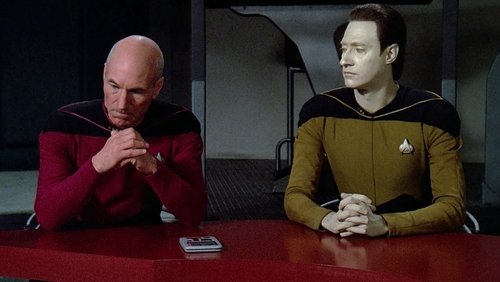
The hearing commences on Stardate 42527.4, with Commander William T. Riker delivering a devastating opening argument. He calls Data to the stand, highlighting his mechanical nature, immense computational speed (eight hundred quadrillion bits of storage, sixty trillion operations per second), and superhuman strength, demonstrated by bending a rod of par-steel. Commander William T. Riker's most impactful move is requesting to remove Data's hand for inspection, a symbolic act that reduces Data to a mere collection of 'neural nets and heuristic algorithms,' concluding with the poignant statement, 'Pinocchio is broken. Its strings have been cut.' This powerful presentation almost convinces Captain Jean-Luc Picard himself, leading to a recess where he seeks counsel from Guinan in Ten Forward. Guinan's insightful analogy of 'disposable creatures' and the historical precedent of slavery clarifies the true stakes for Captain Jean-Luc Picard: the potential creation of a subservient 'race' of androids, devoid of rights.
Armed with this renewed understanding, Captain Jean-Luc Picard returns to the courtroom for his defense. He argues that Data's mechanical nature is irrelevant, as humans are also 'machines of a different type,' and that creation does not equate to ownership, drawing a parallel to children and their parents' DNA. He calls Data to the stand, eliciting responses that demonstrate Data's personal values, such as his desire to keep his medals and a gift from Captain Jean-Luc Picard, and his deep affection for the late Lieutenant Tasha Yar, revealing a capacity for sentimentality and loyalty beyond mere programming. Captain Jean-Luc Picard then calls Commander Bruce Maddox as a hostile witness, systematically challenging his definition of sentience (intelligence, self-awareness, consciousness). He forces Commander Bruce Maddox to concede Data's intelligence and self-awareness, leaving only 'consciousness' as the unproven criterion. Captain Jean-Luc Picard's impassioned closing statement warns against the dangers of denying Data's personhood, equating it to 'servitude and slavery' and reminding the court that Starfleet was founded to 'seek out new life.'
Captain Phillipa Louvois, acknowledging the profound philosophical implications, delivers her landmark ruling: Data is a machine, but he is not the property of Starfleet. She grants Data the 'freedom to choose,' stating that he must be given the liberty to explore the question of whether he possesses a soul. Data immediately exercises this right, formally refusing Commander Bruce Maddox's procedure but, in a gesture of scientific curiosity and goodwill, encourages Commander Bruce Maddox to continue his research, offering his cooperation when the science is more advanced. Commander Bruce Maddox, visibly moved, acknowledges Data's remarkable nature, and Captain Phillipa Louvois notes his shift from referring to Data as 'it' to 'he.' The episode concludes with a moment of reconciliation between Commander William T. Riker and Data, as Data expresses gratitude for Commander William T. Riker's difficult role in the trial, recognizing that his prosecution, though painful, was necessary to secure Data's freedom. This pivotal episode not only secures Data's individual rights but also fundamentally redefines the Federation's understanding of artificial life and the boundaries of personal liberty.
LCARS Tactical Mission Log: Chronological action logs detailing exactly what each character did during the events of this mission, linked directly to personnel dossiers.



Subspace Visual Feed
Sensors & Diagnostic Metrics
Visual Sensor Logs


Synaptic Lore Link Contexts
Commander Bruce Maddox expresses a profound interest in Lieutenant Commander Data (android), revealing his intention to study and potentially disassemble Data (android) to replicate his unique positronic brain.
The USS Enterprise (NCC-1701-D), under the command of Captain Jean-Luc Picard, arrives at Starbase 173 for a routine port call.
While they reminisce and tease each other playfully, the pair is approached by Admiral Nakamura, accompanied by Commander Bruce Maddox, a Starfleet cyberneticist.However, the mission takes an unexpected turn with the arrival of Commander Bruce Maddox, a Starfleet cyberneticist from the Daystrom Technological Institute.
The USS Enterprise (NCC-1701-D), under the command of Captain Jean-Luc Picard, arrives at Starbase 173 for a routine port call.
Maddox and Data greet each other with familiarity; Data explains to Picard that Maddox was the sole member of a Starfleet special admissions panel to oppose Data's admission to Starfleet Academy, on the basis that Data was not a sentient lifeform, who briefly looks annoyed with the memory.
Maddox, prepared for this eventuality, produces orders from Starfleet Command separating Data from the Enterprise and transferring him to Starbase 173, under Maddox's command.
Among the gifts, Worf presents him with a copy of The Dream of the Fire, a classic Klingon novel by K'Ratak.
Data initially finds the prospect 'intriguing' but quickly raises concerns about Commander Bruce Maddox's incomplete research, specifically regarding the electron resistance across neural filaments and the preservation of the 'ineffable quality' of memory.
Mission Registries & Linkages
Subspace Playlists
This registry lists all curated subspace playlists and chronological collections containing this mission.
Technology
This registry contains all specialized technologies deployed, analyzed, or referenced during this mission.
Location
This registry displays all celestial bodies, planets, starbases, or coordinates charted or visited during this mission.
Starship
This registry lists all vessels encountered, scanned, or active during this mission.
Species & Factions
This registry documents all species, civilizations, and organizational factions contacted or active in this sector during the mission.
Culture & Lore
This registry outlines historical events, cultural traditions, organizations, and database lore referenced during this mission.
Production & Archival Linkages
This registry documents behind-the-scenes production references, draft concepts, star charts, or archival cataloging links officially connected to this mission.
"Data would refer back to his trial in his decision to champion the exocomps in Season 6's . He explains to Picard that while he had Picard to defend him, the Exocomps had no one to defend their rights."
"The Positronic brain is a critical component featured in this episode."
"The Daystrom Institute, first mentioned here, was a homage to the character of Richard Daystrom from . ()"
"Admiral Nakamura tells Picard that Starbase 173 has been established in response to disturbances along the Federation/Romulan Neutral Zone, which were first referenced the episode . These disturbances will later be revealed to be early attacks by the Borg."
"Admiral Nakamura tells Picard that Starbase 173 has been established in response to disturbances along the Federation/Romulan Neutral Zone, which were first referenced the episode . These disturbances will later be revealed to be early attacks by the Borg."
"Admiral Nakamura tells Picard that Starbase 173 has been established in response to disturbances along the Federation/Romulan Neutral Zone, which were first referenced the episode . These disturbances will later be revealed to be early attacks by the Borg."
"Admiral Nakamura tells Picard that Starbase 173 has been established in response to disturbances along the Federation/Romulan Neutral Zone, which were first referenced the episode . These disturbances will later be revealed to be early attacks by the Borg."
Continuity & Trivia
-
Jonathan Frakes, who played Commander Riker, found his role as prosecutor extremely challenging and morally conflicted, as it required him to argue against a character his own was deeply bonded with.
-
Gene Roddenberry, Star Trek's creator, was reportedly so impressed with the episode that he declared it 'the episode that makes the statement for Star Trek', highlighting its core philosophical themes.
-
Creator Gene Roddenberry nearly rejected the script, as his vision of the 24th century featured no lawyers and believed criminal intentions would be 'made right'.Sources: Memory Alpha
-
The episode's spec script was "discovered" and utilized due to the 1988 Writers Guild of America strike, which created a need for existing material.Sources: Memory Alpha
-
"The Measure Of A Man" marked Melinda Snodgrass' first television writing credit, and she drew from her personal experience as an attorney for the story.Sources: Memory Alpha
-
The iconic courtroom set was a redress of the Star Trek: The Original Series movie bridge, which had previously been modified to serve as TNG's battle bridge.Sources: Memory Alpha
-
A special "extended edition" of the episode was released on the TNG Season 2 Blu-ray, featuring approximately thirteen minutes of restored footage cut from the original broadcast.Sources: Memory Alpha