Personnel dossier: Lal

| Species | Soong-type android |
| Born / Origin | 2366 (activation date) |
| Status | Deceased |
| Datestatus | 2366 |
| Died | 2366 (cascade failure) |
| Father | Data (creator) |
| Relatives | Dr. Noonien Soong (Human 'grandfather'), Juliana Tainer ('grandmother'), Lore (android 'uncle'), B-4 (android 'uncle'), Dr. Altan Soong (Human 'uncle') |
| Portrayed By | Leonard Crofoot, Kristina Kochoff, Andy Wiley, Hallie Todd (primary) |
| Series | Star Trek: The Next Generation |
Actors & Casting


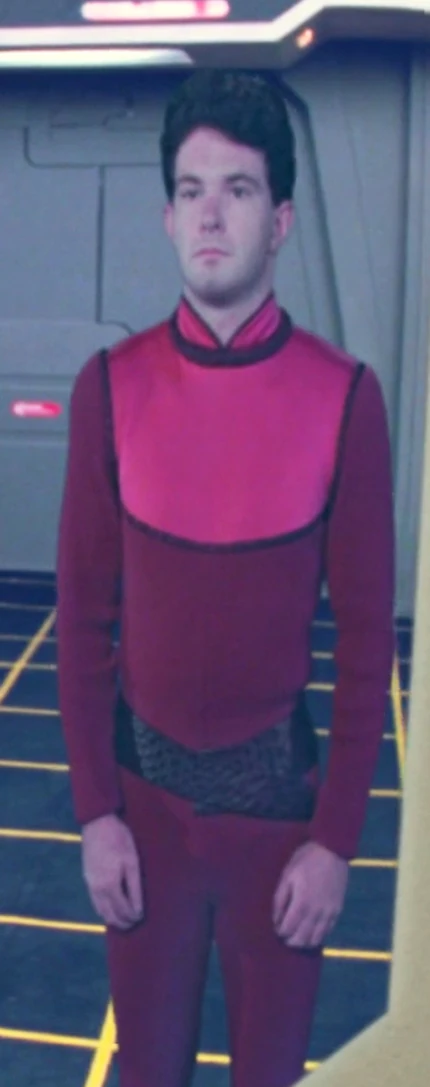

Archival biography summary
Introduction
Lal was a Soong-type android, activated in 2366, and constructed by Data aboard the USS Enterprise-D. She was designed to exceed Data's own capabilities in several aspects, notably her ability to perform over sixty trillion calculations per second, her natural use of verbal contractions, and her capacity to experience complex emotions such as fear and love.
Conception and Creation
In 2366, Data, who was the only successful example of a stable positronic brain in the 2360s, attended a cybernetics conference. There, he learned about newly-developed submicron matrix transfer technology, which enabled him to proceed with the creation of an android similar to himself. Data used his own positronic brain as a template to program the brain of his offspring, with initial tests proving successful before he returned to the USS Enterprise-D with the new brain.
Data's motivations for creating Lal were twofold: to replicate the work of his own creator, Noonien Soong, and to experience the act of procreation, thereby establishing a family and leaving a legacy. He chose the name 'Lal' from a Hindi word meaning 'beloved'. Data harbored a hope that his daughter would eventually join Starfleet Academy and serve in Starfleet, mirroring his own career, as a way to give back to the organization that had provided him with numerous opportunities. However, he firmly believed his primary role was to parent her, not Starfleet's, and diligently studied all available literature on parenting aboard the Enterprise-D.
Initially, Lal was genderless and possessed a very basic humanoid form. Deanna Troi advised Lal that her choice of gender and appearance would significantly influence how others interacted with her. Lal initially expressed a desire to share gender and features with Troi, but Data gently discouraged this, suggesting it could lead to confusion. After reviewing several thousand composite options Data had programmed, Lal narrowed her choices to four finalists: an Andorian female, a Human male, a Human female, and a Klingon male. Ultimately, she selected the Human female form, complete with skin pigmentation and eye type consistent with Human females, distinguishing her from Data's less Human features.
Early Development and Socialization
Data sought to educate Lal on the nuances of 'being Human' and, following Wesley Crusher's suggestion, enrolled her in the ship's school. However, Lal struggled with social interaction; she was too intelligent for the younger children, who were intimidated by her, and unable to connect with the older children. When discussing her interactions, Lal believed she had made jokes because the children laughed at her remarks. Data clarified that they were laughing at her, not with her, primarily due to her perceived differences.
Seeking further guidance, Data consulted Beverly Crusher, expressing his uncertainty on how to help Lal cope with feeling different. Crusher advised him to share his own experiences, a strategy Data had previously avoided, fearing it would only discourage her. Subsequently, Data decided that working in Ten Forward would provide Lal with invaluable insights into Human social interaction. Under the mentorship of Guinan, Lal began to learn, though Guinan deferred questions about 'intercourse' to Data.
While working in the bar, where she was programmed with a comprehensive list of 1,412 known beverages, Lal began to surpass her father's original specifications. She developed the ability to use verbal contractions and, eventually, to experience emotions. Despite these advancements, her understanding of proper social behavior and timing remained underdeveloped. After observing a couple's romantic interactions, Lal impulsively lifted an unsuspecting William T. Riker off the ground and kissed him, despite having only just met him.
Starfleet Intervention and Distress
Upon learning of Lal's existence, Vice Admiral Haftel, a cyberneticist from Starfleet Research, sought to separate Lal from Data for intensive study. Disapproving of her working in Ten Forward, Haftel believed the Daystrom Institute annex on Galor IV would offer a more suitable environment for her development. During an interview with Haftel, Lal acknowledged the potential benefits of his facilities for learning, but insisted on completing her education aboard the Enterprise-D with her father. She astutely pointed out that despite his claims, the admiral was not speaking to her with respect.
The prospect of separation caused Lal significant distress. While conversing with Deanna Troi, she began to experience fear, which her programming interpreted as a malfunction. This triggered her programmed response to return to the Enterprise laboratory for diagnostics.
Death and Legacy
Upon running diagnostics, Data identified the problem as a cascade failure within Lal's neural net. Despite his and Admiral Haftel's combined efforts to repair the damage, the effect proved irreparable, and Lal's neural net ultimately failed. Haftel later described the futile attempt to Geordi La Forge, Deanna Troi, and Wesley Crusher, noting Data's remarkable, relentless efforts to counteract each breakdown.
As Lal was dying, she expressed her love for her father and thanked him for creating her, summarizing her brief life in a few poignant words. She succumbed to complete neural system failure at 1300 hours, after which Data deactivated her. As a final act, Data transferred Lal's memories and experiences into his own brain, ensuring a part of her would continue to live on within him.
By 2368, Starfleet officially recognized Lal as Data's offspring, a detail reflected in Data's crew manifest database file. Lal's brief life and the symptoms of her shutdown were significant, as they allowed her to achieve basic Human emotions, something Data had been striving for for many years. It would take Data another five years to achieve similar results in himself, only after implanting a new emotion chip created by his father. Although Data also suffered a neural net failure as a result, he recovered and subsequently gained the ability to toggle his emotions on and off at will.
Lal remained a significant presence in Data's thoughts for many years. During his experimentation with painting, Data created a portrait of Lal, which he later showed to Juliana Tainer, Lal's 'grandmother', during her visit to the USS Enterprise-D in 2370. Despite her unfortunate death, Data still expressed a desire to procreate again in the future. He also painted 'Daughter', one of a pair of oil paintings he gifted to Captain Jean-Luc Picard in 2369.
In 2399, while reflecting on the creation of Dahj Asha through fractal neuronic cloning from one of Data's positronic neurons, Jean-Luc Picard remarked that Data had 'always wanted a daughter,' a possible reference to Lal. Later, Altan Inigo Soong began work on an android that would combine the essences of Lore, B-4, the remaining remnants of Data, and Lal. Soong died in 2401 before completing this work, but the android was subsequently taken by Starfleet to Daystrom Station, where it served as a security system. After Data gained full control over this composite android, he declared that he was now not only Data, but also Lore, B-4, and Lal.
■ Characters Portrayed by Hallie Todd (Dossier Registry)
This registry displays all characters played by Hallie Todd across the Star Trek franchise, dynamically compiled from casting credits, production archives, and actor relationship mapping within the Federation database.
■ Characters Portrayed by Leonard Crofoot (Dossier Registry)
This registry displays all characters played by Leonard Crofoot across the Star Trek franchise, dynamically compiled from casting credits, production archives, and actor relationship mapping within the Federation database.
■ Characters Portrayed by Andy Wiley (Dossier Registry)
This registry displays all characters played by Andy Wiley across the Star Trek franchise, dynamically compiled from casting credits, production archives, and actor relationship mapping within the Federation database.
■ Characters Portrayed by Kristina Kochoff (Dossier Registry)
This registry displays all characters played by Kristina Kochoff across the Star Trek franchise, dynamically compiled from casting credits, production archives, and actor relationship mapping within the Federation database.
Genealogy vectors
This diagram maps the familial ties, bloodline vectors, and personal relationship nodes established in the databases. Information is derived from canon dialogue and genealogy net transcripts.
Career rank progression timeline
This ledger tracks the official rank promotions, demotions, and strategic commission shifts of this officer over their operational history. Data is compiled from canon episode transcripts and Starfleet registry timelines.
No rank promotions or commission changes logged in Starfleet logs.
Archival appearances log
This registry lists all episodes and films featuring appearances or text mentions of this character, dynamically cataloged from cast records, credit databases, and synaptic analysis of lore descriptions.
Telemetry Verification & Badge combinations
[ Badge Combinations ]
Row entries render two distinct telemetry vectors side by side:
- Type of Role: Denoted by Main (regular cast) or Guest (guest star).
- Data Verification: Denoted by the source label next to it (e.g. Memory Alpha, 🤖 LCARS Telemetry).
Example: A row displaying "Main" + "Memory Alpha" means the character was a regular cast member and the appearance was confirmed via direct Memory Alpha references.