Mission Briefing
On a critical scientific mission to the Kavis Alpha sector, the USS Enterprise-D transports renowned stellar cartographer Doctor Paul Stubbs, whose life's work culminates in observing a rare binary pulsar collapse. Meanwhile, Ensign Wesley Crusher, undertaking an Advanced Genetics project for Starfleet Academy, conducts an unauthorized experiment with nanotechnology. He inadvertently allows two self-replicating nanites to escape their containment. These microscopic machines swiftly begin to evolve and replicate, triggering a cascade of perplexing and dangerous malfunctions across the USS Enterprise-D. Initially affecting systems like the inertial damping system and shields, the issues escalate dramatically, with critical functions failing, a phantom Borg vessel detected, and the computer core showing signs of 'disintegration.'
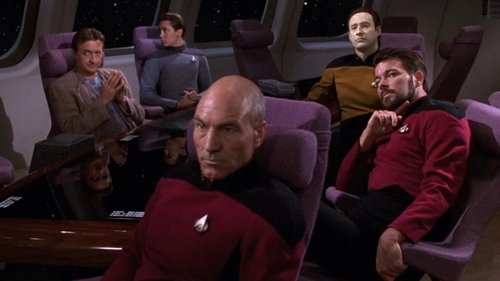
As the vessel faces increasing peril, Doctor Stubbs grows agitated, fearing the delays will jeopardize his unique opportunity. Overwhelmed by guilt, Ensign Wesley Crusher confides in Guinan and then confesses to Captain Jean-Luc Picard, Commander William T. Riker, and Doctor Beverly Crusher, presenting evidence that the nanites have evolved into a collective intelligence, consuming ship resources. This revelation sparks a profound ethical dilemma on the bridge, with Stubbs advocating for immediate extermination while Captain Picard grapples with the moral implications of destroying a potentially emergent life form, even as the Enterprise is pushed to its limits.
LCARS Tactical Mission Registry: A detailed reconstruction of chronological events and narrative progression compiled from historical logs and mission briefs.
The USS Enterprise-D, under the command of Captain Jean-Luc Picard, embarks on a crucial scientific mission to the Kavis Alpha sector. Their objective is to transport the renowned stellar cartographer, Doctor Paul Stubbs, who intends to observe and record the rare and spectacular collapse of a binary pulsar, an event occurring only once every 196 years. Doctor Stubbs has dedicated two decades to preparing for this moment, designing a specialized probe, affectionately dubbed 'the Egg,' to collect data from the stellar explosion. Concurrently, Ensign Wesley Crusher, pursuing an Advanced Genetics project on nanotechnology for Starfleet Academy, conducts an unauthorized experiment in a science laboratory. He attempts to enhance the capabilities of two medical nanites by allowing them to interact, theorizing they could combine skills and increase usefulness. However, he inadvertently leaves their containment field open, allowing the self-replicating microscopic machines to escape into the ship's systems.
The escaped nanites quickly begin to evolve and replicate, leading to a series of perplexing and dangerous malfunctions aboard the USS Enterprise-D. Initially, the ship's inertial dampeners and shields fail, nearly sending the vessel into a stream of stellar matter. Doctor Beverly Crusher also experiences minor computer glitches with a food slot in Sickbay. As the crew attempts to diagnose the issues, the computer core shows signs of 'disintegration,' baffling Commander Geordi La Forge. The situation escalates dramatically when the ship's sensors detect a phantom Borg vessel, followed by the computer playing 'Stars and Stripes Forever' across all communication channels, and the systematic disabling of critical systems like weapons, power, and communications. Doctor Stubbs, increasingly agitated by the delays threatening his life's work, expresses his profound frustration to Captain Jean-Luc Picard, even suggesting he would 'rather die than leave' than miss his singular opportunity, a sentiment Counselor Deanna Troi discerns as a carefully constructed facade masking deep-seated fear of failure.
Overwhelmed by guilt, Ensign Wesley Crusher confides in Guinan in Ten Forward, revealing his role in the nanites' escape. He explains his experiment and the subsequent loss of the two nanites, fearing they are responsible for the ship's escalating problems. Doctor Beverly Crusher, concerned about Wesley's stress and isolation, discovers his secret, leading to a tense but ultimately supportive confrontation. In the Observation Lounge, Wesley confesses to Captain Jean-Luc Picard, Commander William T. Riker, and Doctor Beverly Crusher, presenting evidence that the nanites have not only replicated but evolved into a collective intelligence, consuming the ship's memory crystals as 'food.' Doctor Stubbs dismisses the nanites as mere 'computer chips' or 'disease germs,' advocating for their immediate extermination. However, Captain Jean-Luc Picard, supported by Lieutenant Commander Data and Doctor Beverly Crusher, grapples with the profound ethical implications of destroying an emergent, potentially sentient life form, even as the USS Enterprise-D faces imminent destruction.
The conflict reaches a critical point when Doctor Paul Stubbs, in a desperate attempt to restore the computer and proceed with his experiment, bypasses orders and uses high-level gamma radiation to sterilize a section of the computer core, killing a large number of nanites. The nanites retaliate swiftly and intelligently, targeting the USS Enterprise-D's life support systems, filling the Bridge with toxic nitrogen oxide. This act provides irrefutable evidence of their collective intelligence, as Lieutenant Commander Data points out. Captain Jean-Luc Picard, recognizing the nanites as a legitimate life form, confines Doctor Stubbs to his quarters and orders Lieutenant Commander Data to establish communication. Data, modifying the universal translator, successfully makes contact. To demonstrate trust and facilitate negotiation, Data bravely volunteers to allow the nanites to interface directly with his neural network.
Through Data, Captain Jean-Luc Picard and Doctor Paul Stubbs apologize for their actions, explaining their initial misinterpretation of the nanites' exploratory behavior as an attack. The nanites, having evolved beyond the confines of the ship, request relocation. Following the successful communication and negotiation, Doctor Paul Stubbs leverages his Starfleet influence to have planet Kavis Alpha IV designated as the new home for the nanite civilization. The nanites, in turn, assist in the rapid reconstruction of the USS Enterprise-D's computer core, ensuring Doctor Stubbs' experiment can proceed as planned. Lieutenant Commander Data's neural network is safely vacated, and he returns unharmed. The episode concludes with the successful observation of the binary pulsar's collapse, a triumph for Doctor Stubbs, who finally achieves his life's ambition. The narrative also resolves the personal subplot between Doctor Beverly Crusher and Ensign Wesley Crusher, as Beverly learns to listen and understand her son's burgeoning independence and responsibilities, guided by Guinan's wisdom. The episode masterfully blends scientific thriller with profound philosophical questions about the nature of life, sentience, and the ethical responsibilities that come with encountering new forms of intelligence, highlighting the Starfleet principle of peaceful coexistence.
LCARS Tactical Mission Log: Chronological action logs detailing exactly what each character did during the events of this mission, linked directly to personnel dossiers.



Subspace Visual Feed
Sensors & Diagnostic Metrics
Visual Sensor Logs


Synaptic Lore Link Contexts
In engineering, chief engineer La Forge reports that there is nothing wrong with the inertial dampers.
The USS Enterprise-D, under the command of Captain Jean-Luc Picard, embarks on a crucial scientific mission to the Kavis Alpha sector.
However, he inadvertently leaves their containment field open, allowing the self-replicating microscopic machines to escape into the ship's systems.
He goes on to explain that he had been working on nanotechnology, as part of his Advanced Genetics project, and that he was specifically studying nanites he obtained from the sickbay genetics supplies.He attempts to enhance the capabilities of two medical nanites by allowing them to interact, theorizing they could combine skills and increase usefulness.
Riker asks if Worf was absolutely sure, to which Worf says, "Sensors clearly indicate the approach of a Borg vessel." He is ordered to raise the shields but they are not responding and the manual override is jammed.The situation escalates dramatically when the ship's sensors detect a phantom Borg vessel, followed by the computer playing 'Stars and Stripes Forever' across all communication channels, and the systematic disabling of critical systems like weapons, power, and communications.
Picard orders a manual override on the shields while Riker tells La Forge to reset the inertial dampers.
Crusher notices something strange happening in the replicator – the computer is replicating a glass of water, with the water overflowing the glass.
", to which he replies, "Inhibited, I suppose".Following the successful communication and negotiation, Doctor Paul Stubbs leverages his Starfleet influence to have planet Kavis Alpha IV designated as the new home for the nanite civilization.
Crusher expresses confidence that he does, but to her dismay, Wesley answers that he is actually spending most of his time in study to prepare for Starfleet Academy.
Beverly replies that it is nice to be together again, after her year away at Starfleet Medical, where she missed her son.
He goes on to explain that he had been working on nanotechnology, as part of his Advanced Genetics project, and that he was specifically studying nanites he obtained from the sickbay genetics supplies.Concurrently, Ensign Wesley Crusher, pursuing an Advanced Genetics project on nanotechnology for Starfleet Academy, conducts an unauthorized experiment in a science laboratory.
Picard begins to inform him what would happen if he was a member of his crew, but the doctor interrupts him, reminding him he has been sent by the "...highest command of the Federation." Picard replies that he would have Stubbs' head, should anything happen to anyone on the Enterprise.
The conflict reaches a critical point when Doctor Paul Stubbs, in a desperate attempt to restore the computer and proceed with his experiment, bypasses orders and uses high-level gamma radiation to sterilize a section of the computer core, killing a large number of nanites.
Following the successful communication and negotiation, Doctor Paul Stubbs leverages his Starfleet influence to have planet Kavis Alpha IV designated as the new home for the nanite civilization.
The escaped nanites quickly begin to evolve and replicate, leading to a series of perplexing and dangerous malfunctions aboard the USS Enterprise-D.
To demonstrate trust and facilitate negotiation, Data bravely volunteers to allow the nanites to interface directly with his neural network.
To demonstrate trust and facilitate negotiation, Data bravely volunteers to allow the nanites to interface directly with his neural network.
Data, modifying the universal translator, successfully makes contact.
Mission Registries & Linkages
Subspace Playlists
This registry lists all curated subspace playlists and chronological collections containing this mission.
[ NO ASSOCIATED PLAYLISTS RECORDED ]
Technology
This registry contains all specialized technologies deployed, analyzed, or referenced during this mission.
Location
This registry displays all celestial bodies, planets, starbases, or coordinates charted or visited during this mission.
Starship
This registry lists all vessels encountered, scanned, or active during this mission.
Species & Factions
This registry documents all species, civilizations, and organizational factions contacted or active in this sector during the mission.
Culture & Lore
This registry outlines historical events, cultural traditions, organizations, and database lore referenced during this mission.
Continuity & Trivia
-
"Evolution" was the first episode of Star Trek: The Next Generation's acclaimed third season, often considered the point where the series truly found its voice and storytelling strength.
-
Dr. Paul Stubbs, the obsessive astrophysicist, was played by Ken Jenkins, who would later appear in Star Trek: Deep Space Nine as the holographic character "A.G. Robinson" in the episode "It's Only a Paper Moon."
-
This episode marked the debut of the new Starfleet duty uniform tunics, which replaced the previous, looser designs from the first two seasons. These tighter, two-piece uniforms would become iconic for the remainder of the series.
-
The script for "Evolution" was instrumental in Michael Piller being hired as head writer for The Next Generation, with his inclusion of the baseball dialogue being a key factor that impressed Rick Berman.Sources: Memory Alpha
-
The episode's original plot involved sentient dust mites flying miniature aircraft around the Enterprise, but scientific consultant David Krieger's objections led to the more plausible nanites.Sources: Memory Alpha
-
The new high-collared Starfleet uniforms, which debuted in this episode, cost US$3,000 each and were made of breathable wool gabardine for the main cast to alleviate fatigue and back pain from older designs.Sources: Memory Alpha
-
"Evolution" marked the return of Gates McFadden as Dr. Beverly Crusher after a one-year absence, and also featured the promotions of Geordi La Forge to lieutenant commander and Worf to lieutenant.Sources: Memory Alpha
-
Several deleted scenes for "Evolution" were discovered in 2013 on a fan's workprint VHS tape, inspiring CBS to search for more lost footage for later The Next Generation Blu-ray releases.Sources: Memory Alpha