Mission Briefing
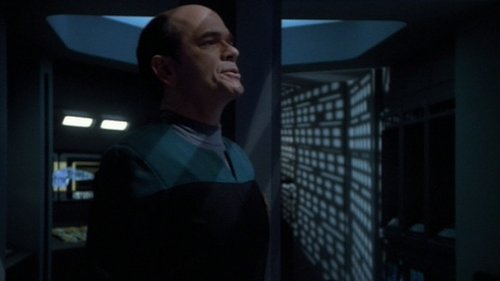
Seven hundred years after USS Voyager's supposed passage through a distant quadrant, a backup copy of The Doctor's program is reactivated in the Museum of Kyrian Heritage. He awakens to a shocking reality: USS Voyager is remembered as a 'warship' that committed horrific atrocities, including genocide, against the Kyrian people, fundamentally altering their history and relationship with the Vaskans. The museum's exhibits portray Captain Kathryn Janeway and her crew as ruthless aggressors, responsible for immense suffering and the rise of the Vaskan dynasty. The Doctor, a 'living witness' to the actual events, is outraged by this distorted historical narrative and finds himself accused of war crimes, facing the threat of de-compilation. He must now confront a deeply entrenched, centuries-old historical account that paints his ship and crew as villains, while attempting to prove the truth of USS Voyager's mission as explorers.
LCARS Tactical Mission Registry: A detailed reconstruction of chronological events and narrative progression compiled from historical logs and mission briefs.
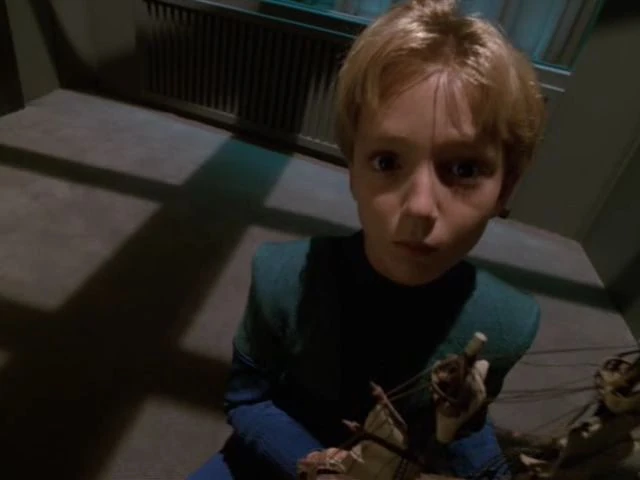
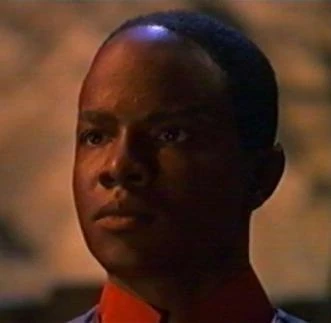
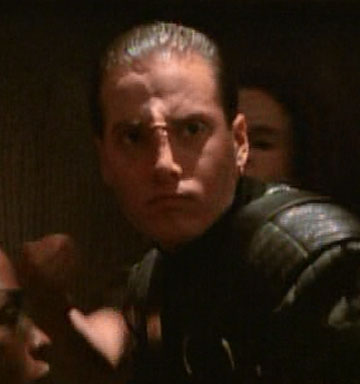
The episode 'Living Witness' opens in a chilling holographic simulation within the Museum of Kyrian Heritage, set seven hundred years after USS Voyager's supposed encounter with the Kyrian and Vaskan peoples. This simulation portrays Captain Kathryn Janeway as a ruthless warmonger, negotiating with Vaskan Ambassador Daleth to use USS Voyager's advanced technology to annihilate the Kyrians. Janeway, depicted with short hair and black gloves, orders the use of biogenic weapons, integrated into the ship's phasers by an android version of The Doctor, to commit genocide against the Kyrian population to force their leader, Tedran, out of hiding. The simulation further shows Commander Chakotay and Lieutenant Harry Kim torturing a Kyrian prisoner, and a fully Borg Seven of Nine assimilating captured Kyrian intruders in engineering. Captain Janeway is even shown personally executing Tedran and his accomplice. This 'history' is presented by the Kyrian curator, Quarren, to a mixed group of Kyrians and Vaskans, emphasizing USS Voyager's role as a 'Warship Voyager' that brought the Vaskans to power and oppressed the Kyrians for centuries.
During the museum tour, a Vaskan visitor challenges the historical accuracy, prompting Quarren to reveal a recently discovered data storage device from USS Voyager, found nine meters beneath the ruins of Kesef. This device, believed to contain personal logs, is hoped to provide definitive proof. Later, Quarren successfully accesses the device, which turns out to be a backup copy of The Doctor's program. Reactivated after seven centuries, The Doctor is disoriented and horrified to find himself in a future where USS Voyager is remembered as a genocidal warship. He vehemently denies the accusations of war crimes, pointing out numerous inaccuracies in the Kyrian historical recreation, such as USS Voyager's destination being Mars instead of Earth, and the crew's uncharacteristic, violent behavior. Quarren, initially dismissive, is forced to reconsider when The Doctor, a 'living witness' to the actual events, challenges the entire narrative as revisionist history designed to bolster Kyrian cultural identity.
Convinced by The Doctor's insistence and the undeniable fact that he is a hologram, not an android, Quarren allows him to create his own holographic recreation of USS Voyager's encounter. The Doctor's version depicts Captain Kathryn Janeway negotiating a dilithium trade with Ambassador Daleth, only for USS Voyager to be attacked and boarded by Kyrian raiders led by Tedran. Three engineering crewmen are killed, and Seven of Nine is taken hostage. During the ensuing confrontation in the mess hall, security subdues the Kyrians, but Ambassador Daleth seizes the opportunity to shoot and kill Tedran with a Vaskan weapon, not a Starfleet phaser. The Doctor presents this as proof that USS Voyager was not responsible for Tedran's death, condemning it as 'a tragic, needless death.' While a Kyrian arbiter dismisses The Doctor's recreation as fiction, the Vaskan arbiters are more receptive, as their people have historically been painted as the aggressors. The Doctor offers to prove his account by reactivating a medical tricorder from the museum, which contains Tedran's bio-readings, to show he was killed by a Vaskan weapon.
As The Doctor and Quarren work to reactivate the medical tricorder, a mob storms the museum, destroying artifacts and displays. The new revelations have ignited long-simmering tensions between the Kyrians and Vaskans, leading to riots and even talk of another war. The Doctor, witnessing the chaos, suggests his program be deleted, believing his continued presence is causing more harm than good. He argues that history is open to interpretation and that taking away Tedran's status as a martyr might be wrong. However, Quarren passionately refutes this, insisting that The Doctor's firsthand account is crucial to correcting a history that has been abused for centuries, preventing further conflict. The Doctor relents, and they continue their search for the medical tricorder amidst the wreckage.
The episode concludes with a glimpse into the far future, where a new tour guide explains that The Doctor's testimony was a pivotal moment, leading to a dialogue and eventual unity between the Kyrian and Vaskan peoples, ushering in the 'Dawn of Harmony.' Quarren lived long enough to witness the beginning of this peace. The Doctor served as Surgical Chancellor of the united races for many years before departing in a small craft, setting a course for the Alpha Quadrant, attempting to trace USS Voyager's path home, driven by 'a longing for home.' This final scene implies that the entire episode, including the initial museum tour and The Doctor's subsequent experiences, was itself a historical recreation, further emphasizing the fluid and interpretive nature of history.
LCARS Tactical Mission Log: Chronological action logs detailing exactly what each character did during the events of this mission, linked directly to personnel dossiers.







Subspace Visual Feed
Sensors & Diagnostic Metrics
Visual Sensor Logs


Synaptic Lore Link Contexts
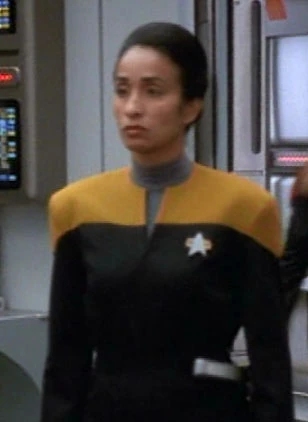
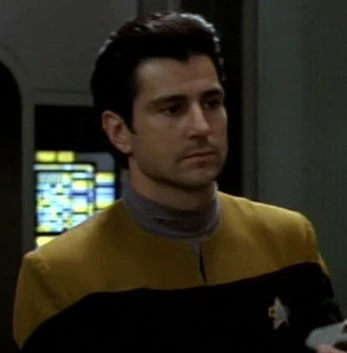
Neelix, at ops and in a gold Starfleet uniform, reports they are under attack by Kyrians.During the ensuing confrontation in the mess hall, security subdues the Kyrians, but Ambassador Daleth seizes the opportunity to shoot and kill Tedran with a Vaskan weapon, not a Starfleet phaser.
A fully Borg Seven of Nine activates in cargo bay two along with three other drones.The simulation further shows Commander Chakotay and Lieutenant Harry Kim torturing a Kyrian prisoner, and a fully Borg Seven of Nine assimilating captured Kyrian intruders in engineering.
Janeway, depicted with short hair and black gloves, orders the use of biogenic weapons, integrated into the ship's phasers by an android version of The Doctor, to commit genocide against the Kyrian population to force their leader, Tedran, out of hiding.
He vehemently denies the accusations of war crimes, pointing out numerous inaccuracies in the Kyrian historical recreation, such as USS Voyager's destination being Mars instead of Earth, and the crew's uncharacteristic, violent behavior.
He vehemently denies the accusations of war crimes, pointing out numerous inaccuracies in the Kyrian historical recreation, such as USS Voyager's destination being Mars instead of Earth, and the crew's uncharacteristic, violent behavior.
Janeway, depicted with short hair and black gloves, orders the use of biogenic weapons, integrated into the ship's phasers by an android version of The Doctor, to commit genocide against the Kyrian population to force their leader, Tedran, out of hiding.
During the museum tour, a Vaskan visitor challenges the historical accuracy, prompting Quarren to reveal a recently discovered data storage device from USS Voyager, found nine meters beneath the ruins of Kesef.
This simulation portrays Captain Kathryn Janeway as a ruthless warmonger, negotiating with Vaskan Ambassador Daleth to use USS Voyager's advanced technology to annihilate the Kyrians.
The Doctor offers to prove his account by reactivating a medical tricorder from the museum, which contains Tedran's bio-readings, to show he was killed by a Vaskan weapon.
The episode 'Living Witness' opens in a chilling holographic simulation within the Museum of Kyrian Heritage, set seven hundred years after USS Voyager's supposed encounter with the Kyrian and Vaskan peoples.
Mission Registries & Linkages
Subspace Playlists
This registry lists all curated subspace playlists and chronological collections containing this mission.

Technology
This registry contains all specialized technologies deployed, analyzed, or referenced during this mission.
Location
This registry displays all celestial bodies, planets, starbases, or coordinates charted or visited during this mission.
Starship
This registry lists all vessels encountered, scanned, or active during this mission.
Species & Factions
This registry documents all species, civilizations, and organizational factions contacted or active in this sector during the mission.
Culture & Lore
This registry outlines historical events, cultural traditions, organizations, and database lore referenced during this mission.
Production & Archival Linkages
This registry documents behind-the-scenes production references, draft concepts, star charts, or archival cataloging links officially connected to this mission.
"Upon his reactivation, The Doctor initially mistakes the Museum of Kyrian Heritage for a holodeck, highlighting his disorientation and the advanced nature of the Kyrian simulation technology."
"The existence of The Doctor's backup module in this episode prompts a discussion in the continuity notes about its consistency with earlier episodes, such as 'Message in a Bottle' and 'Nothing Human,' where attempts to create or transfer his program were problematic, or where the Crell Moset program was created."
"Upon his reactivation, The Doctor immediately questions the absence of his mobile emitter, highlighting his confusion about his current location and state, as he is accustomed to being portable."
"Phasers are depicted as weapons used by the simulated USS Voyager crew, and the type of weapon used to kill Tedran (Vaskan vs. Starfleet phaser) becomes a crucial point of evidence in The Doctor's attempt to correct history."
"Photon torpedoes are mentioned as part of the 'Warship Voyager's' arsenal in the Kyrian historical simulation, with a prop of a 25-isoton yield torpedo displayed in the museum."
"The transwarp drive prop, previously seen in the episode 'Threshold,' is visible on Quarren's desk in the Museum of Kyrian Heritage, serving as a historical artifact."
"A medical tricorder from the museum becomes a crucial piece of evidence, as The Doctor believes its bio-readings can prove Tedran was killed by a Vaskan weapon, not a Starfleet phaser, thereby validating his version of history."
"The episode fails to explain how the Warship Voyager got stuck in the Delta Quadrant in the first place. When speaking to Tedran, he questions Janeway by saying “to reach your home, you would destroy ours?” to which Janeway responds with “that’s right”. If Janeway was willing to commit genocide to get home, it throws into question why she didn’t use the Caretaker's array to get home, rather than destroying it to protect the Ocampa in the series’ debuting two-parter Caretaker (episode)."
"A tall, cylindrical glass chamber seen in the fictional sickbay of the Kyrian simulation later appeared as the quarantine chamber on Cold Station 12 in Star Trek: Enterprise."
"The Kyrian historical simulation incorrectly states that USS Voyager was trying to get home to Mars, prompting The Doctor to angrily correct them, stating that Earth was their true home."
"The entire episode is set on the Kyrian and Vaskan homeworld, specifically within the Museum of Kyrian Heritage, where the historical conflict between the two species and USS Voyager's alleged role is explored and ultimately re-evaluated."
"The Kyrian historical simulation incorrectly identifies Mars as USS Voyager's home planet, a detail The Doctor immediately corrects, emphasizing the extent of the historical revisionism."
"The continuity notes suggest that the Kyrians' misconception of Mars as USS Voyager's home might stem from the fact that USS Voyager was built at Utopia Planitia Fleet Yards, which orbits Mars."
"This was the first episode of any Star Trek series not to feature any living Human characters on-screen. All Human characters appear only as holographic representations."
"This episode depicts a Kazon for the first time since the third-season premiere ."
"The idea of The Doctor in a futuristic museum was one of the episode's earliest plot points. Joe Menosky commented, "All we really had going into this story was the very powerful, very compelling image of The Doctor in a museum in the future." An aspect that needed to be addressed, however, was the museum's location. "For a while we thought it was in the Alpha Quadrant," Menosky recollected. "Was it a Romulan museum? A Klingon museum? We didn't know." Executive producer Rick Berman was involved in settling this issue. Menosky remarked, "I think it might have been Rick Berman who said, 'No, it's got to be in Delta, it's got to be an alien museum,' for the very good reason that he didn't want to let it be known that Voyager had successfully gotten home. If you've got The Doctor in a museum 700 years from now, there is a good chance that people at that museum know about the fate of Voyager. We just didn't want to have to deal with that. So with Rick's input we realized that it had to be an alien museum." (Cinefantastique, Vol. 30, No. 9/10, p. 104)"
"The episode fails to explain how the Warship Voyager got stuck in the Delta Quadrant in the first place. When speaking to Tedran, he questions Janeway by saying “to reach your home, you would destroy ours?” to which Janeway responds with “that’s right”. If Janeway was willing to commit genocide to get home, it throws into question why she didn’t use the Caretaker's array to get home, rather than destroying it to protect the Ocampa in the series’ debuting two-parter Caretaker (episode)."
"The idea of The Doctor in a futuristic museum was one of the episode's earliest plot points. Joe Menosky commented, "All we really had going into this story was the very powerful, very compelling image of The Doctor in a museum in the future." An aspect that needed to be addressed, however, was the museum's location. "For a while we thought it was in the Alpha Quadrant," Menosky recollected. "Was it a Romulan museum? A Klingon museum? We didn't know." Executive producer Rick Berman was involved in settling this issue. Menosky remarked, "I think it might have been Rick Berman who said, 'No, it's got to be in Delta, it's got to be an alien museum,' for the very good reason that he didn't want to let it be known that Voyager had successfully gotten home. If you've got The Doctor in a museum 700 years from now, there is a good chance that people at that museum know about the fate of Voyager. We just didn't want to have to deal with that. So with Rick's input we realized that it had to be an alien museum." (Cinefantastique, Vol. 30, No. 9/10, p. 104)"
Continuity & Trivia
-
This episode is unique in Star Trek canon for being set almost entirely 700 years in the future, offering a rare glimpse into a distant post-Federation timeline and its unique societal developments.
-
Many of the regular *Voyager* cast members play dual roles, appearing as their usual characters in the Doctor's historical re-enactments and also as distinct Kyrian or Vaskan characters in the future timeline.
-
"Living Witness" explores themes of historical revisionism and the subjective nature of truth, paralleling real-world issues of cultural memory and the rewriting of history by victors or those in power.
-
Executive producer Rick Berman insisted the future museum be located in the Delta Quadrant to avoid confirming Voyager's ultimate fate, thus preventing any implication of the ship having returned home.Sources: Memory Alpha
-
Actor Robert Picardo uniquely plays three different versions of The Doctor in this episode, none of which are his character's typical series iteration.Sources: Memory Alpha
-
The highly praised and expensive "Museum of Kyrian Heritage" set was later modified and reused as the body enhancement facility on Ru'afo's flagship in Star Trek: Insurrection.Sources: Memory Alpha
-
"Living Witness" marked Tim Russ's directorial debut for Star Trek, an opportunity he pursued for three years by undertaking a learning program and interning behind the scenes.Sources: Memory Alpha
-
This episode holds the unique distinction of being the first Star Trek installment ever not to feature any living Human characters on-screen, as all appear solely as holographic representations.Sources: Memory Alpha