Class dossier: Shuttlepod (22nd century)
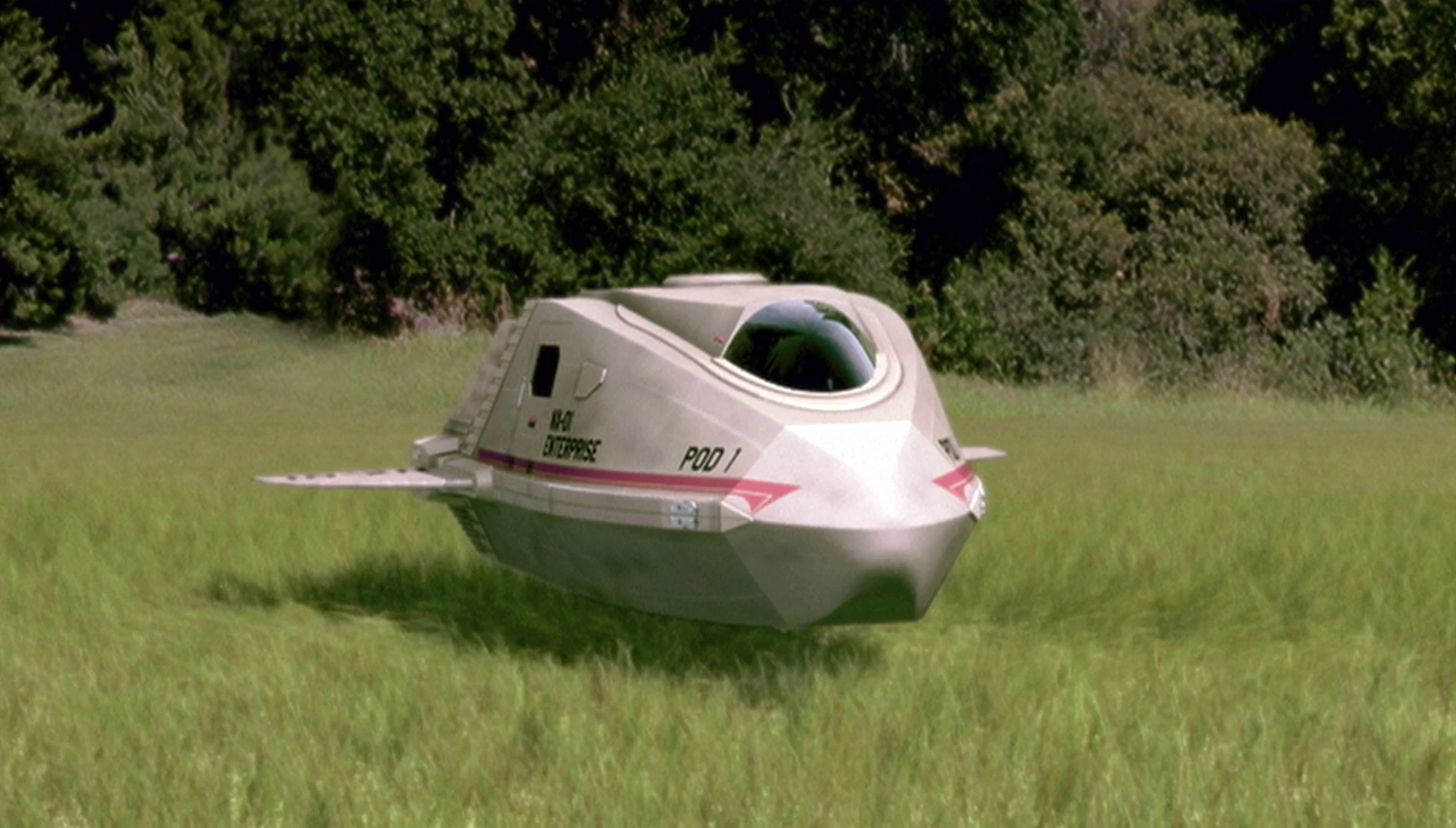
Design & Development
The 22nd century shuttlepod was a versatile type of shuttlecraft primarily operated by Starfleet, designed for transporting personnel to and from planets and spacecraft. These vehicles were classified as OTV Type K42/Personnel. The design philosophy aimed for a 'flying machine with wings' rather than the more box-like shuttles seen in later eras. Its aesthetic was influenced by contemporary Earth reentry vehicles, such as the Lockheed Martin X-33 and the X-39, reflecting a belief that these designs represented the pinnacle of non-warp flight technology for the next century. Initially conceived with four wings, the design was refined to incorporate two retractable wings that slid out from the body, a modification made to ensure compatibility with starship launch bays and to avoid interference with internal structures.
Technical Specifications
Each shuttlepod was equipped with a single deck and could accommodate a pilot and six passengers, though conditions were noted to be cramped. The interior featured a swiveling pilot's chair, two similar chairs behind it, and two upholstered benches at the rear that could double as bunks. These benches had lift-up seats for storage access. Entry points included a roof hatch, side entrances, and a large rear entrance. Standard equipment included oxygen recyclers, a store of rations, and a tiny built-in stove, but they notably lacked toilet facilities and typically did not store Universal translators.
Propulsion & Maneuvering
Shuttlepods were propelled by impulse engines, capable of a normal maximum speed of one-quarter impulse, though slightly faster speeds were achievable. For additional thrust, fusion overburn could be utilized. The impulse engine module at the aft of the craft could be safely ejected and detonated if necessary. Multiple thrusters provided precise control for landing and maneuvering. Each shuttlepod featured a single plasma injector, which, if damaged, could lead to plasma leaks. The craft could operate with a damaged EPS conduit, though replacement was standard procedure.
Tactical & Defensive Systems
For defense, shuttlepods were constructed with a ditanium hull reinforced with polarized hull plating. Hatches were made of duratanium alloy, capable of withstanding a quarter kiloton thermokinetic explosion at close range. They could endure attacks from conventional projectile weapons, such as those from American P-51 Mustangs, but were vulnerable to heavier anti-aircraft artillery and explosives small enough to be carried by hand. They could also survive two phase cannon hits. For offensive capabilities, shuttlepods were armed with two forward-mounted plasma cannons, which could fire both plasma bullets and beam emissions, with a range of less than ten kilometers. These cannons were more powerful than Starfleet/ECS plasma rifles. Shuttlepods could also be modified to carry at least six spatial charges, launched as missiles, capable of spreading particles over a five hundred-kilometer radius.
Sensor & Communication Systems
A com array enabled subspace communications over large distances. Shuttlepods possessed the ability to distinguish between Vulcan and Human bio-signs, even in adverse weather conditions. However, atmospheric interference could negatively impact their communications and sensor capabilities, and severe weather could prevent landing. Proximity alarms were also standard. Each shuttlepod was equipped with a transponder for other spacefaring vehicles to lock onto, though this could be disabled. While NX-class starships could identify the quantity and species of occupants, shuttlepods could be configured to emanate false life signs. The hull could be insulated with minerals like trellium-D to protect against spatial anomalies, a process requiring at least twelve hours.
Service History
Shuttlepods were extensively used by Starfleet in the 2150s and early 2160s, often transporting Starfleet personnel, MACOs, and diplomatic delegations. The NX-class starship Enterprise (NX-01) famously carried two shuttlepods, 'Shuttlepod 1' and 'Shuttlepod 2', throughout its ten-year mission from 2151 to 2161. Starfleet Command also operated shuttlepods, which featured distinct blue and silver streamlines and registry numbers, such as the NC-05 seen in 2154. In the mirror universe of the mid-2150s, the Terran Empire utilized similar shuttlepods aboard their NX-class starships, such as the ISS Avenger (NX-09). The United Federation of Planets starship USS Franklin also carried at least one shuttlepod until its disappearance in the mid-2160s. Shuttlepods were later featured in a holoprogram in 2370, simulating the interior of the Enterprise (NX-01) and locations on Rigel X.
Docking Procedures
When stored aboard an NX-class starship, shuttlepods were typically housed in the vessel's launch bay on F Deck. For space travel, a magnetic docking arm lowered the pod through a set of doors beneath the starship's hull before releasing it. To return, shuttlepods docked with the magnetic arm and were elevated back into the launch bay. Starfleet officers received training in these docking maneuvers.
-
Impulse drive
-
Thrusters
-
Fusion overburn
-
Plasma cannons
-
Spatial charges
-
Ditanium hull
-
Duratanium alloy reinforcement
This directory lists all individual commissioned starships belonging to this class profile. Data is retrieved from the Starfleet registry ledger.
