Class dossier: Class 2 shuttle
Introduction
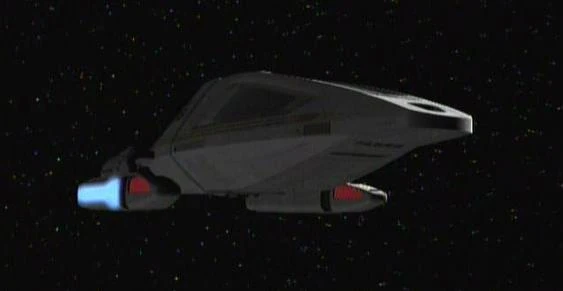
The Class 2 shuttle, also officially referred to as a Type 9 shuttlecraft, served as a vital short-range auxiliary space vessel within Starfleet. These embarked craft were primarily utilized from larger starships for various missions, succeeding the earlier Class 1 shuttle in service.
Design & Development
The genesis of the Class 2 shuttle's design stemmed from a desire within the Starfleet art department to introduce a 'cool and sleek shuttle' for the Star Trek: Voyager episode 'Threshold'. Rick Sternbach was tasked with this design in mid-1995, collaborating closely with production designer Richard James and set designer John Chichester to ensure a cohesive interior and exterior. The resulting design, quickly dubbed the 'Speedboat Shuttle' by the art department, marked a significant departure from the more traditional, box-shaped Starfleet shuttle designs. Sternbach finalized blueprints in November 1995, leading to the construction of the physical studio model by Tony Meininger's Brazil-Fabrication & Design. This Class 2 shuttle model holds the distinction of being the last physical shuttle model built for Star Trek: Voyager, as production transitioned to CGI. For later season appearances, a CGI model was developed at Foundation Imaging, with Rob Bonchune among the artists contributing to its graphics. While Rick Sternbach initially designated this design as the 'Type 12 shuttlecraft' and the Star Trek: The Next Generation Technical Manual referenced a similar 'Type-9A' for a large cargo shuttle, the designation 'Type 9 shuttlecraft' was canonized in 2384 through its appearance on the master situation display of the USS Dauntless in the Star Trek: Prodigy episode 'Mindwalk'.
Class History
Throughout the 2360s, the Class 2 shuttle was extensively employed by Starfleet Academy as a training ship. Tom Paris famously recounted the cramped conditions, noting that cadets were often 'shoehorned' into these vessels for weeks, leading to 'Class 2 claustrophobia'. By the 2370s, the Class 2 shuttle became a standard component of Intrepid-class starships, including the USS Voyager (NCC-74656). Its compact size prompted comments from Seven of Nine and B'Elanna Torres, who suggested the need for a 'larger, more efficient' shuttle. This sentiment was echoed by Tom Paris, who stated that 'Class 2 shuttles just don't cut it in the Delta Quadrant,' directly influencing the decision to construct the more advanced Delta Flyer in 2375. The Class 2 shuttle's robust design allowed it to tolerate gravimetric eddies more effectively than a larger Intrepid-class starship. Its service continued into the 2380s, with the type observed as part of the standard inventory of Dauntless-class starships, as depicted on the master situation display of the USS Dauntless in 2384.
Technical Specifications
The Class 2 shuttle's main body comprised a fuselage with port and starboard nacelles attached via pylons. Its hull was constructed from a durable tritanium alloy, featuring a rear entry hatch for access to the interior. Standard systems included a tractor beam, transporter, inertial dampers, com system, optical scanners, structural integrity field, and a message buoy. Propulsion systems consisted of thrusters, impulse engines, and warp drive, incorporating stabilizer acceleration sensors and attitude control thrusters. While its standard top speed was Warp 4, the Class 2 shuttle 'Cochrane' (04), attached to the USS Voyager, achieved Warp 9.7 in 2372 after the discovery of a new stable dilithium form, and even Warp 10 with the engagement of its transwarp drive. Another shuttle of this class was successfully modified with a coaxial warp drive. For defensive capabilities, the shuttle was equipped with deflector shields, phaser banks, and photon torpedoes, boasting a weapons range of at least 20,000 kilometers. Theoretically, Class 2 shuttles could be modified with Borg-developed shields to navigate gravimetric currents caused by a graviton ellipse, and in practice, two shuttles were outfitted with refractive shielding.
Interior Configuration
The interior of the Class 2 shuttle featured a cockpit with seating for two, complemented by a small cabin in the aft section, accommodating a crew complement of one to six. The craft was not 'built for comfort,' often inducing 'Class 2 claustrophobia' among cadets. Captain Kathryn Janeway, however, believed it possible to live aboard this type of shuttle alone for extended periods, citing 'plenty of rations.' Entry was facilitated by a large hatch at the rear, leading to passenger benches parallel to the aft walls, ample cargo space, and storage for at least two EV suits. The shuttle's transporter system was also located in the aft compartment. The relatively cramped cockpit included two swiveled chairs, with approximately 180 degrees of forward control consoles split between them and a small centrally located viewscreen/monitor. The pilot's seat was positioned on the port side, and the chairs were mounted on a track, allowing them to access rear consoles located on the half-wall separating the forward and aft compartments.
Named Shuttles of the Class
Notable Class 2 shuttles include the 'Cochrane' (registry 04), attached to the USS Voyager (NCC-74656), which was destroyed in 2374 after achieving Warp 10 in 2372. Another 'Cochrane' (registry 04) was also attached to the USS Voyager in 2374, with its status unknown. The 'Dawkins' was active at Jupiter Station in 2377.
-
Impulse engines
-
Thrusters
-
Coaxial warp drive
-
Phaser banks
-
Photon torpedoes
-
Deflector shields
-
Borg developed shields
This directory lists all individual commissioned starships belonging to this class profile. Data is retrieved from the Starfleet registry ledger.
No individual vessels of this class are currently registered in the active Starfleet archives.