Class dossier: DY-100 class
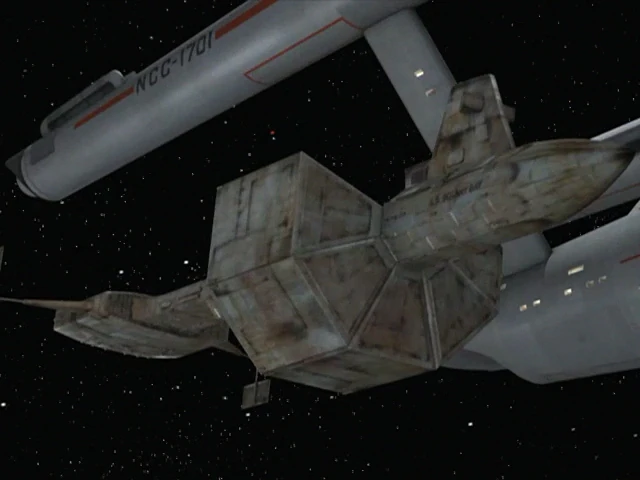
Design & Development
The DY-100 class was an early design of Earth pre-warp vessels that were in operation during the late 20th century. These ships were specifically engineered for interplanetary travel within the Sol system. They featured simple nuclear-powered engines and were equipped with artificial gravity, utilizing transistors as core components. DY-100 class ships were launched into orbit using booster rockets. In the 1990s, this class of spaceship was considered among Earth's most advanced. Production of DY-100 class ships commenced before 1996 and concluded sometime before the year 2000. A subsequent generation, the DY-500 class, shared a similar configuration, leading to occasional confusion, as demonstrated by Captain James T. Kirk in 2267 before being corrected by Spock in the episode 'Space Seed'. Significant advancements in sub-light propulsion technology ultimately led to the abandonment of the DY-100 class.
Sleeper Ship Configuration
At least some vessels of the DY-100 class were designed as sleeper ships. In this configuration, a crew of at least 85 individuals could be placed into suspended animation within life support canisters prior to liftoff. The ship's life support system would then be deactivated for the duration of the journey. The use of suspended animation was a critical necessity for interplanetary travel up to approximately 2018, as journeys between planets within the Sol system typically spanned several years before that time. The USS Enterprise (NCC-1701) famously encountered the DY-100 class sleeper ship SS Botany Bay in 2267, carrying Khan Noonien Singh and his Augment followers.
Service History & Appearances
The most notable vessel of this class, the SS Botany Bay, was discovered adrift in space by the USS Enterprise (NCC-1701) in 2267, as depicted in the Star Trek: The Original Series episode 'Space Seed'. An alternate reality version of the SS Botany Bay was also found adrift in 2258. The DY-100 class has made several appearances or references across Star Trek productions. In 1996, a model of a DY-100 appeared on a window sill in the office of Rain Robinson at the Griffith Observatory in California, and she also possessed a photograph of a DY-100 launch, as seen in the Star Trek: Voyager episode 'Future's End'. A photograph of the same DY-100 launch was displayed in the 602 Club, alongside other significant space achievements like the NX-Alpha, the Phoenix, and the USS Enterprise (XCV 330), as shown in the Star Trek: Enterprise episode 'First Flight'. The class was also referenced via a computer display in the Star Trek: Voyager episode 'Drone' and through a photograph in the Star Trek: Enterprise episode 'Home'. Footage of the DY-100 class studio model was re-used in the original version of 'The Ultimate Computer' to represent the Federation freighter Woden, though this was later retconned to an Antares-class vessel in the remastered version.
Behind the Scenes & Apocrypha
In the original script for the Star Trek: The Original Series episode 'Space Seed', dated October 26, 1966, this class was initially designated 'CZ-100'. Author James Blish, working from non-final script drafts, adhered to the 'CZ-100' designation in his 1968 novelization of the episode. Doug Drexler, a prominent advocate for the DY-100 class, championed its inclusion in Star Trek: Enterprise, though producers ultimately declined, citing its resemblance to a pencil. According to the reference book 'Star Trek: Communicator' issue 18, significant improvements in sub-light propulsion technology led to the abandonment of DY-100 ships. In apocryphal works, the 1977 'Enterprise Log 4' comic depicted an unnamed DY-100 class ship with the registry FWB 52, part of a fleet used to colonize planets in the Sol system. The 'Star Trek Spaceflight Chronology' states that the DY-100 was Earth's first mass-produced spaceship, with production beginning in 1996. This source details cargo, fuel, and passenger container capabilities, and mentions its use between Earth and Luna in standard configuration, and to Mars in an uprated mode. A journey to Mars using suspended animation was stated to take 937 days. The 'Spaceflight Chronology' also describes an SS Copernicus of the DY-100 class, serving from 1995 to 2020, with a length of 100 meters, a weight of 2.72 million kilograms, and a complement of 22, utilizing chemical/fission propulsion. The SS Copernicus is likely intended as the prototype of the class, differing from the SS Botany Bay by having a built-in engine pack of six chemical boosters for lift-off, though graphics show only four boosters.
-
Nuclear fusion engines
-
Chemical/fission propulsion
-
None
-
None
This directory lists all individual commissioned starships belonging to this class profile. Data is retrieved from the Starfleet registry ledger.
