Class dossier: Galileo type shuttlecraft
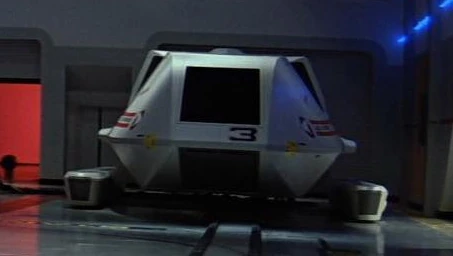
Introduction
The Galileo-type shuttlecraft was a versatile and widely utilized shuttlecraft design operated by Starfleet throughout the 23rd and 24th centuries. Known for its robust construction and adaptability, it served as a primary auxiliary craft for numerous Starfleet starships, including several iterations of the USS Enterprise.
Design & Physical Arrangement
The 23rd-century configuration of the Galileo-type shuttlecraft featured two nacelles, each attached to the sides near the ventral hull by two pylons. Propulsion was further augmented by two impulse thrusters positioned aft, above and to the sides of the rear hatch. The craft also incorporated small, stub wings on its centerline and four maneuvering thrusters located near its corners for precise control. Access was provided by two side doors, and the cockpit boasted a large forward-facing window on the dorsal side of the front. The forward ventral hull was characterized by a large black surface, with a series of landing lights centrally located. By the 2370s, the design underwent modifications, including the addition of two side windows just forward of the side doors and the removal of the stub wings, as observed in Star Trek Generations. The script for Star Trek V: The Final Frontier initially described retractable wings, a feature not implemented in the full-scale mock-ups or studio models.
Interior Layout
Internally, the cockpit of the Galileo-type shuttlecraft was equipped with two forward-facing seats, separated by a large center screen. The main cabin was designed for passenger transport, featuring two rows of lights running the length of the ceiling, each with a handrail positioned directly beneath it. Inward-facing bench seats lined the sides of the craft, complemented by track lighting beneath them. For security and mission readiness, three weapons lockers were integrated into the design: two located just aft of the side doors, one on each wall, and a third positioned below the center screen in the cockpit, as depicted in Star Trek V: The Final Frontier.
Service History & Notable Vessels
The Galileo-type shuttlecraft saw extensive service across the 23rd and 24th centuries. Notable vessels of this type include the USS Copernicus (registry 3), which was attached to the USS Enterprise (NCC-1701-A) and was destroyed in 2287. Another shuttle, the USS Galileo (registry 5), also attached to the USS Enterprise (NCC-1701-A), sustained damage in 2287. In the 24th century, the USS Hawking (registry 15) was attached to the USS Enterprise (NCC-1701-D) and was active in 2371. An unnamed Shuttlecraft 3 was active in the 2270s, attached to Starfleet Command. The class made appearances in Star Trek: The Motion Picture
- The Director's Edition, Star Trek V: The Final Frontier, and Star Trek Generations. The 2022 version of Star Trek: The Motion Picture
- The Director's Edition notably features multiple Galileo-type shuttles docked at the Federation Council building in San Francisco.
Technical Notes & Classifications
While never explicitly given a canonical class or type designation on-screen, the Galileo-type shuttlecraft's in-universe dimensions were reportedly intended to be 30 by 13.5 by 8 feet (approximately 9.14 by 4.11 by 2.44 meters) without engines, according to information from the '40 Years of Star Trek: The Collection auction catalog' and 'American Cinematographer'. The 'Star Trek: The Official Starships Collection' initially designated this type as a Type 04 shuttlecraft in Issue #19, later revising it to a Type 06 shuttlecraft in Issue #23, consistently noting an approximate length of 9.1 meters.
- No propulsion telemetry logged in database.
- No armament telemetry logged in database.
- No defensive systems telemetry logged in database.
This directory lists all individual commissioned starships belonging to this class profile. Data is retrieved from the Starfleet registry ledger.
No individual vessels of this class are currently registered in the active Starfleet archives.