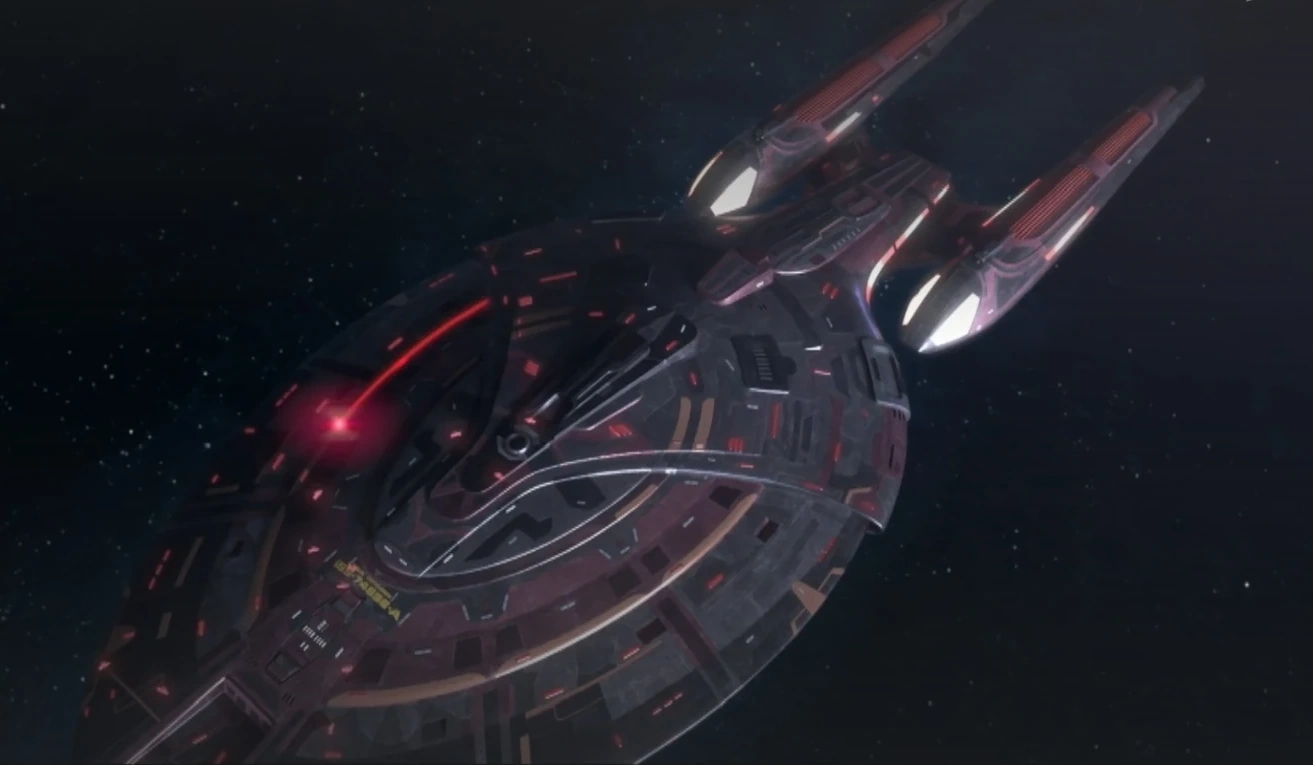
Class dossier: Lamarr class

Design & Development
The Lamarr class was a type of Federation starship operated by Starfleet, primarily serving as a science vessel during the late 24th century. Its hull configuration adopted the familiar saucer-type shape seen in many previous starship classes, consisting of a primary hull, a secondary hull, and nacelles designed for warp generation and control. The class was named after the actress and inventor Hedy Lamarr.
Technical Specifications & Capabilities
Lamarr-class starships were equipped with 29 decks and designed to accommodate a crew complement of 800. They featured two schools, two primary shuttlebays, and at least one additional hanger that could be refitted into a third shuttlebay, located behind the deflector dish on the port side. Deck 1 housed the main bridge, while Deck 8 contained sickbay. The primary transporter room was located on Deck 9, with additional transporter rooms on Decks 1 and 8. For tactical engagements, these vessels were heavily armed, featuring phaser arrays, photon torpedoes, quantum torpedoes, bio-molecular weapons, isokinetic cannons, nuclear missiles, phase cannons, phased plasma torpedoes, polaron torpedoes, spatial torpedoes, tetryon cannons, and tricobalt devices. A dedicated battle bridge was also part of their design. Defensively, they were protected by deflector shields.
As science vessels, Lamarr-class ships carried advanced probes for data collection, which could also function as transmission relays. According to The Doctor, these ships were refitted 'stem to stern' with the latest and greatest technologies collected by the USS Voyager (NCC-74656) from the Delta Quadrant, 'and then some.' Scientific and recreational facilities included over 16 holodecks and a Cetacean Ops facility. The ships also incorporated holographic projectors throughout, allowing holograms such as The Doctor and the holo-duplicates of the young USS Protostar crew to move freely without needing mobile emitters or being restricted to specific areas like sickbay or the holodecks. Shuttlebay facilities included fore and aft bays, a port-side bay, and carried six Sacagawea shuttlecraft and rescue shuttles. Cargo facilities included fore and aft 'warehouse/spacecraft sections.' Propulsion systems comprised impulse engines, warp drive, and a quantum slipstream drive. This advanced propulsion allowed Lamarr-class ships to reach distant locations like Solum in the Delta Quadrant within a relatively short time, a journey that the diplomatic shuttle Sacagawea would typically take approximately five months to complete, though prior passage through an abandoned Borg transwarp conduit likely reduced the overall distance for the USS Voyager (NCC-74656-A). The class was also capable of atmospheric entry and planetary landing.
Service History
The Lamarr class was in active service by 2384. One notable vessel of this class, the USS Voyager (NCC-74656-A), played a significant role in Starfleet operations. In 2384, the USS Voyager (NCC-74656-A) dispatched shuttles to retrieve Dal R'El, Rok-Tahk, Jankom Pog, Gwyndala, Murf, and Zero from San Francisco Bay, as depicted in 'Supernova, Part 2.' Later that year, the USS Voyager (NCC-74656-A) embarked on its maiden voyage. With most of Starfleet engaged in the Romulan evacuation, Vice Admiral Kathryn Janeway, the legendary captain of the original USS Voyager (NCC-74656), volunteered to serve as its commanding officer. Officially, the science vessel's first mission was to study the Janeway wormhole, but Vice Admiral Janeway's true intention was to launch a rescue mission for her former first officer, Captain Chakotay, as detailed in 'Into the Breach, Part I' and 'Into the Breach, Part II.' The USS Voyager (NCC-74656-A) subsequently played a pivotal role in thwarting Asencia's plot to destroy the Federation and in repairing a temporal paradox that threatened the universe, events chronicled in 'Ouroboros, Part I' and 'Ouroboros, Part II.' Following these events, Captain Chakotay took command of the ship. The USS Voyager (NCC-74656-A) was out of service by 2401. In the Mirror Universe, an Imperial Starfleet counterpart, the ISS Voyager (NCC-74656-A), was active in 2384.
- No propulsion telemetry logged in database.
-
Bio-molecular warheadOriginal Database Entry: Bio-molecular weapons
-
Isokinetic cannonOriginal Database Entry: Isokinetic cannons, Phase cannons, Tetryon cannons
-
Nuclear missileOriginal Database Entry: Nuclear missiles
-
Phase cannonOriginal Database Entry: Phaser arrays, Isokinetic cannons, Phase cannons, Phased plasma torpedoes, Tetryon cannons
-
Phased plasma torpedoOriginal Database Entry: Photon torpedoes, Quantum torpedoes, Phased plasma torpedoes, Polaron torpedoes, Spatial torpedoes
-
PhaserOriginal Database Entry: Phaser arrays
-
Photon torpedoOriginal Database Entry: Photon torpedoes, Quantum torpedoes, Phased plasma torpedoes, Polaron torpedoes, Spatial torpedoes
-
Polaron torpedoOriginal Database Entry: Photon torpedoes, Quantum torpedoes, Phased plasma torpedoes, Polaron torpedoes, Spatial torpedoes
-
Quantum torpedoOriginal Database Entry: Photon torpedoes, Quantum torpedoes, Phased plasma torpedoes, Polaron torpedoes, Spatial torpedoes
-
Spatial torpedoOriginal Database Entry: Photon torpedoes, Quantum torpedoes, Phased plasma torpedoes, Polaron torpedoes, Spatial torpedoes
-
Tetryon cannonOriginal Database Entry: Isokinetic cannons, Phase cannons, Tetryon cannons
-
Deflector shields
This directory lists all individual commissioned starships belonging to this class profile. Data is retrieved from the Starfleet registry ledger.