Mission Briefing
A Kobheerian freighter arrives at Deep Space Nine, carrying a Cardassian passenger, Aamin Marritza, who is suffering from Kalla-Nohra Syndrome. Major Kira Nerys immediately recognizes the rare disease as originating from a horrific mining accident at the Gallitep labor camp during the Cardassian Occupation of Bajor, a camp she helped liberate. Convinced that Marritza must be a notorious war criminal responsible for the atrocities committed there, Major Kira Nerys orders his detention, sparking a tense investigation. As Commander Benjamin Sisko and Constable Odo navigate the political complexities with the Bajoran Provisional Government and the Cardassian Union, Major Kira Nerys confronts Marritza, who initially denies his involvement, setting the stage for a profound exploration of truth, justice, and the lingering scars of war.
LCARS Tactical Mission Registry: A detailed reconstruction of chronological events and narrative progression compiled from historical logs and mission briefs.
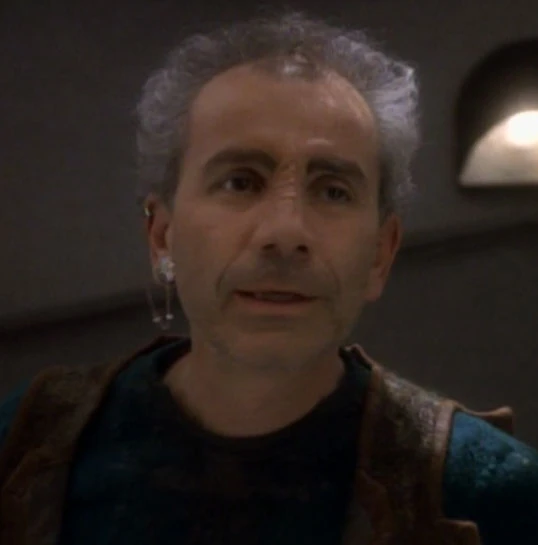
The episode 'Duet' begins with a seemingly routine day in Operations on Deep Space Nine, where Major Kira Nerys and Lieutenant Jadzia Dax are exchanging lighthearted stories. Their conversation is interrupted by the arrival of the Kobheerian freighter 'Rak-Miunis', carrying a passenger, Aamin Marritza, who requires urgent medical attention for a condition known as Kalla-Nohra Syndrome. Dr. Julian Bashir is unfamiliar with the ailment, but Major Kira Nerys immediately recognizes it as a disease exclusively contracted during a mining accident at the infamous Gallitep labor camp on Bajor, a site of horrific atrocities during the Cardassian Occupation of Bajor. Believing the passenger to be a Bajoran survivor, Major Kira Nerys rushes to the Infirmary, only to discover that the patient is a Cardassian. Her immediate reaction is to call for security, leading to Marritza's apprehension by Constable Odo on the Promenade, where Major Kira Nerys vehemently declares him a war criminal. Commander Benjamin Sisko, initially skeptical, learns that Marritza is not on any official Bajoran Provisional Government list of war criminals, but Major Kira Nerys's emotional recounting of the brutal conditions at Gallitep convinces him to investigate further. The situation quickly escalates with a transmission from Bajoran Minister Kaval, who congratulates Commander Benjamin Sisko on detaining Marritza and asserts Bajor's claim to the Cardassian if his presence at Gallitep is confirmed.
Despite Commander Benjamin Sisko's initial concerns about her objectivity, Major Kira Nerys insists on leading the investigation into Aamin Marritza, promising to act fairly out of duty to the victims of Gallitep. In the holding cell, Marritza initially attempts to deceive them, claiming to suffer from Pottrik Syndrome and denying any presence on Bajor, asserting he was a file clerk on Kora II. However, Dr. Julian Bashir's bio-probe definitively confirms Marritza has Kalla-Nohra Syndrome, proving his presence at Gallitep. Confronted with this evidence, Marritza changes his story, admitting to being a file clerk at the camp but minimizing the atrocities, attributing deaths to industrial accidents and worker feuds. He then reveals a chilling Cardassian strategy: Gul Darhe'el, the camp's commander, deliberately circulated rumors of massacres to keep the Bajorans 'thinking of yourselves as victims' and 'afraid... and helpless.' Marritza challenges Major Kira Nerys, accusing her of seeking vengeance rather than justice, a sentiment that resonates with her own internal struggle, as she confides in Lieutenant Jadzia Dax her desire for Marritza to be 'something worse' than a mere file clerk.
The political ramifications of Marritza's detention quickly become apparent when Gul Dukat, a former Cardassian prefect of Bajor, hails Commander Benjamin Sisko, demanding Marritza's release and warning against Bajoran 'hate-mongers' causing conflict between the Cardassian Union and the Federation. Meanwhile, Major Kira Nerys continues her internal struggle, admitting to Lieutenant Jadzia Dax that she wants Marritza to be guilty, believing his punishment would bring 'satisfaction' to Bajor. However, Dax suggests that Major Kira Nerys is 'trying too hard to believe' her own words, implying that simple vengeance is not enough. The investigation takes a dramatic turn when Commander Benjamin Sisko's senior staff, after consulting the Bajoran Central Archives, discovers that the man in custody is not the Aamin Marritza from historical records. Through image enhancement, they identify the prisoner as Gul Darhe'el, the notorious 'Butcher of Gallitep.' Major Kira Nerys confronts the prisoner, who, now embracing the identity of Gul Darhe'el, taunts her with his 'accomplishments,' dismissing the Bajoran resistance, including Major Kira Nerys's Shakaar resistance cell, as a mere annoyance, and defiantly stating that his death would not 'undo what I've accomplished. The dead will still be dead!'
Constable Odo, however, finds Gul Darhe'el's knowledge of Major Kira Nerys's Shakaar resistance cell suspicious, as a labor camp commander would not typically possess such specific intelligence. This prompts Odo to initiate a deeper investigation, reviewing off-station requests for information about Major Kira Nerys. Simultaneously, Gul Dukat, contacted by Odo, vehemently denies Gul Darhe'el is alive, providing a death certificate and progress reports indicating Darhe'el died six years prior and was on Cardassia receiving the Proficient Service Medallion during the Gallitep accident. This evidence contradicts the prisoner's Kalla-Nohra Syndrome diagnosis. Dr. Julian Bashir's medical records check on Marritza reveals a crucial detail: five years prior, he began taking large doses of dermatiraelian plastiscine, a dermal regenerative agent used after cosmetic surgery. This confirms that the man in custody surgically altered his appearance to resemble Gul Darhe'el and deliberately orchestrated his capture by booking passage on a ship specifically stopping at Deep Space Nine.
Major Kira Nerys returns to the holding cell, now armed with the full truth. She confronts the prisoner, who, despite her probing questions about his medical history and cosmetic surgery, desperately clings to his fabricated identity as Gul Darhe'el, ranting about his 'genocidal' actions. However, Major Kira Nerys sees through the facade and declares, 'You're Marritza, aren't you?' The prisoner breaks down, confessing to being the real Aamin Marritza, a cowering file clerk who 'covered my ears every night' to block out the screams of the Bajoran laborers. Overwhelmed by guilt for his inaction, Marritza insists he 'deserves to be dead' and begs Major Kira Nerys to allow him to be tried and executed as Gul Darhe'el, believing his death would force Cardassia to 'admit its guilt' and pave the way for a new Cardassia. Major Kira Nerys, deeply moved, refuses to participate in what she calls 'another murder.' As she and Constable Odo escort a now-released Aamin Marritza to a ship bound for Kora II, he is tragically stabbed by Kainon, a Bajoran survivor of Gallitep, who declares, 'He's a Cardassian. That's reason enough.' Marritza dies in Major Kira Nerys's arms, leaving her to utter, 'No... It's not,' a profound realization about the nature of justice and vengeance.
LCARS Tactical Mission Log: Chronological action logs detailing exactly what each character did during the events of this mission, linked directly to personnel dossiers.


Subspace Visual Feed
Sensors & Diagnostic Metrics
Visual Sensor Logs



Synaptic Lore Link Contexts
The disease originated from a mining accident at the Gallitep labor camp, which Kira helped liberate during the Occupation, so she goes to greet the new arrival in the infirmary, believing him to be a Bajoran.Fuelled by a lifetime of Bajoran suffering under Cardassian occupation, Kira relentlessly interrogates the seemingly unassuming man, determined to secure justice.
When Kira reaches the infirmary, she finds Bashir's patient is not a Bajoran, but a Cardassian.In one of Deep Space Nine's most profound early episodes, Major Kira Nerys confronts the specter of Cardassian war crimes head-on.
A Kobheerian freighter, the Rak-Miunis, arrives with a passenger who requires medical assistance for a condition known as Kalla-Nohra Syndrome.Their conversation is interrupted by the arrival of the Kobheerian freighter 'Rak-Miunis', carrying a passenger, Aamin Marritza, who requires urgent medical attention for a condition known as Kalla-Nohra Syndrome.
The disease originated from a mining accident at the Gallitep labor camp, which Kira helped liberate during the Occupation, so she goes to greet the new arrival in the infirmary, believing him to be a Bajoran.Dr. Julian Bashir is unfamiliar with the ailment, but Major Kira Nerys immediately recognizes it as a disease exclusively contracted during a mining accident at the infamous Gallitep labor camp on Bajor, a site of horrific atrocities during the Cardassian Occupation of Bajor.
In Odo's office, Kira admits to Commander Benjamin Sisko and Odo that the Bajoran Provisional Government has not listed the Cardassian, Aamin Marritza, for any war crimes.
The prisoner claims that the Cardassians were doing the same: they had an empire to manage and protect and had urgent need of Bajoran resources.The political ramifications of Marritza's detention quickly become apparent when Gul Dukat, a former Cardassian prefect of Bajor, hails Commander Benjamin Sisko, demanding Marritza's release and warning against Bajoran 'hate-mongers' causing conflict between the Cardassian Union and the Federation.
Odo also notes that, during the prisoner's last two weeks on Kora II, he resigned his post at the military academy, put his affairs in order – even providing handsomely for his housekeeper – and booked passage on a ship specifically scheduled to stop at Deep Space 9, returning him to Bajoran jurisdiction – an unusual choice of travel plan for a Cardassian war criminal.
However, Dr. Julian Bashir's bio-probe definitively confirms Marritza has Kalla-Nohra Syndrome, proving his presence at Gallitep.
Mission Registries & Linkages
Subspace Playlists
This registry lists all curated subspace playlists and chronological collections containing this mission.
Technology
This registry contains all specialized technologies deployed, analyzed, or referenced during this mission.
Location
This registry displays all celestial bodies, planets, starbases, or coordinates charted or visited during this mission.
Starship
This registry lists all vessels encountered, scanned, or active during this mission.
[ NO STARSHIPS REGISTERED ]
Species & Factions
This registry documents all species, civilizations, and organizational factions contacted or active in this sector during the mission.
Culture & Lore
This registry outlines historical events, cultural traditions, organizations, and database lore referenced during this mission.
Production & Archival Linkages
This registry documents behind-the-scenes production references, draft concepts, star charts, or archival cataloging links officially connected to this mission.
"The plot of this episode was inspired by 's 1967 stage play , which tells of a Jewish man accused of being a war criminal. In fact, Leonard Nimoy had starred in a production of the play years earlier. That play, in turn, is based on actual events that took place after World War II, such as the and the hunt for top-ranking Nazi officials who escaped Germany and made up new identities for themselves, such as . Noted Michael Piller, "Ira Behr gave us the twist that gave it The Man in the Glass Booth kind of feeling, where the guy isn't who he says he is but is doing it for more noble reasons." (The Fifty-Year Mission: The Next 25 Years, p. 461)"
"In The New Trek Programme Guide, the authors comment that "Duet" was "the pinnacle of the season, a tightly plotted and allusive tale that could be 'about' the Simon Wiesenthal Centre, the modern Nazi's re-writing of World War Two or even Bosnia. Although the juxtaposition with the previous episode is less than ideal, with Kira seeming to go behind Sisko's back to get what she wants, the strength of the script and the performances more than make up for this. Harris Yulin excels as the coward who personalized the guilt of an entire race. This powerful and absorbing drama is also very Roddenberryesque: Kira realises, just before the clever twist ending, that his being a Cardassian is not reason enough to want to kill him." (The New Trek Programme Guide, pp. 316 – 317)"
Continuity & Trivia
-
Marc Alaimo, who famously portrayed Gul Dukat throughout DS9, appears in this episode as the Cardassian prisoner, Gul Darhe'el/Aamin Marritza. He originally auditioned for the role of Benjamin Sisko.
-
"Duet" is widely considered by fans and critics alike to be one of the strongest episodes of Deep Space Nine's first season, and a pivotal character study for Major Kira Nerys.
-
The disease Kalla-Nohra, characterized by distinct lesions, was specifically conceived for this episode as a physical marker of those who suffered in Cardassian labor camps, adding a unique, visually impactful element to the mystery.
-
The episode's plot was inspired by Robert Shaw's 1967 play "The Man in the Glass Booth," a work that Star Trek veteran Leonard Nimoy had previously starred in.
-
To balance the budget for DS9's first season, "Duet" was intentionally written as a bottle show, with co-writer Peter Allan Fields being asked to create a "show that costs nothing."
-
"Duet" reunited actors Armin Shimerman (Quark) and guest actor Harris Yulin (Marritza), who had previously worked together on Broadway.
-
The character of Neela, who becomes an assassin in the following episode "In the Hands of the Prophets," makes her first appearance in "Duet," a change from original plans to introduce her earlier.
-
In April 2022, "Duet" was temporarily the only missing episode when Deep Space Nine moved from Netflix to Paramount+, sparking a short-lived controversy among fans and former production staff until its restoration.