Mission Briefing
The USS Enterprise-D, under the command of Captain Jean-Luc Picard, encounters a millennia-old Promellian battle cruiser adrift near Orelious Nine. Drawn by a faint distress signal, Captain Picard leads an away team, including Commander William T. Riker, Lieutenant Worf, and Lieutenant Commander Data, to investigate the derelict vessel. Unbeknownst to the crew, their presence inadvertently activates a sophisticated defensive mechanism, trapping the USS Enterprise-D within a dangerous subspace field. The starship’s shields begin to fail, and its energy reserves plummet, mirroring the fate of the ancient Promellian ship.
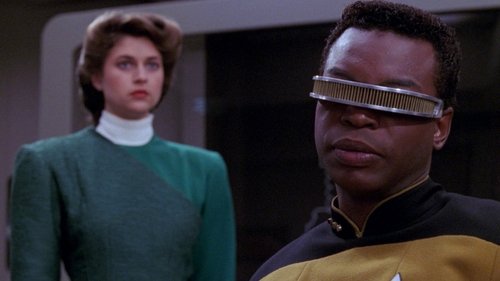
Chief Engineer Geordi La Forge faces the daunting task of finding a solution as the USS Enterprise-D faces imminent destruction. Under immense pressure, he turns to the Holodeck, creating a sophisticated simulation of Doctor Leah Brahms, the brilliant theoretical physicist behind the USS Enterprise-D's warp drive, to serve as a technical consultant. Meanwhile, Commander Riker and Lieutenant Commander Data return to the Promellian ship, hoping to uncover clues from its logs. The crew must now race against time to understand and escape the insidious trap before the USS Enterprise-D suffers the same devastating end as its ancient predecessor.
LCARS Tactical Mission Registry: A detailed reconstruction of chronological events and narrative progression compiled from historical logs and mission briefs.
The USS Enterprise-D, under the command of Captain Jean-Luc Picard, encounters an ancient Promellian battle cruiser, the Cleponji, near Orelious Nine. This vessel, adrift for millennia, emits a distress signal that draws the Starfleet crew to its location. Captain Jean-Luc Picard, a keen enthusiast of historical artifacts and starship design, leads an away team, including Commander William T. Riker, Lieutenant Worf, and Lieutenant Commander Data, to explore the derelict ship. Unbeknownst to them, their presence inadvertently activates a sophisticated energy-draining 'booby trap' – a defensive mechanism deployed by the Menthars during their ancient conflict with the Promellians. The USS Enterprise-D becomes ensnared by subspace filaments, its shields rapidly failing, and its energy reserves plummeting, trapping the starship in the same fate that befell the Cleponji's original crew.
As the USS Enterprise-D faces imminent destruction, Chief Engineer Geordi La Forge is tasked with finding a solution. Earlier, Geordi La Forge experienced a personal setback when a holodeck date with Christy Henshaw ended in rejection, highlighting his struggles with interpersonal relationships. Now, under immense pressure, he turns to the USS Enterprise-D's computer for assistance, seeking the theoretical physicist who designed the starship's warp drive, Doctor Leah Brahms of the Daystrom Institute Theoretical Propulsion Group. Geordi La Forge creates a sophisticated holodeck simulation of Doctor Leah Brahms, initially intending her as a purely technical consultant. Concurrently, Commander William T. Riker and Lieutenant Commander Data return to the Promellian battle cruiser, the Cleponji, to retrieve its logs. They discover the final message of Captain Galek Sar, which reveals that the Promellian vessel was destroyed by 'aceton assimilators' – primitive generators concealed in debris that drain power and convert it into lethal radiation, confirming the nature of the 'booby trap' now afflicting the USS Enterprise-D.
Geordi La Forge's interaction with the holographic Doctor Leah Brahms evolves significantly. Initially, the simulation is based on technical specifications, but Geordi La Forge requests a more 'personal' synthesis, incorporating personality profiles from various Starfleet databases. This creates a more interactive and emotionally complex holographic entity. As they work together in a holodeck recreation of the Utopia Planitia drafting room, the holographic Doctor Leah Brahms challenges Geordi La Forge's engineering assumptions, leading to a deeper understanding of the USS Enterprise-D's warp core. They devise a temporary solution to extend the starship's energy supplies by reorienting the dilithium crystal lattice and adjusting matter-antimatter injection rates, allowing the shields to be maintained for a longer period. This unexpected emotional connection to the holographic Doctor Leah Brahms raises profound questions about the psychological impact and ethical boundaries of advanced holographic technology, particularly amidst a desperate fight for survival.
Despite the temporary energy solution, the USS Enterprise-D remains trapped, with radiation levels steadily increasing and fatal exposure time dwindling. Geordi La Forge and the holographic Doctor Leah Brahms continue to search for an escape, realizing that directly overpowering the 'booby trap' is futile, as it merely feeds the 'aceton assimilators' more energy. They conceive of a radical, counter-intuitive maneuver: a microsecond burst of full impulse power to overcome inertia, immediately followed by a complete shutdown of all non-essential systems, relying only on minimal life support and two thrusters. This strategy, which Commander William T. Riker likens to flying an 'airplane with only one propeller', requires precise, human-driven intuition rather than computer automation. Captain Jean-Luc Picard, drawing on his childhood fascination with model ships and the 'human factor' of experience and intuition, takes the conn himself. He skillfully navigates the USS Enterprise-D through the treacherous debris field, using the gravitational pull of an asteroid as a 'slingshot' to achieve the necessary velocity and trajectory, successfully escaping the 'booby trap'.
With the USS Enterprise-D safely out of the 'booby trap', Captain Jean-Luc Picard orders Commander William T. Riker to ensure the ancient Promellian battle cruiser, the Cleponji, and the 'aceton assimilators' are destroyed with photon torpedoes, preventing any future starships from falling victim to the same fate. Back in the holodeck, Geordi La Forge reflects on the experience with the holographic Doctor Leah Brahms. He acknowledges that while technology is powerful and enabling, sometimes the most effective solution involves turning it off and relying on human ingenuity and intuition. He bids farewell to the holographic Doctor Leah Brahms, who reminds him that her essence is embedded within the USS Enterprise-D's very design, a constant presence in his work. The episode concludes with a powerful thematic statement on the balance between technological advancement and the irreplaceable human element of creativity, adaptability, and the will to survive.
LCARS Tactical Mission Log: Chronological action logs detailing exactly what each character did during the events of this mission, linked directly to personnel dossiers.


Subspace Visual Feed
Sensors & Diagnostic Metrics
Visual Sensor Logs


Synaptic Lore Link Contexts
While he comments that it's crude in comparison to isolinear optical chips, Picard points out that the cruiser was built when Humans were perfecting the mechanical clock and using steel crossbows in battle.Riker likens to flying an 'airplane with only one propeller', requires precise, human-driven intuition rather than computer automation.
The away team, meanwhile, repowers the cruiser's bridge with the power pack they brought, and Worf takes tricorder images of the tactical display.
He tries to come up with a solution using the help of a holodeck recreation of Drafting Room 5 at the Utopia Planitia Fleet Yards and accidentally ends up having the computer recreate a holodeck image of Dr.
They discover that the asteroids have been booby-trapped with aceton assimilators, and that it is impossible to destroy the asteroids while they absorb the energy of the fired phasers.
Riker can't help but smile as Picard ponders on manning Earth's earliest spacecraft, or flying an airplane with just a single propeller to keep it airborne, "can you imagine that?"
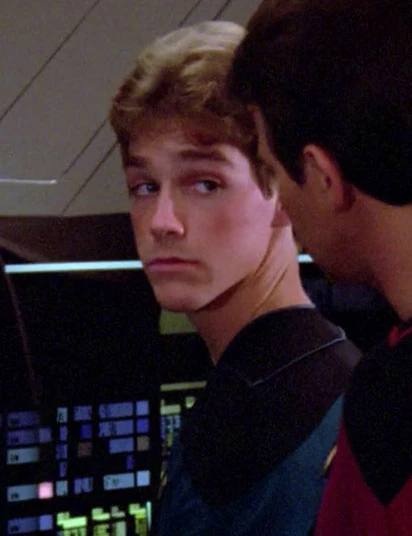
In order to eliminate the time-differential between order and action, Captain Picard relieves Wesley of the helm to maneuver the ship himself, while Riker warns the crew to brace themselves for the impulse burst, as the inertial dampers are on manual.
Back in the holodeck, La Forge says to Leah that he thinks technology improves people's lives, including his, and even his eyesight, lets species travel through the galaxy but sometimes, technology needs to be turned off.
Riker likens to flying an 'airplane with only one propeller', requires precise, human-driven intuition rather than computer automation.
Now, under immense pressure, he turns to the USS Enterprise-D's computer for assistance, seeking the theoretical physicist who designed the starship's warp drive, Doctor Leah Brahms of the Daystrom Institute Theoretical Propulsion Group.
Earlier, Geordi La Forge experienced a personal setback when a holodeck date with Christy Henshaw ended in rejection, highlighting his struggles with interpersonal relationships.
Riker to ensure the ancient Promellian battle cruiser, the Cleponji, and the 'aceton assimilators' are destroyed with photon torpedoes, preventing any future starships from falling victim to the same fate.
This unexpected emotional connection to the holographic Doctor Leah Brahms raises profound questions about the psychological impact and ethical boundaries of advanced holographic technology, particularly amidst a desperate fight for survival.
As they work together in a holodeck recreation of the Utopia Planitia drafting room, the holographic Doctor Leah Brahms challenges Geordi La Forge's engineering assumptions, leading to a deeper understanding of the USS Enterprise-D's warp core.
Now, under immense pressure, he turns to the USS Enterprise-D's computer for assistance, seeking the theoretical physicist who designed the starship's warp drive, Doctor Leah Brahms of the Daystrom Institute Theoretical Propulsion Group.
Mission Registries & Linkages
Subspace Playlists
This registry lists all curated subspace playlists and chronological collections containing this mission.
Technology
This registry contains all specialized technologies deployed, analyzed, or referenced during this mission.
Location
This registry displays all celestial bodies, planets, starbases, or coordinates charted or visited during this mission.
Starship
This registry lists all vessels encountered, scanned, or active during this mission.
[ NO STARSHIPS REGISTERED ]
Species & Factions
This registry documents all species, civilizations, and organizational factions contacted or active in this sector during the mission.
Culture & Lore
This registry outlines historical events, cultural traditions, organizations, and database lore referenced during this mission.
Continuity & Trivia
-
This episode marks the first appearance of Dr. Leah Brahms, a character who would later return and play a significant role in Geordi La Forge's personal life.
-
This is the first time in the series that Geordi La Forge is seen removing his VISOR, revealing the actor LeVar Burton's eyes to the audience.
-
The 'booby trap' was deliberately conceived by the writers as a non-sentient, environmental antagonist, forcing the crew to rely on intellect and scientific problem-solving rather than engaging in a traditional battle.
-
Initially, Captain Picard was slated to interact with the simulated Leah Brahms, but Michael Piller changed it to Geordi La Forge, believing it better suited Geordi's character as someone who struggles with women but loves his ship.Sources: Memory Alpha
-
The character of Leah Brahms was originally named Navid Daystrom, intended as a descendant of Richard Daystrom, but the name was changed after Susan Gibney was cast, while still retaining a Daystrom Institute tie-in.Sources: Memory Alpha
-
This episode holds the distinction of being the first Star Trek episode ever directed by a woman, Gabrielle Beaumont.Sources: Memory Alpha
-
This episode introduced the final version of the Starfleet uniforms used in the series, featuring removed chest seams and smaller shoulder pads, though only Captain Picard wore the updated uniform in this installment.Sources: Memory Alpha
-
A memorable blooper occurred during filming when Michael Dorn, as Worf, humorously misdelivered a line about building model ships, accidentally stating, 'I did not play with boys,' eliciting laughter on set.Sources: Memory Alpha