Mission Briefing
The USS Enterprise (NCC-1701) arrives at Starbase 11 for repairs after a perilous ion storm, during which Captain James T. Kirk was forced to jettison a critical pod, resulting in the presumed death of Records Officer Lieutenant Commander Benjamin Finney. Starfleet authorities launch an inquiry when computer logs contradict Captain James T. Kirk's official report regarding the sequence of events, specifically the timing of the jettison relative to a Red alert. This grave discrepancy leads to Captain James T. Kirk being formally accused of willful perjury and culpable negligence, propelling him into a high-stakes general court-martial. Haunted by a past incident and fueled by grief, Lieutenant Commander Benjamin Finney's daughter confronts Captain James T. Kirk, accusing him of her father's murder, intensifying the pressure on the embattled captain. Doctor Leonard McCoy introduces Captain James T. Kirk to the Starfleet prosecuting officer, who warns him of the impending 'Kirk versus the computer' battle and recommends the eccentric attorney, Samuel T. Cogley, for his defense. As the trial unfolds, even Commander Spock's steadfast testimony about Captain James T. Kirk's character struggles against the cold, hard data presented by the prosecution, leaving Captain James T. Kirk to question his own memories.
LCARS Tactical Mission Registry: A detailed reconstruction of chronological events and narrative progression compiled from historical logs and mission briefs.
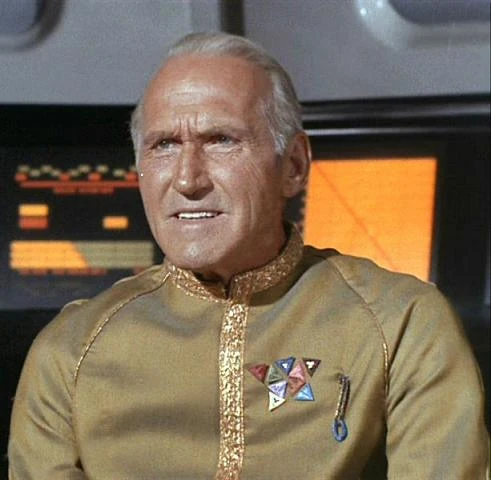
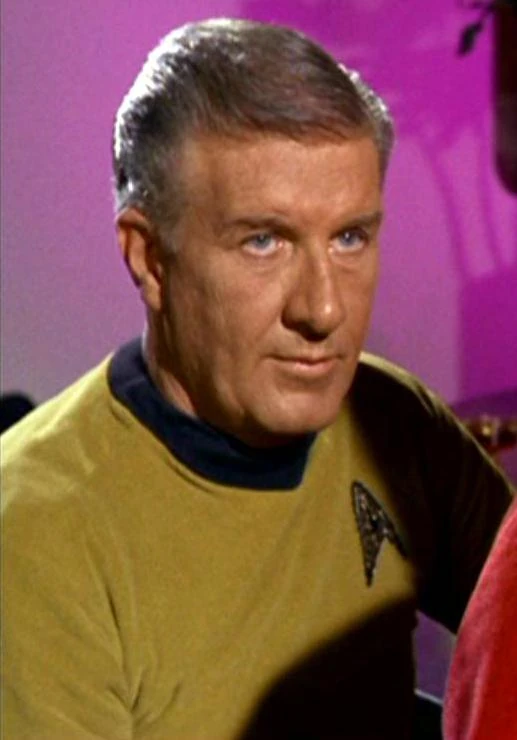
The USS Enterprise (NCC-1701) arrives at Starbase 11 for repairs after a severe ion storm, during which Captain James T. Kirk was forced to jettison an ion pod, resulting in the presumed death of Records Officer Lieutenant Commander Benjamin Finney. Commodore Stone, the commanding officer of Starbase 11, reviews Captain James T. Kirk's sworn deposition, which states that the ion pod was ejected after the ship went to red alert. However, the computer logs contradict this, showing the ejection occurred before red alert. This discrepancy leads Commodore Stone to accuse Captain James T. Kirk of willful perjury and order an official inquiry, which quickly escalates into a general court-martial. Lieutenant Commander Benjamin Finney's daughter, Jame Finney, confronts Captain James T. Kirk, accusing him of her father's murder, fueled by a long-standing animosity stemming from an incident years prior on the USS Republic where Captain James T. Kirk's log entry led to Lieutenant Commander Benjamin Finney's reprimand and stalled promotion.
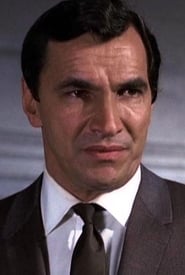
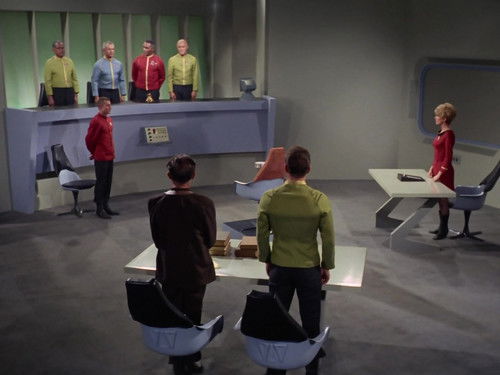
Captain James T. Kirk, confident in his innocence, initially dismisses the severity of the situation, even when meeting old Starfleet Academy classmates at the M-11 Starbase Club who appear to have already judged him guilty. Doctor Leonard McCoy introduces Captain James T. Kirk to Areel Shaw, a former romantic interest and a lieutenant in Starfleet's Legal Division, who reveals she is the prosecuting officer. She warns Captain James T. Kirk about the prosecution's strategy of 'Kirk versus the computer' and recommends Samuel T. Cogley, an eccentric attorney who prefers physical books over computers, to defend him. The court-martial begins with Commodore Stone presiding, and Captain James T. Kirk pleads not guilty to charges of perjury and culpable negligence. During the proceedings, Commander Spock testifies to Captain James T. Kirk's predictable character, asserting that he is incapable of panic or malice, despite the computer's contradictory log. Doctor Leonard McCoy is compelled to admit the theoretical possibility of Captain James T. Kirk reciprocating Lieutenant Commander Benjamin Finney's hatred, further complicating the defense.
Samuel T. Cogley, surprisingly, chooses not to cross-examine the prosecution's witnesses, instead calling Captain James T. Kirk to the stand. Captain James T. Kirk reiterates his account, emphasizing the necessity of his actions to save the USS Enterprise (NCC-1701). However, Areel Shaw presents a damning visual playback from the USS Enterprise (NCC-1701)'s bridge, which clearly shows Captain James T. Kirk pressing the jettison button while the ship was still on yellow alert, directly contradicting his testimony and the captain's own memory. This evidence leaves Captain James T. Kirk shocked and momentarily doubting himself, while Samuel T. Cogley suggests a plea change. Meanwhile, on the USS Enterprise (NCC-1701), Commander Spock, after repeatedly beating the ship's computer at three-dimensional chess, realizes that the computer's programming must have been tampered with, as it should only be capable of stalemates against his equally matched skill. Doctor Leonard McCoy, initially dismissive, quickly grasps the significance of Commander Spock's discovery.
With this new information, Samuel T. Cogley dramatically demands that the court reconvene aboard the USS Enterprise (NCC-1701), arguing that Captain James T. Kirk has the right to confront his accuser, which in this case is the tampered computer. On the USS Enterprise (NCC-1701), Commander Spock testifies that only Captain James T. Kirk, Commander Spock himself, or Lieutenant Commander Benjamin Finney could have altered the computer's memory banks. Samuel T. Cogley then posits that Lieutenant Commander Benjamin Finney is not dead, but hiding, a possibility Captain James T. Kirk confirms. To prove this, Captain James T. Kirk orders all non-essential personnel, except for members of the court and the command crew, to beam off the ship, while Commander Spock uses the ship's auditory sensors, amplified by a booster and masked by Doctor Leonard McCoy's white-sound device, to detect a single remaining heartbeat on B-Deck, near main engineering.
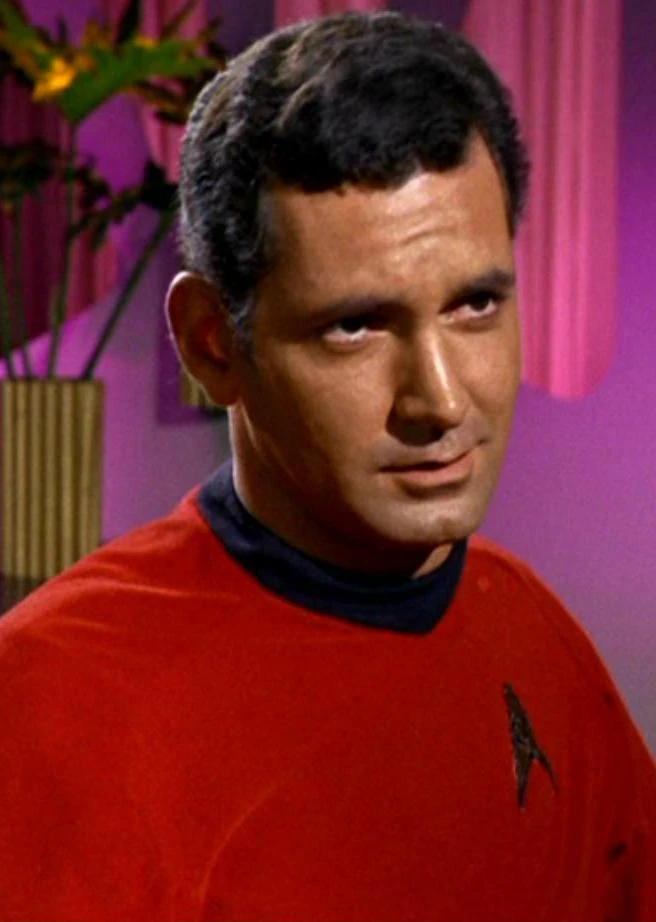
Captain James T. Kirk confronts a delusional Lieutenant Commander Benjamin Finney in main engineering, who confesses to tampering with the computer logs and sabotaging the USS Enterprise (NCC-1701)'s primary energy circuits, intending to destroy the ship and ruin Captain James T. Kirk's career as revenge for the past reprimand. As the USS Enterprise (NCC-1701)'s orbit begins to decay, Captain James T. Kirk engages Lieutenant Commander Benjamin Finney in a desperate struggle. Samuel T. Cogley's foresight in bringing Jame Finney back aboard proves crucial, as Captain James T. Kirk uses her presence to distract Lieutenant Commander Benjamin Finney, gaining the upper hand. A beaten and sobbing Lieutenant Commander Benjamin Finney reveals the location of the sabotage, allowing Captain James T. Kirk to effect repairs in a Jefferies tube, restoring power and stabilizing the ship's orbit. Commodore Stone dismisses the court-martial without findings, and Areel Shaw, having successfully 'lost' the case, shares a final, affectionate moment with Captain James T. Kirk before the USS Enterprise (NCC-1701) departs Starbase 11, with Samuel T. Cogley now representing Lieutenant Commander Benjamin Finney in his own trial.
LCARS Tactical Mission Log: Chronological action logs detailing exactly what each character did during the events of this mission, linked directly to personnel dossiers.




Subspace Visual Feed
Sensors & Diagnostic Metrics
Visual Sensor Logs



Synaptic Lore Link Contexts
The USS Enterprise (NCC-1701) undergoes repairs at Starbase 11 following an ion storm, and all court-martial proceedings against Captain James T. Kirk occur at this facility and its orbit.Kirk, arrives at Starbase 11 for critical repairs after enduring a severe ion storm.
The USS Enterprise (NCC-1701)'s impulse engines are deactivated during an experiment, causing the ship to orbit Starbase 11 by momentum, which later leads to orbital decay due to sabotage.
Kirk, confident in his innocence, initially dismisses the severity of the situation, even when meeting old Starfleet Academy classmates at the M-11 Starbase Club who appear to have already judged him guilty.
Kirk's sworn deposition, which states that the ion pod was ejected after the ship went to red alert.
Kirk, confident in his innocence, initially dismisses the severity of the situation, even when meeting old Starfleet Academy classmates at the M-11 Starbase Club who appear to have already judged him guilty.
Kirk to Areel Shaw, a former romantic interest and a lieutenant in Starfleet's Legal Division, who reveals she is the prosecuting officer.
The USS Enterprise (NCC-1701) arrives at Starbase 11 for repairs after a severe ion storm, during which Captain James T.
Kirk, accusing him of her father's murder, fueled by a long-standing animosity stemming from an incident years prior on the USS Republic where Captain James T.
Mission Registries & Linkages
Subspace Playlists
This registry lists all curated subspace playlists and chronological collections containing this mission.
Technology
This registry contains all specialized technologies deployed, analyzed, or referenced during this mission.
Location
This registry displays all celestial bodies, planets, starbases, or coordinates charted or visited during this mission.
Starship
This registry lists all vessels encountered, scanned, or active during this mission.
Species & Factions
This registry documents all species, civilizations, and organizational factions contacted or active in this sector during the mission.
Culture & Lore
This registry outlines historical events, cultural traditions, organizations, and database lore referenced during this mission.
Production & Archival Linkages
This registry documents behind-the-scenes production references, draft concepts, star charts, or archival cataloging links officially connected to this mission.
"Elements like the two-person transporter alcove and a barkeeper's costume from Starbase 11 are later repurposed for Deep Space Station K-7, creating visual consistency across Starfleet facilities."
"Samuel T. Cogley references the Constitution of the United States, a foundational document from Earth, as a precedent for human rights, emphasizing its lasting legal importance."
"The officers' lounge on Starbase 11 is known as the M-11 Starbase Club, and "M-11" was also designated in the script as the name of the starbase's planet, offering geographical context."
"Nensi Chandra was a member of the Starfleet Academy board in an alternate timeline, where she was responsible for evaluating Kirk's actions."
"The registry number NCC-1685 is among several starship numbers displayed on a chart in Commodore Stone's office, later linked to Constitution-class starships in production documents."
"The registry number NCC-1697 is shown on a chart in Commodore Stone's office, helping to establish Starfleet's early vessel numbering system."
"The registry number NCC-1700 appears on a chart in Commodore Stone's office, indicating a potential earlier numbering system or a wider array of Constitution-class ships."
"The registry number NCC-1718 is visible on a chart in Commodore Stone's office, adding more detail to the Starfleet vessel registry system."
"The registry number NCC-1831 is also found on a chart in Commodore Stone's office, contributing to the visual depiction of Starfleet's active fleet."
"The term "Starfleet" makes its first appearance in the series within this specific episode."
"This episode introduces the terms "Starfleet Command" and "Starfleet" for the very first time."
Continuity & Trivia
-
Actress Elisha Cook Jr., who played Samuel T. Cogley, the eccentric defense attorney, was a veteran character actor known for his roles in classic films like 'The Maltese Falcon' and 'The Big Sleep'.
-
The episode features the first on-screen appearance of a Federation Starbase other than Earth Spacedock (though that was seen much later). Starbase 11 serves as the primary setting for Kirk's court-martial.
-
The visual effect of Lieutenant Commander Finney hiding within the Enterprise's 'computer banks' was achieved using a set built to resemble oversized circuitry, with actor Richard Webb physically present among the props.
-
Percy Rodriguez's portrayal of Commodore Stone as a Black flag officer in charge of white subordinates was considered groundbreaking for 1967, and the episode notably aired without censorship or banning from Southern broadcasting stations.Sources: Memory Alpha
-
This episode marks the first time the terms "Starfleet" and "Starfleet Command" were explicitly used in the series.Sources: Memory Alpha
-
Despite his veteran status, actor Elisha Cook Jr. had significant difficulty remembering his lines as Samuel T. Cogley, requiring his character's speeches to be meticulously pieced together through editing.Sources: Memory Alpha
-
An incongruity where members of Kirk's court-martial are seen in the bar before the court-martial is officially considered resulted from re-ordering scenes during editing to quicken the pace of Act One.Sources: Memory Alpha
-
A scene where Jame Finney entered engineering to prompt her father to reveal his sabotage was filmed but ultimately cut, necessitating Kirk's voice-over explanation in the final episode to cover the character's motivation.Sources: Memory Alpha