Mission Briefing
The USS Enterprise (NCC-1701) encounters an extraordinary enigma in uncharted space: a Class M planet, lifeless for half a million years, yet emanating a powerful, deliberate energy signature. This energy reveals itself to be Sargon, an ancient, highly advanced consciousness. Sargon claims to be a survivor of a civilization that once spread across the Milky Way Galaxy, possibly progenitors to both Humanity and Vulcans. Trapped for millennia as pure energy alongside two others, Thalassa and Henoch, Sargon requests temporary refuge within Human bodies to construct new, mechanical vessels for their consciousness, promising vast knowledge in return.
Despite Doctor Leonard H. McCoy’s grave ethical and medical concerns regarding alien possession, Captain James T. Kirk, First Officer Spock, and Doctor Ann Mulhall volunteer to host the ancient entities, driven by Starfleet’s core mission of exploration and contact. The transference proceeds, with Sargon inhabiting Captain James T. Kirk, Thalassa inhabiting Doctor Ann Mulhall, and Henoch inhabiting First Officer Spock. However, the experience of physical form begins to exert unforeseen influences on these ancient minds, leading to escalating conflicts and moral quandaries as one of the beings displays a sinister desire to permanently retain their host body, challenging the very foundation of their agreement and the crew's bold decision.
LCARS Tactical Mission Registry: A detailed reconstruction of chronological events and narrative progression compiled from historical logs and mission briefs.
The USS Enterprise (NCC-1701), under the command of Captain James T. Kirk, encounters a profound mystery in uncharted space: a Class M planet, dead for half a million years, yet emanating a powerful energy signature. This energy, which affects the starship's systems and directs its course, is revealed to be the consciousness of Sargon, an ancient, highly advanced energy being. Sargon communicates directly with Captain James T. Kirk, claiming to be a survivor of a civilization that once colonized the galaxy, potentially making them the ancestors of humanity and Vulcans. He explains that he and two other beings, Thalassa and Henoch, have been trapped as pure energy for millennia following a cataclysmic war on their homeworld. Sargon requests temporary refuge in human bodies to construct new, mechanical vessels for their consciousness, promising vast knowledge in return. Despite Doctor Leonard H. McCoy's strong reservations about the ethical and medical dangers of alien possession, Captain James T. Kirk, First Officer Spock, and Doctor Ann Mulhall volunteer to host the ancient entities, driven by Starfleet's primary mission of exploration and contact with alien intelligences.
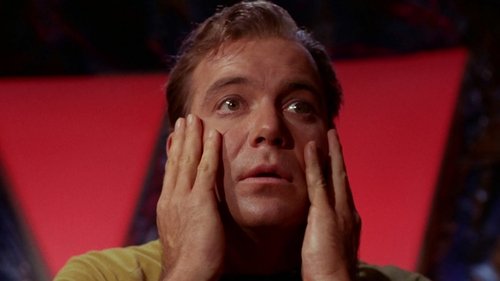
The landing party beams deep beneath the planet's surface into an ancient, technologically advanced chamber. Sargon demonstrates his power by temporarily inhabiting Captain James T. Kirk's body, causing a dangerous surge in his metabolic rate, which Doctor Leonard H. McCoy quickly notes. Sargon explains that their original bodies were much like human ones, but their minds were infinitely greater, and they require human hands to build their new android forms. After returning Captain James T. Kirk to his body, Sargon allows the crew to return to the USS Enterprise (NCC-1701) to discuss the proposal. In a tense briefing, Doctor Leonard H. McCoy vehemently opposes the plan, citing the immense risks and the potential for the ancient beings to destroy their hosts. However, Captain James T. Kirk, supported by First Officer Spock and Doctor Ann Mulhall, argues that the potential for knowledge and advancement outweighs the dangers, emphasizing Starfleet's core principle of 'risk is our business.' With unanimous, albeit reluctant, consent, the transference proceeds, with Sargon inhabiting Captain James T. Kirk, Thalassa inhabiting Doctor Ann Mulhall, and Henoch inhabiting First Officer Spock.
Upon transference, the human bodies experience extreme physiological stress, requiring a metabolic reduction injection to stabilize their vital functions. While Sargon (in Captain James T. Kirk's body) and Thalassa (in Doctor Ann Mulhall's body) express joy at experiencing physical sensations again and share a tender reunion, Henoch (in First Officer Spock's body) immediately displays a more sinister and manipulative nature. Henoch, desiring to permanently retain First Officer Spock's superior Vulcan body, secretly sabotages the metabolic reduction injection intended for Sargon. He coerces Nurse Christine Chapel, under his mental influence, to prepare a lethal dose for Sargon (in Captain James T. Kirk's body) while ensuring his own injection is harmless. Nurse Christine Chapel, disoriented and unable to articulate her suspicions, administers the injections as instructed. Meanwhile, Thalassa, too, begins to succumb to the temptations of physical sensation, expressing reluctance to leave Doctor Ann Mulhall's body and questioning Sargon's plan for mechanical androids, further highlighting the corrupting influence of physical form on their ancient minds.
As the construction of the android bodies progresses, Sargon's condition in Captain James T. Kirk's body rapidly deteriorates due to Henoch's sabotaged injection. Doctor Leonard H. McCoy, unaware of the deception, struggles to understand why Sargon is weakening despite the administered medication. Thalassa, witnessing Sargon's decline, becomes increasingly assertive in her desire to keep Doctor Ann Mulhall's body, even attempting to bribe Doctor Leonard H. McCoy with the promise of saving Captain James T. Kirk's life if he allows her to remain. She reveals the vast, destructive powers her species possesses, threatening Doctor Leonard H. McCoy when he refuses to 'peddle flesh.' Sargon, however, had anticipated Henoch's treachery. He reveals that he had transferred Captain James T. Kirk's consciousness into a spare receptacle and his own consciousness into the receptacle containing Captain James T. Kirk's mind, while Captain James T. Kirk's consciousness was temporarily housed within Nurse Christine Chapel. This allowed Sargon to survive the death of Captain James T. Kirk's body and to observe Henoch's actions.
With Captain James T. Kirk's body now deceased, Sargon, having returned to the receptacle, orchestrates a final confrontation with Henoch on the USS Enterprise (NCC-1701) bridge. He instructs Doctor Leonard H. McCoy to prepare a supposedly lethal injection for First Officer Spock's body, knowing Henoch would read Doctor Leonard H. McCoy's thoughts and believe it to be genuine. Henoch, fearing destruction, abandons First Officer Spock's body, and his energy essence dissipates, ending his malevolent threat. First Officer Spock's consciousness is then safely returned to his own body. Sargon and Thalassa, having witnessed the corrupting influence of physical bodies and the dangers of their own ancient power, decide that their existence in the physical world is too perilous. They request one final, brief moment of shared consciousness in Captain James T. Kirk and Doctor Ann Mulhall's bodies to say farewell before departing into oblivion together. The episode concludes with the USS Enterprise (NCC-1701) crew reflecting on the profound encounter, the immense knowledge gained, and the inherent risks and responsibilities of deep space exploration, emphasizing the delicate balance between scientific advancement and ethical considerations when encountering vastly superior intelligences.
LCARS Tactical Mission Log: Chronological action logs detailing exactly what each character did during the events of this mission, linked directly to personnel dossiers.


Subspace Visual Feed
Sensors & Diagnostic Metrics
Visual Sensor Logs


Synaptic Lore Link Contexts
The crew arrive at a destroyed class M planet – much older than Earth, Spock determines, and long dead, its atmosphere ripped away by some cataclysmic event about half a million years ago.
Kirk, claiming to be a survivor of a galactic civilization and proposing a startling request: temporary refuge in human bodies for himself and two other beings, Thalassa and Henoch, to construct new vessels.
In his captain's log (Stardate 4768.3 – see below), Captain Kirk states his intention to risk contact; Lieutenant Uhura tells him that the entry will not reach Starfleet for three weeks due to the Enterprises distance from known space.Kirk, First Officer Spock, and Doctor Ann Mulhall volunteer, driven by Starfleet's mission of exploration.
The USS Enterprise (NCC-1701), under the command of Captain James T.
They colonized throughout the galaxy.
Mulhall objects to this idea, but Spock picks up on it, saying it might explain away some elements of Vulcan pre-history.Kirk, claiming to be a survivor of a civilization that once colonized the galaxy, potentially making them the ancestors of humanity and Vulcans.
In the pharmacology laboratory, Henoch/Spock and Chapel make up a metabolic reduction formula which, administered from a hypospray at 10 cc/hr, should allow the three cataclysm survivors to function in their host bodies.
McCoy finds it a suspicious coincidence that the bodies of both the captain and first officer are required for the task ahead and worries that to such "giants" the Human crew must be "insects." Kirk compares the undertaking at hand with the first Earth missions to the Moon, to Mars, to Alpha Centauri, and reminds McCoy that six generations ago surgery was done with scalpels and catgut.
Kirk's consciousness into a spare receptacle and his own consciousness into the receptacle containing Captain James T.
Mission Registries & Linkages
Subspace Playlists
This registry lists all curated subspace playlists and chronological collections containing this mission.
[ NO ASSOCIATED PLAYLISTS RECORDED ]
Technology
This registry contains all specialized technologies deployed, analyzed, or referenced during this mission.
Location
This registry displays all celestial bodies, planets, starbases, or coordinates charted or visited during this mission.
Starship
This registry lists all vessels encountered, scanned, or active during this mission.
Species & Factions
This registry documents all species, civilizations, and organizational factions contacted or active in this sector during the mission.
Culture & Lore
This registry outlines historical events, cultural traditions, organizations, and database lore referenced during this mission.
Production & Archival Linkages
This registry documents behind-the-scenes production references, draft concepts, star charts, or archival cataloging links officially connected to this mission.
"The name of the planet itself, Arret ("Terra", Earth in Latin, inverted), is never mentioned onscreen, much as Neural, the site of , is also unspoken."
"This is the second time a reference is made in Star Trek about the Apollo moon program, after . Filmed more than a year-and-a-half before the first lunar landing, Kirk rhetorically asks McCoy in this episode, "Do you wish that the first Apollo mission hadn't reached the Moon?" The first manned Apollo mission, Apollo 1 (intended to be a test-flight of the Command and Service Module in Earth orbit only), never flew, since a tragic fire claimed the lives of three astronauts. This happened on 27 January 1967, months before the script was submitted to the production team and a full year before this episode aired. The first Apollo mission in which astronauts orbited – and technically "reached" – the moon was Apollo 8 in December 1968, ten months after this episode aired. However, the Apollo 11 astronauts were the first to "reach" the moon by landing on it in 20 July 1969, after Star Trek was canceled. Kirk's next comments about going "on to Mars and then to the nearest star" seem to suggest that he is referring to the Apollo 11 lunar mission."
"The name of the planet itself, Arret ("Terra", Earth in Latin, inverted), is never mentioned onscreen, much as Neural, the site of , is also unspoken."
"It is unclear how Arretan might have inspired the Adam and Eve story on Earth, especially since they ended their galactic colonization before their civil war. Their colonizing period, which occurred 600,000 years ago, is the earliest estimate for the appearance of Homo heidelbergensis, an early ancestor Humans share with the Neanderthals."
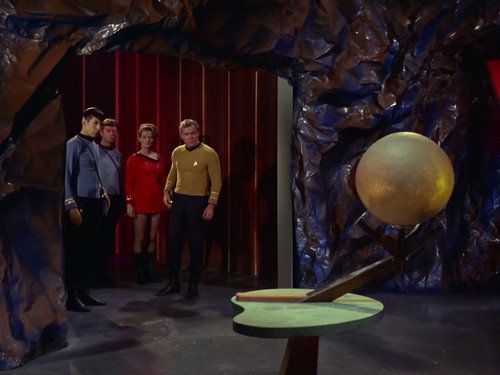
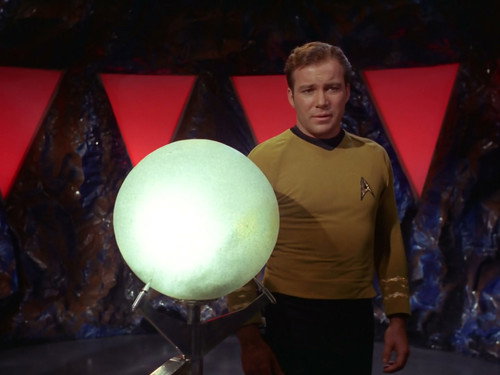
"One of the fiberglass globes was re-used later as part of the Romulan cloaking device in , and for M-4 in ."
Continuity & Trivia
-
This episode marks the first appearance of the name 'Sargon' in Star Trek, a name that would later be used for a different alien entity (Sargon of Exo III) in the animated series episode "The Slaver Weapon."
-
Actress Diana Muldaur, who plays Dr. Ann Mulhall in this episode, would later return to the Star Trek universe as Dr. Katherine Pulaski in the second season of Star Trek: The Next Generation.
-
Gene Roddenberry's uncredited rewrite changed the episode's ending to the aliens fading into oblivion, a philosophical alteration that prompted original writer John T. Dugan to use the pen name "John Kingsbridge" in the credits.Sources: Memory Alpha
-
NBC program manager Stan Robertson found Sargon's speculation about Adam and Eve being ancient space travelers sacrilegious, leading to the insertion of Dr. Mulhall's line about Earth life evolving independently.Sources: Memory Alpha
-
William Blackburn, who played the android, had to consume nourishment through a straw due to his restrictive latex makeup during twelve-hour shooting days, and achieved the android's blank eyes by simply rolling his eyeballs upwards.Sources: Memory Alpha
-
Captain Kirk's rhetorical question about the first Apollo mission reaching the Moon was anachronistic, as the episode aired ten months before Apollo 8 orbited the Moon and over a year before Apollo 11 landed on it.Sources: Memory Alpha
-
The distinctive fiberglass globes representing the Arretan entities were later repurposed as part of the Romulan cloaking device in "The Enterprise Incident" and as the M-4 computer in "Requiem for Methuselah."Sources: Memory Alpha